
Grade 10 Agriculture · Strand 1.0 Crop Production · Sub-strand 1.2 Properties of Soil
These are free study notes for Grade 10 learners, written to the KICD curriculum design and taken from our full Grade 10 Agriculture notes. Soil experiments (comparing drainage or water-holding in sand, loam and clay) are common practical questions. Know the set-up, the result and the reason.
Two farmers plant the same maize variety on the same day; one harvests twice as much as the other. Often the difference is the soil. In this topic we learn the physical, chemical and biological properties of soil, how to test them with simple experiments, and how the soil profile affects crop production.
What soil is made of
Soil
The natural surface layer of the earth in which plants grow, made of mineral matter, organic matter, water, air and living organisms.
| Component | Share in a good soil | Role |
|---|---|---|
| Mineral matter | about 45% | Broken rock particles (sand, silt, clay) that hold nutrients and anchor roots |
| Organic matter | about 5% | Rotting plant and animal remains that become humus |
| Water | about 25% | Dissolves nutrients and is taken up by roots |
| Air | about 25% | Gives oxygen for root and organism respiration |
| Living organisms | small but vital | Bacteria, fungi and earthworms break down matter and mix the soil |
The shares of water and air change with the weather: after heavy rain water fills most spaces; in a dry spell air fills them.
Soil properties are grouped into three: physical (texture, structure, porosity, drainage, capillarity, water holding capacity), chemical (pH and nutrients) and biological (humus and living organisms).
Physical properties of soil
Soil texture
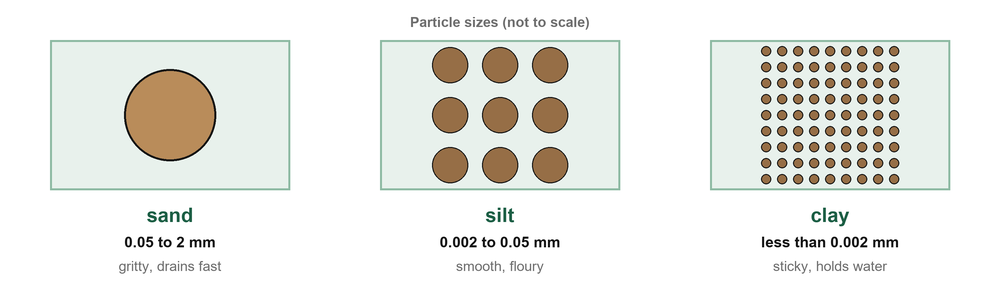
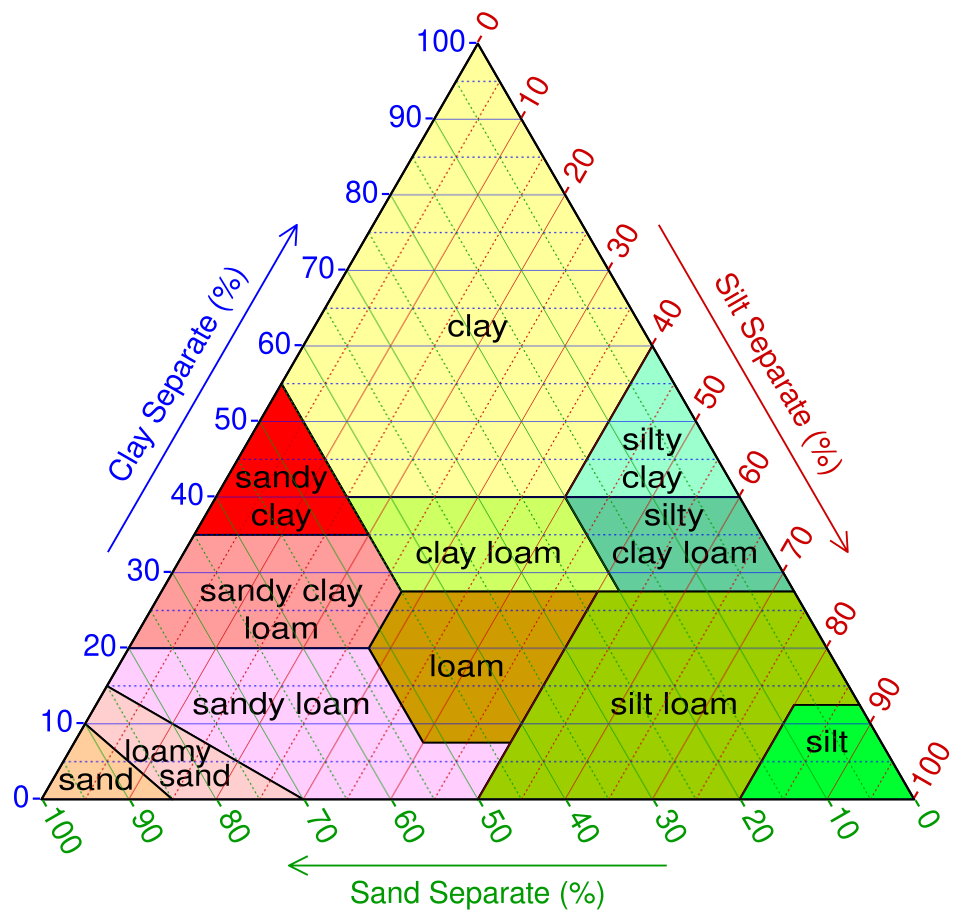
How coarse or fine a soil feels, decided by the proportions of sand, silt and clay particles.
| Feature | Sandy soil | Clay soil | Loam |
|---|---|---|---|
| Feel | Gritty | Sticky when wet, hard when dry | Smooth, crumbly |
| Drainage | Very fast | Very slow, waterlogs | Good |
| Water holding | Low | High | Moderate |
| Nutrients | Few, easily leached | Many | Good supply |
| Ease of digging | Easy | Heavy | Easy |
| Suited crops | Groundnuts, cassava, carrots | Rice, bananas (with water) | Most crops |
Soil structure
The way soil particles are grouped together into crumbs or lumps (aggregates).
A good crumb structure has spaces between crumbs for air and water and is held together by humus and roots. It is destroyed by heavy machines, cultivating wet soil, overgrazing and burning.
Porosity
The total amount of pore space between soil particles; it decides how much air and water the soil can hold.
Drainage
How quickly water moves down through the soil: fast in sand, slow in clay.
Capillarity
The upward rise of water through fine soil pores from the water table: strong in clay and loam, weak in sand.
Water holding capacity
The amount of water a soil keeps after free water has drained away: high in clay and in soils rich in humus.
Remember
Texture is hard to change, but adding organic matter improves both sandy soils (holds more water) and clay soils (better drainage and crumb structure).
Investigating physical properties
Sedimentation test for texture
- Half fill a clear jar with soil and add water to three-quarters full.
- Close the lid, shake well and let it stand for 24 hours.
- Sand settles first at the bottom, then silt; clay stays on top.
- Measure each layer and work out its percentage of the total.
Working out texture from the jar
Sand 30 mm, silt 15 mm, clay 15 mm: total 60 mm.
Sand = 30 ÷ 60 × 100 = 50%; silt = 15 ÷ 60 × 100 = 25%; clay = 25%.
A balanced mixture like this is a loam.
Feel test: rub moist soil between thumb and fingers. Sand is gritty and will not hold a ball; loam forms a ball that breaks when pressed; clay can be rolled into a long thin ribbon.
Drainage and water holding capacity
- Put filter paper or cloth in three funnels over three measuring cylinders.
- Add 100 g of dry sand, loam and clay, one to each funnel.
- Pour 100 cm³ of water on each at the same time and start the timer.
- Read the water collected after 1, 2 and 5 minutes.
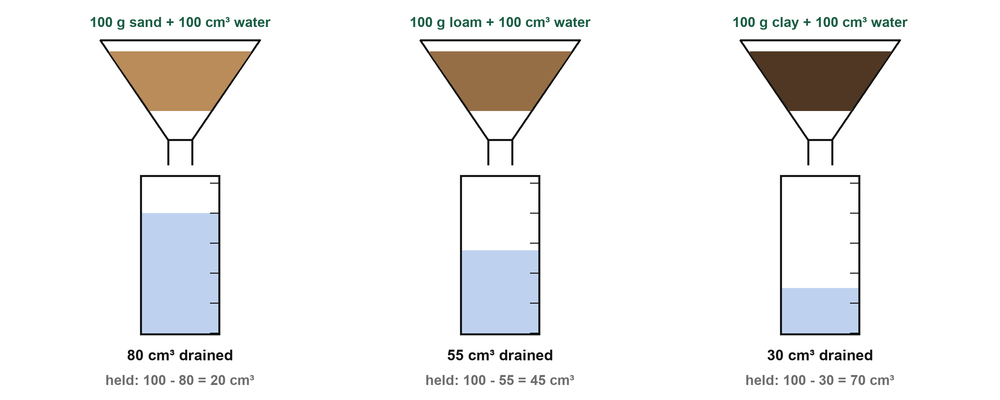
- Water held = 100 cm³ minus water collected.
Reading the results
Clay: 30 cm³ drained, so 100 - 30 = 70 cm³ held.
Sand: 80 cm³ drained, so 100 - 80 = 20 cm³ held.
Sand drains fastest and holds least; clay drains slowest and holds most; loam is in between.
Fair test
Use the same mass of soil, the same volume of water and the same time for each sample, so that only the soil type changes.
Chemical properties of soil
Soil pH
A measure of how acidic or alkaline a soil is on a scale of 0 to 14: below 7 is acidic, 7 is neutral, above 7 is alkaline.
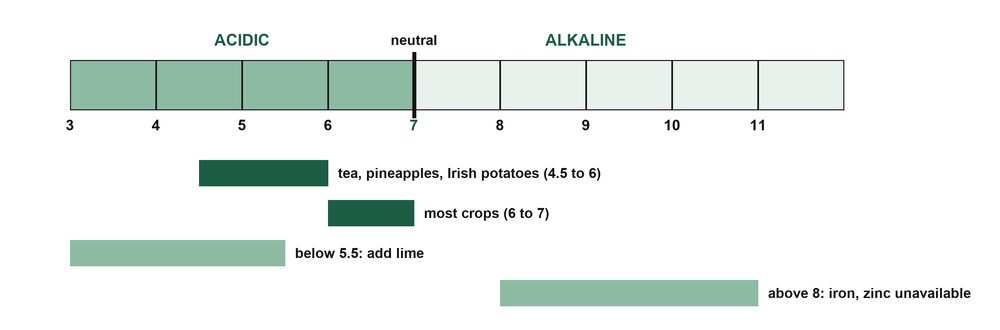
- Most crops grow best between pH 6 and 7.
- Tea, pineapples and Irish potatoes like acid soils (pH 4.5 to 6).
- In very acid soils aluminium and manganese become toxic and phosphorus is locked up.
- In very alkaline soils iron and zinc become unavailable.
- Acid soils are corrected by liming; alkaline soils by adding organic matter or sulphur.
Soil nutrients
| Group | Nutrients |
|---|---|
| Major (macro) nutrients | Nitrogen, phosphorus, potassium |
| Secondary nutrients | Calcium, magnesium, sulphur |
| Trace (micro) nutrients | Iron, zinc, boron, copper, manganese, molybdenum |
Cation exchange capacity
The ability of a soil, especially its clay and humus, to hold positively charged nutrients such as potassium and calcium so they are not leached.
Testing soil pH
- Take a sample from 10 to 15 cm deep and remove stones and roots.
- Mix one part soil with two to five parts distilled or rain water and stir.
- Let it settle, then dip in indicator paper or add indicator solution.
- Compare the colour with the chart and record the pH.
Safety
Wear gloves when using indicator solutions, keep them away from the eyes and mouth, and wash your hands afterwards.
Biological properties of soil
Humus
The dark, well-rotted organic matter in soil, formed when dead plants and animals are broken down by organisms.
Why humus matters
- Improves soil structure by binding particles into crumbs.
- Holds water and nutrients like a sponge.
- Feeds soil organisms and releases nutrients slowly.
- Darkens the soil so it warms faster.
| Organism | Role in the soil |
|---|---|
| Earthworms | Mix the soil and make channels for air and water |
| Bacteria and fungi | Decompose organic matter and release nutrients |
| Nitrogen-fixing bacteria | Live in legume root nodules and add nitrogen |
| Termites and ants | Mix and aerate soil, though some are pests |
| Nematodes | Some are harmful pests of roots, others help decomposition |
Simple investigations: compare the colour of topsoil, subsoil and soil under a tree (darker usually means more humus); shake soil in water and see organic bits float; count earthworms in a marked square of moist soil.
Humus is increased by adding manure, compost, crop residues and mulch, and by stopping burning.
The soil profile and crop production
Soil profile
A vertical section through the soil from the surface down to the parent rock, showing its layers (horizons).
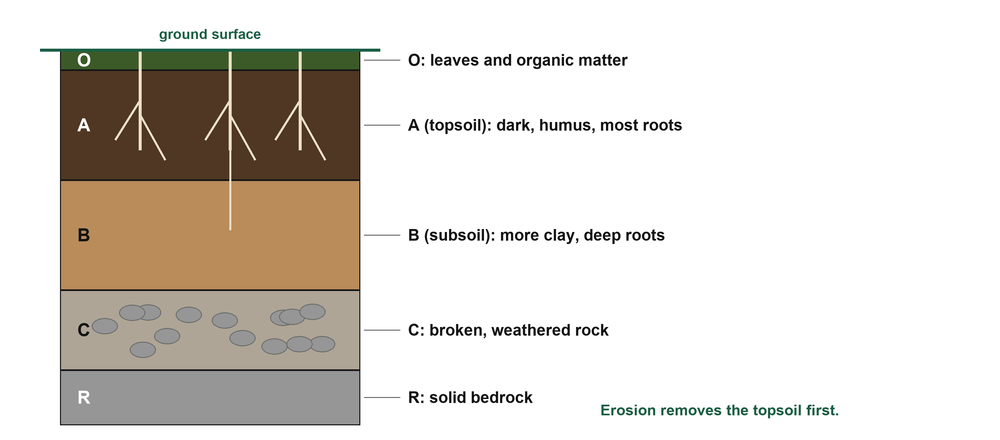
| Horizon | Description | Importance to crops |
|---|---|---|
| O | Thin layer of fallen leaves and organic matter | Source of humus |
| A (topsoil) | Dark, rich in humus, full of roots and organisms | Holds most nutrients and roots; lost first to erosion |
| B (subsoil) | Lighter, more clay and minerals washed down | Reached by deep roots; a clay layer may cause waterlogging |
| C | Broken, weathered parent rock | Source of new mineral matter |
| R | Solid bedrock | Limits root depth and drainage if near the surface |
- A deep topsoil gives more room for roots and holds more water and nutrients.
- Shallow soil over rock or a hardpan limits roots: choose shallow-rooted crops.
- Deep-rooted crops such as coffee and maize need deep soils.
- The profile guides the depth of ploughing and the need for drainage or conservation.
Remember
Erosion removes the topsoil first, and with it most of the humus and nutrients. That is why soil conservation protects productivity.
Key points to remember
- Soil is made of mineral matter, organic matter, water, air and living organisms.
- Physical properties include texture, structure, porosity, drainage, capillarity and water holding capacity.
- Sand drains fast and holds little water; clay holds much water but drains poorly; loam is best for most crops.
- Soil pH controls nutrient availability; most crops prefer pH 6 to 7 and acid soils are limed.
- Humus and soil organisms improve structure, water holding and fertility.
- The soil profile (O, A, B, C, R) shows the depth and quality of soil available to roots.
Practice questions
Name the five components of soil. (5 marks)
Show the answer
Mineral matter; organic matter; water; air; living organisms.
Distinguish between soil texture and soil structure. (2 marks)
Show the answer
Texture is how coarse or fine a soil is, decided by the proportions of sand, silt and clay; structure is the way the particles are grouped into crumbs or lumps.
In a sedimentation test the layers measured 24 mm sand, 12 mm silt and 4 mm clay. Work out the percentage of sand in the sample. (2 marks)
Show the answer
Total = 24 + 12 + 4 = 40 mm; sand = 24 ÷ 40 × 100 = 60%.
In a drainage experiment, 100 cm³ of water was poured on each soil. 85 cm³ drained through soil A and 35 cm³ through soil B. (a) Calculate the water held by each soil. (b) Identify which is likely to be sandy. (c) State one way to improve soil A for growing vegetables. (5 marks)
Show the answer
- (a) Soil A: 100 - 85 = 15 cm³; soil B: 100 - 35 = 65 cm³.
- (b) Soil A, because it drains fast and holds little water.
- (c) Add manure or compost (or mulch and water often) to increase water holding capacity.
Explain why most crops do poorly in very acid soils and state how such a soil can be corrected. (3 marks)
Show the answer
- Aluminium and manganese reach toxic levels and phosphorus is locked up, so it is not available to plants.
- Correct by liming (adding agricultural lime).
State four ways in which humus improves soil. (4 marks)
Show the answer
Improves structure; holds water; holds and slowly releases nutrients; feeds soil organisms; darkens the soil so it warms faster.
Explain why erosion of the A horizon lowers crop yields more than loss of any other layer. (2 marks)
Show the answer
The A horizon (topsoil) holds most of the humus, nutrients, organisms and roots, so losing it removes the most fertile part of the soil.
This is one topic. Get the whole year. The full Grade 10 Agriculture notes cover every sub-strand of Terms 1, 2 and 3 like this one, with pictures, key points and practice questions with answers, as a printable PDF for KSh 150. Pay with M-Pesa and download at once.
Get the full Grade 10 Agriculture notes · All Grade 10 Agriculture resources · Notes for every grade


