Grade 10 Biology · Strand 2.0 Anatomy and Physiology of Plants · Sub-strand 2.1 Nutrition
These are free study notes for Grade 10 learners. They follow the official KICD curriculum design for Grade 10 Biology (the same topics, in the same order, that your teacher uses) and are taken from our full Grade 10 Biology notes. This builds directly on Grade 9 photosynthesis but goes deeper into the chloroplast and the two stages. Revise the Grade 9 basics first if they feel shaky.
Every bite of ugali, every glass of milk and every breath of oxygen can be traced back to green plants. Plants make food from carbon dioxide and water using light energy. In this topic we learn the types of nutrition in plants, the structure of the chloroplast where food is made, and the light and dark stages of photosynthesis, and we see why photosynthesis matters to all life.
Types of nutrition in plants
Nutrition
The way an organism obtains and uses food for energy, growth and repair.
Autotrophic nutrition
Making one's own complex food from simple inorganic substances (carbon dioxide and water) using an outside source of energy.
Heterotrophic nutrition
Obtaining ready-made food from other organisms, living or dead.
| Kind of autotroph | Energy source | Examples |
|---|---|---|
| Photoautotroph (photosynthesis) | Light, trapped by chlorophyll | Green plants, algae, some bacteria |
| Chemoautotroph (chemosynthesis) | Energy from chemical reactions | Nitrifying bacteria in the soil |
Heterotrophic modes in plants
| Mode | How the plant feeds | Examples |
|---|---|---|
| Parasitic | Takes food (and water) from a living host and harms it, using suckers (haustoria) that grow into the host | Striga (witchweed) on maize and sorghum roots; dodder on hedges |
| Saprophytic | Feeds on dead, decaying matter: releases enzymes onto it, digests it outside the body and absorbs the products | Indian pipe (a flowering plant with no chlorophyll); fungi such as mushrooms and bread mould |
| Symbiotic | Two organisms live together and both benefit | Legumes (beans, peas) with Rhizobium bacteria in root nodules; fungi (mycorrhiza) on tree roots |
| Insectivorous | Green plants that also trap and digest insects to get nitrogen, because they grow in soils poor in nitrates | Sundew, pitcher plant, Venus flytrap |
Farming link
Striga can destroy a whole maize crop in western Kenya. Farmers control it by crop rotation, uprooting it before it seeds, using resistant varieties, and adding manure.
The chloroplast
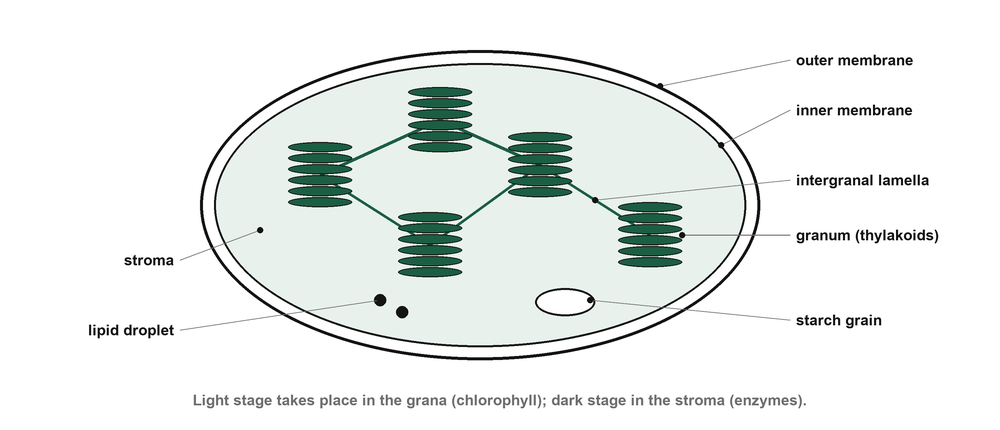
Chloroplasts are oval organelles, about 2 to 10 micrometres long, found mainly in palisade and spongy mesophyll cells and in guard cells. Each is bounded by a double membrane (envelope).
| Part | Structure | How it suits its function |
|---|---|---|
| Double membrane (envelope) | Two membranes | Controls what enters and leaves the chloroplast |
| Grana (singular granum) | Stacks of flat discs called thylakoids carrying chlorophyll | Huge surface area for chlorophyll to trap light: the light stage takes place here |
| Intergranal lamellae | Membranes joining the grana | Link the grana and spread them out to receive light |
| Stroma | Colourless fluid with enzymes | Contains the enzymes of the dark stage |
| Starch grains | Small grains in the stroma | Store food made in photosynthesis |
| Lipid droplets, DNA, ribosomes | In the stroma | Store lipid; let the chloroplast make some of its own proteins |
Photosynthesis
Photosynthesis
The process by which green plants make glucose from carbon dioxide and water, using light energy trapped by chlorophyll, and release oxygen.
The equation
In words: carbon dioxide + water → glucose + oxygen (light energy, chlorophyll).
In symbols: 6CO2 + 6H2O → C6H12O6 + 6O2.
| Need | Where it comes from |
|---|---|
| Carbon dioxide | The air, through the stomata |
| Water | The soil, through the root hairs and xylem |
| Light | The sun (or a lamp) |
| Chlorophyll | In the chloroplasts |
| Suitable temperature | Enzymes of the dark stage need warmth |
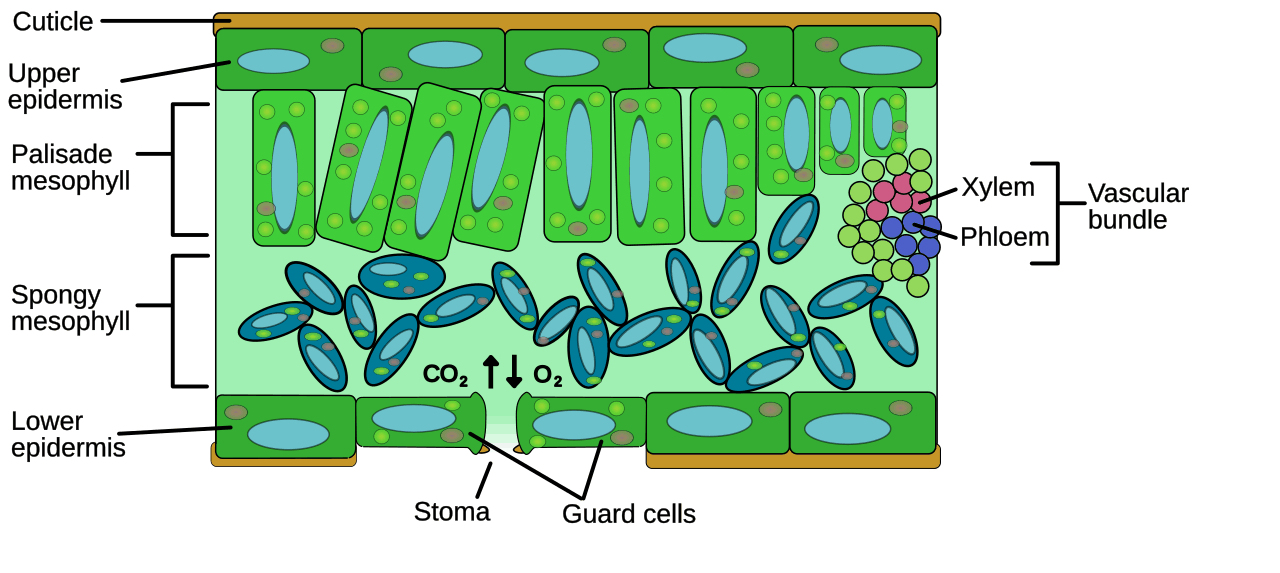
- Broad, flat blade: large surface area to absorb light and carbon dioxide.
- Thin: carbon dioxide diffuses only a short distance to the cells.
- Palisade cells near the top, packed with chloroplasts, receive the most light.
- Air spaces in the spongy layer let gases move; stomata let carbon dioxide in and oxygen out.
- Veins bring water (xylem) and carry away food (phloem).
The light and dark stages
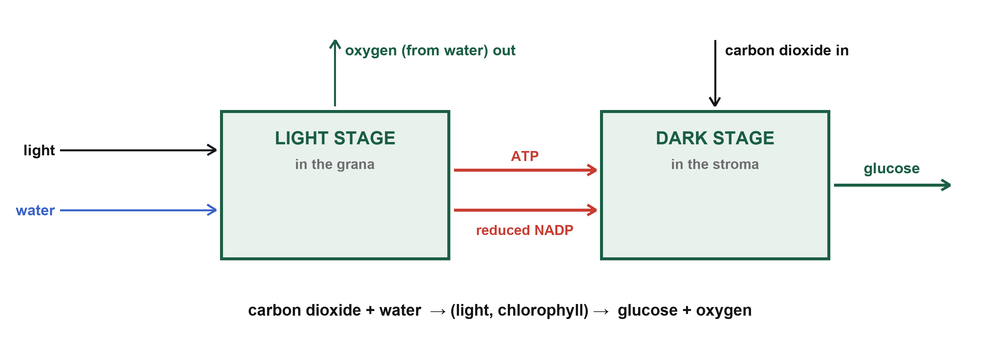
The light stage (in the grana)
- Chlorophyll absorbs light energy.
- The energy splits water into hydrogen and oxygen (photolysis); the oxygen is given off as a by-product.
- The energy is also used to make ATP (an energy carrier).
- The hydrogen is picked up by a carrier, NADP, forming reduced NADP.
The dark stage (in the stroma)
- Carbon dioxide combines with a 5-carbon compound (ribulose bisphosphate) in the presence of an enzyme: carbon dioxide fixation.
- The products are reduced, using the hydrogen from reduced NADP and the energy of ATP, into a 3-carbon sugar.
- The 3-carbon sugars form glucose; some are used to remake the 5-carbon compound so the cycle continues.
| Feature | Light stage | Dark stage |
|---|---|---|
| Site | Grana (thylakoids) | Stroma |
| Needs light directly | Yes | No (but needs ATP and reduced NADP from the light stage) |
| Inputs | Light, water | Carbon dioxide, ATP, reduced NADP |
| Outputs | Oxygen, ATP, reduced NADP | Glucose (carbohydrate) |
| Controlled by enzymes | Little | Yes, so it depends on temperature |
A favourite exam point
The oxygen given off in photosynthesis comes from water (in the light stage), not from carbon dioxide.
Evidence of photosynthesis and its significance
Testing a leaf for starch
- Destarch the plant by keeping it in the dark for 48 hours; then expose it to light for some hours.
- Dip the leaf in boiling water for a minute to kill it and stop enzyme action.
- Put it in a test tube of ethanol in a hot water bath (no naked flame: ethanol catches fire) to remove the chlorophyll.
- Dip it in warm water to soften it, and spread it on a white tile.
- Add iodine solution: blue-black shows starch, so photosynthesis took place.
A leaf partly covered with foil turns blue-black only where light reached it; a variegated leaf turns blue-black only where it was green. So light and chlorophyll are both needed.
What happens to the glucose
- Used in respiration to release energy.
- Stored as starch (in leaves, tubers such as potatoes, seeds).
- Changed to sucrose and carried in the phloem.
- Changed to cellulose for cell walls, or to oils and proteins (with nitrates).
Significance of photosynthesis in nature
- Food: it starts every food chain; all animals depend on it directly or indirectly.
- Oxygen: it releases the oxygen needed for respiration.
- Carbon dioxide balance: it removes carbon dioxide from the air, reducing global warming.
- Energy: it stores the sun's energy in food, firewood and (over millions of years) fossil fuels.
- Raw materials: timber, fibres, medicines and other plant products.
Key points to remember
- Plants are mostly autotrophs (photosynthesis); a few are parasitic, saprophytic, symbiotic or insectivorous.
- The chloroplast has a double membrane, grana of thylakoids carrying chlorophyll, and an enzyme-rich stroma.
- Photosynthesis: carbon dioxide + water → glucose + oxygen, using light energy and chlorophyll.
- Light stage (grana): water is split, oxygen released, ATP and reduced NADP made.
- Dark stage (stroma): carbon dioxide is fixed and reduced to sugar using ATP and reduced NADP.
- Photosynthesis supplies food, oxygen and stored energy, and removes carbon dioxide from the air.
Practice questions
Distinguish between autotrophic and heterotrophic nutrition. (2 marks)
Show the answer
Autotrophic: the organism makes its own food from simple inorganic substances using energy from light or chemical reactions. Heterotrophic: the organism takes in ready-made food from other organisms.
Name the mode of nutrition shown by: (a) striga (b) a bean plant with root nodules (c) the sundew (d) bread mould. (4 marks)
Show the answer
(a) Parasitic (b) symbiotic (c) insectivorous (d) saprophytic.
Explain how the structure of the chloroplast is suited to its function. (3 marks)
Show the answer
- Grana (stacked thylakoids) give a large surface area holding chlorophyll to absorb light.
- The stroma contains the enzymes for the dark stage.
- The double membrane controls the entry and exit of materials.
State the products of the light stage of photosynthesis and say what happens to each. (3 marks)
Show the answer
- Oxygen: given off through the stomata (or used in respiration).
- ATP: provides energy for the dark stage.
- Reduced NADP: provides hydrogen to reduce carbon dioxide in the dark stage.
Give three differences between the light stage and the dark stage. (3 marks)
Show the answer
Any three: grana vs stroma; needs light vs does not need light directly; water split vs carbon dioxide fixed; products oxygen, ATP and reduced NADP vs glucose; little vs much enzyme control.
In a starch test on a leaf, why is the leaf: (a) boiled in water (b) placed in hot ethanol (c) dipped in warm water afterwards? (3 marks)
Show the answer
(a) To kill it and stop enzyme action (and soften it) (b) to remove chlorophyll so the colour change can be seen (c) to soften the brittle leaf.
Why must ethanol be heated in a water bath and not over a flame? (1 mark)
Show the answer
Ethanol is highly flammable and would catch fire.
State three ways in which photosynthesis is important in nature. (3 marks)
Show the answer
Any three: makes food for all organisms; releases oxygen; removes carbon dioxide from the air; stores energy in food and fuels; provides raw materials such as timber and fibre.
This is one topic. Get the whole year. The full Grade 10 Biology notes cover every sub-strand of Terms 1, 2 and 3 like this one, with pictures, key points and practice questions with answers, as a printable PDF for KSh 150. Pay with M-Pesa and download at once.
Get the full Grade 10 Biology notes · All Grade 10 Biology resources · Notes for every grade