
Grade 10 Business Studies · Strand 1.0 Business and Money Management · Sub-strand 1.4 Banking
These are free study notes for Grade 10 learners, written to the KICD curriculum design and taken from our full Grade 10 Business Studies notes. Banking connects to everyday life in Kenya (M-Pesa, agency banking, loans). Use real examples from your own family when you answer questions.
Most Kenyans now use a bank in some way, whether through an account, an ATM card, a bank agent at the local shop or a mobile banking app. In this topic we learn what banks are and why they are important in an economy, the types of accounts banks offer, how to open a junior savings account, the ethical and unethical practices in banking, and the trends that are changing banking in Kenya.
Banks and financial institutions
Bank
A business that accepts deposits from the public, keeps them safe, lends money and provides payment services.
Banking
The business of accepting deposits, lending money and providing payment and other financial services.
Banks earn income from the difference between the interest charged on loans and the interest paid on deposits, and from fees and charges.
| Institution | Main role |
|---|---|
| Central Bank of Kenya (CBK) | The government's bank and the bankers' bank; issues currency; licenses and supervises banks |
| Commercial banks | Serve individuals and businesses with accounts, loans and payments (for example KCB, Equity, Co-operative Bank) |
| Microfinance banks | Small loans and savings for small businesses and low-income earners |
| Mortgage finance institutions | Long-term loans for buying or building houses |
| Development banks | Long-term finance for large projects |
| SACCOs | Savings and credit co-operative societies that save and lend among their members |
Remember
Deposits in Kenyan banks are protected up to a limit by the Kenya Deposit Insurance Corporation (KDIC).
Importance of banking in an economy
To individuals and businesses
- Safe keeping of money and valuables (safe custody).
- Encouraging saving by paying interest.
- Loans and overdrafts to start or expand businesses or buy homes.
- Easy, safe payment by cheque, card, transfer and mobile banking.
- Bank statements: an accurate record of receipts and payments for accounts and tax.
- Foreign exchange, trade finance and financial advice.
To the economy
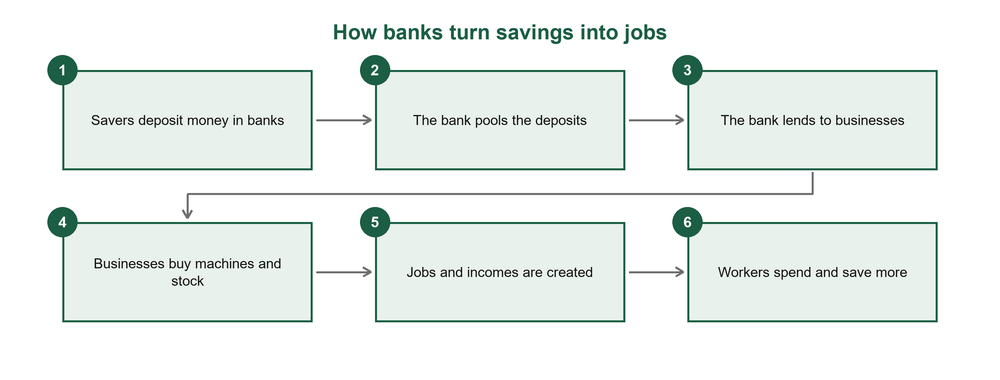
- Channel savings from many people to investors, which increases production and creates jobs.
- Create credit: loans made from deposits add to the money available for spending.
- Support trade within Kenya and with other countries through payments, foreign exchange and letters of credit.
- Act as agents of government: collect and pay government money, handle government securities and help the CBK carry out monetary policy.
- Employ many people and pay taxes.
Savings become investment
If 1,000 families each deposit KSh 20,000, the bank holds 1,000 × 20,000 = KSh 20,000,000.
Part of this is lent to a factory that buys machines and hires workers, who then spend their wages in local shops.
Types of accounts offered by banks
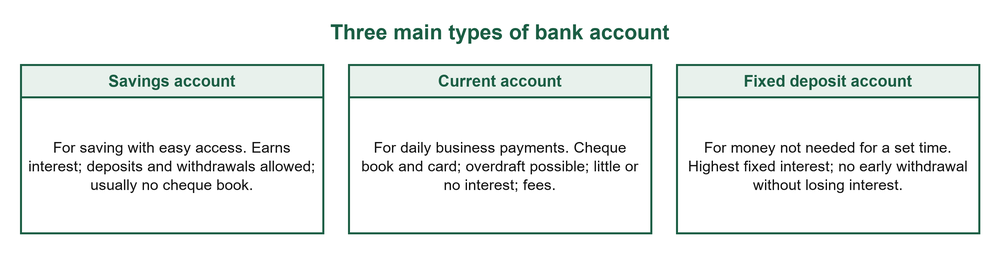
| Feature | Savings account | Current account | Fixed deposit account |
|---|---|---|---|
| Main use | Saving with easy access | Frequent daily payments, mainly by businesses | Money not needed for a set period |
| Interest | Earns interest (low rate) | Little or none | Highest, at a fixed rate |
| Withdrawals | Allowed; free withdrawals may be limited | Any time, by cheque, card or transfer | Only at the end of the period without losing interest |
| Cheque book | Not usually | Yes | No |
| Overdraft | No | Possible for customers with a good record | No |
| Charges | Low | Ledger or maintenance fees | Few |
Overdraft
Permission to draw more than is in a current account, up to an agreed limit, with interest charged on the amount overdrawn.
Cheque
A written order to a bank to pay a stated amount to a named person or to bearer. It shows the date, the payee, the amount in words and figures and the drawer's signature.
Simple interest = principal × rate ÷ 100 × time in years.
Calculations on accounts
Savings: KSh 10,000 at 6 per cent a year for one year earns 10,000 × 6 ÷ 100 = KSh 600.
Fixed deposit: KSh 100,000 for six months at 8 per cent a year earns 100,000 × 8 ÷ 100 × 1/2 = KSh 4,000.
Current account: a shop with KSh 30,000 and an overdraft limit of KSh 20,000 can pay out up to 30,000 + 20,000 = KSh 50,000.
Junior accounts are savings accounts for children, opened and run with a parent or guardian.
Opening a junior savings account
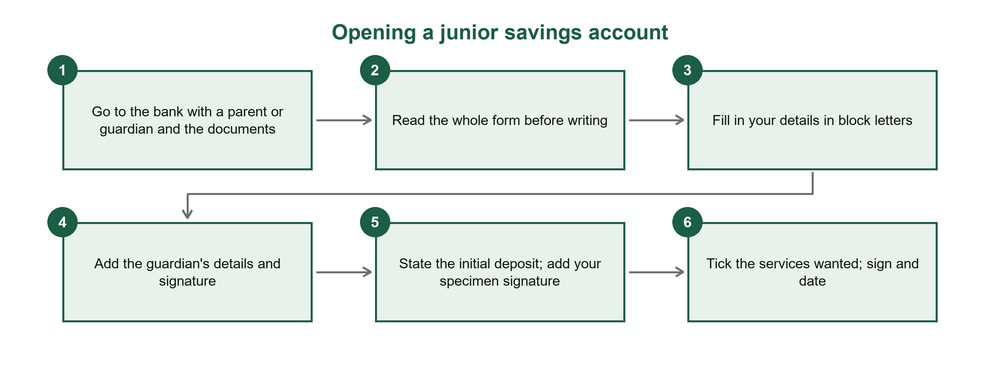
Filling in the account-opening form
- Read the whole form before writing anything.
- Fill in your personal details in block letters: full names, date of birth, school, address and telephone number.
- Give the parent or guardian's details and their signature.
- State the initial deposit.
- Add your specimen signature, which the bank will use to check your signature later.
- Tick the services wanted, such as an ATM card or mobile banking, then sign and date the form.
Documents usually needed: the learner's birth certificate or school identification, the parent or guardian's national identity card, passport photographs and sometimes a KRA PIN. Requirements differ between banks.
Care
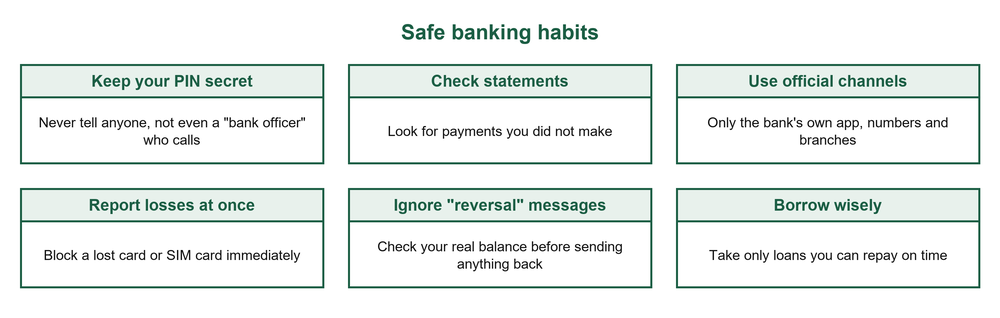
Use blue or black ink and do not cross out or leave blanks: alterations may look like fraud. Keep your account details and PIN private.
Ethical and unethical practices in banking
| Ethical practice | Unethical practice |
|---|---|
| Confidentiality: customers' information is kept private except where the law requires it | Leaking customers' information |
| Honesty and transparency about interest rates, charges and terms | Hidden charges |
| Fair treatment of all customers | Insider lending to relatives and friends without proper checks; bribery to approve loans |
| Responsible lending: lending only what a borrower can repay | Giving false information to get a loan |
| Know Your Customer (KYC) checks and reporting suspicious transactions | Money laundering |
| Prompt service and fair handling of complaints | Fraud and forgery of cheques or signatures; stealing customers' funds |
Customers have duties too: give true information, repay loans on time, protect cards and PINs and report errors.
Cyber fraud
Phishing
Tricking a customer into giving a PIN, password or other details, for example through a fake message or call.
SIM-swap fraud is when a criminal gets a replacement of a customer's SIM card in order to take over their mobile banking.
Effects of unethical practices
Customers lose money and trust; banks make losses and may collapse; staff may be jailed; the economy suffers when people stop depositing money. Trust is the basis of banking.
Trends in banking in Kenya
| Trend | What it means |
|---|---|
| Mobile banking | Checking balances, transferring money and paying bills by phone; mobile money linked to bank accounts |
| Agency banking | Shops and other agents accept deposits and pay out cash for banks close to where people live |
| Internet and app banking | Banking services online at any time |
| Card and contactless payments | Debit, credit and prepaid cards; tap-to-pay and QR-code payments |
| Digital lending | Loans by phone within minutes; digital lenders must be licensed by the CBK |
| Instant transfers and fewer branches | Money moves between banks at once; banks invest in technology and close some branches |
Digital banking
Advantages
- Convenient: available any time, anywhere
- Fast and usually cheaper
- Reaches people in rural areas
- Leaves a record of every transaction
Disadvantages
- Risk of fraud and scams
- Loss of a phone or card
- High charges or interest on some digital loans
- Needs digital skills and network coverage
Think about it
Before taking a digital loan, read the terms: interest and fees can be high, and late repayment brings penalties and a poor credit record.
Key points to remember
- A bank accepts deposits, lends money and provides payment services; Kenya has the CBK, commercial, microfinance, mortgage and development banks, and SACCOs.
- Banks keep money safe, encourage saving, lend, ease payments and support trade, government and investment.
- Savings accounts earn interest with easy access; current accounts suit daily business payments with cheques and overdrafts; fixed deposits earn the highest interest for a set period.
- Simple interest = principal × rate ÷ 100 × time in years.
- Ethical banking means confidentiality, honesty, fair treatment, responsible lending and KYC; fraud, insider lending and hidden charges destroy trust.
- Trends include mobile, agency, internet and card banking and digital lending, which bring convenience and new risks.
Practice questions
Define a bank and state three types of financial institutions in Kenya. (4 marks)
Show the answer
- A bank is a business that accepts deposits, lends money and provides payment services.
- Any three: Central Bank of Kenya; commercial banks; microfinance banks; mortgage finance institutions; development banks; SACCOs.
Explain four ways in which banks are important in an economy. (8 marks)
Show the answer
- They channel savings to investors, increasing production and jobs.
- They create credit, adding to money available for spending.
- They support trade through payments and foreign exchange.
- They act as agents of government (also: employ people and pay taxes; keep money safe).
Compare a savings account and a current account under three headings. (6 marks)
Show the answer
- Interest: savings earns interest; current earns little or none.
- Cheque book: savings usually none; current has one.
- Overdraft: not on savings; possible on current (also: withdrawals limited on savings, any time on current).
Calculate the simple interest on KSh 50,000 in a fixed deposit for one year at 8 per cent. (2 marks)
Show the answer
50,000 × 8 ÷ 100 = KSh 4,000.
State four details a learner fills in on a junior savings account form and two documents needed. (6 marks)
Show the answer
- Details: full names, date of birth, school, address, telephone number, guardian's details, initial deposit, specimen signature.
- Documents: birth certificate or school identification; parent or guardian's national identity card (also passport photographs).
Explain three ethical practices expected of banks. (6 marks)
Show the answer
- Confidentiality: keep customers' information private.
- Transparency: explain interest rates and charges clearly.
- Responsible lending: lend only what a borrower can repay (also: fair treatment; KYC checks).
A customer receives a message asking for their PIN to "update the account". Name this type of fraud and state two things the customer should do. (3 marks)
Show the answer
- Phishing.
- Do not share the PIN; report the message to the bank using its official number; delete the message.
State two advantages and two disadvantages of agency and mobile banking. (4 marks)
Show the answer
- Advantages: services close to where people live; available any time; lower costs; wider access in rural areas.
- Disadvantages: fraud; loss of a phone; high charges on some services or loans; needs network and digital skills.
This is one topic. Get the whole year. The full Grade 10 Business Studies notes cover every sub-strand of Terms 1, 2 and 3 like this one, with pictures, key points and practice questions with answers, as a printable PDF for KSh 150. Pay with M-Pesa and download at once.
Get the full Grade 10 Business Studies notes · All Grade 10 Business Studies resources · Notes for every grade


