
Grade 10 English · Theme 6.0 Culture (Values and Beliefs) · Sub-strand 6.3.1 Clauses
These are free study notes for Grade 10 learners, written to the KICD curriculum design and taken from our full Grade 10 English notes. Clauses are the key to sentence variety in compositions as well as to grammar questions. Try rewriting one of your own paragraphs using what you learn here.
Clauses let us pack more information into a sentence and show how ideas relate. A relative clause tells us which person or thing we mean ("the elder who tells stories"); an adverbial clause tells us when, why, where or under what condition something happens ("because it unites us"). This topic covers both, with their punctuation.
Main and subordinate clauses
Clause
A group of words with a subject and a verb.
Main (independent) clause
A clause that makes complete sense on its own: "The elders respect the tradition."
Subordinate (dependent) clause
A clause that cannot stand alone and depends on a main clause: "who tell the stories", "because it is important".
Relative clauses
Relative clause
A subordinate clause that describes a noun (its antecedent). It begins with a relative word.
| Relative word | Used for | Example |
|---|---|---|
| who / whom | people | The elder who tells the stories is Mzee Juma. |
| whose | possession | The girl whose grandmother sings is my friend. |
| which | things | The drum, which is made of animal skin, is very old. |
| that | people or things (defining only) | The book that I borrowed is about proverbs. |
| where | places | The village where I grew up has many traditions. |
| when | times | The day when we hold the festival is a holiday. |
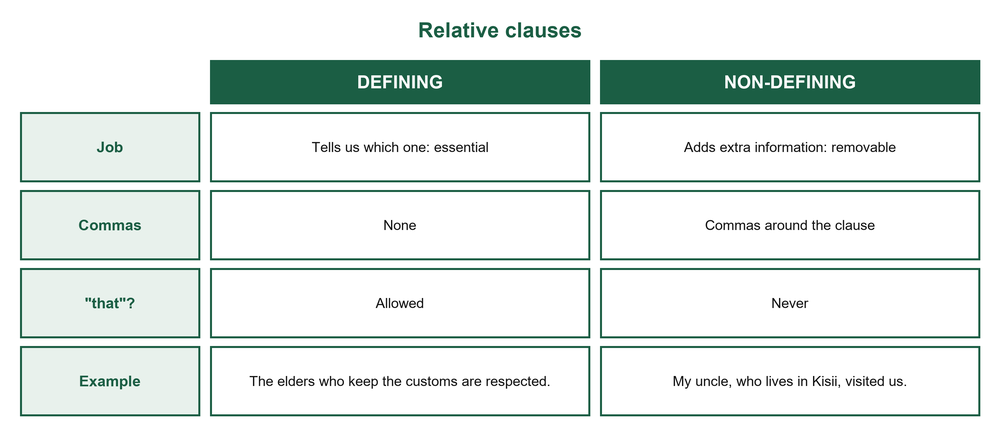
| Defining | Non-defining |
|---|---|
| Essential: tells us which one | Extra information: can be removed |
| No commas | Commas around it |
| "that" allowed; pronoun may be dropped when it is the object | "that" not allowed; pronoun never dropped |
| The elders who keep the old customs are respected. | My uncle, who lives in Kisii, visited us. |
Watch out
"The drivers who drive carefully arrive safely" means only the careful ones. "The drivers, who drive carefully, arrive safely" means all of them. The commas change the meaning.
Adverbial clauses
Adverbial clause
A subordinate clause that works like an adverb, beginning with a subordinating conjunction.
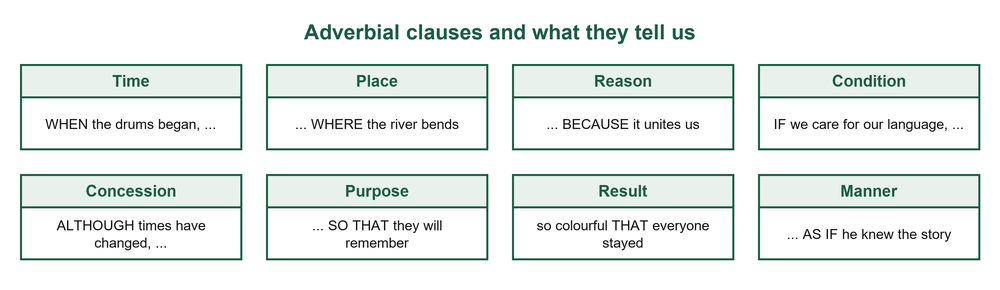
| Kind | Conjunctions | Example |
|---|---|---|
| Time | when, while, after, before, until, as soon as | When the drums began, the dancers entered. |
| Place | where, wherever | We built the house where the river bends. |
| Reason | because, since, as | We keep the custom because it unites us. |
| Condition | if, unless, provided that | If we care for our language, it will survive. |
| Concession | although, though, even though | Although times have changed, the tradition remains. |
| Purpose | so that, in order that | We teach the children so that they will remember. |
| Result | so ... that, such ... that | The festival was so colourful that everyone stayed. |
| Manner | as, as if, as though | He spoke as if he knew the whole story. |
Punctuation: put a comma after an adverbial clause that comes first ("If you visit Lamu, you will enjoy the festival"); usually no comma when it comes last ("You will enjoy the festival if you visit Lamu").
Using clauses in writing
A paragraph on hospitality
"Hospitality is a value that many Kenyan communities cherish. When a visitor arrives, the family, who may have little, offers tea or a meal. This custom, which has been handed down for generations, shows respect for guests. Although modern life is busy, we should keep hospitality because it builds friendship."
Relative: that many Kenyan communities cherish (defining); who may have little, which has been handed down for generations (non-defining).
Adverbial: When a visitor arrives (time); Although modern life is busy (concession); because it builds friendship (reason).
Watch out
"Because it is our culture." on its own is a fragment. Join it to a main clause: "We keep the dance because it is our culture."
Key points to remember
- A main clause stands alone; a subordinate clause depends on a main clause.
- Relative clauses describe nouns and begin with who, whom, whose, which, that, where or when.
- Defining clauses identify (no commas); non-defining clauses add extra information (commas, no "that").
- Adverbial clauses show time, place, reason, condition, concession, purpose, result or manner.
- Put a comma after an adverbial clause that begins a sentence.
Practice questions
Join with a relative pronoun: (a) "I met a woman. Her son is a pilot." (b) "This is the village. I was born there." (2 marks)
Show the answer
(a) "I met a woman whose son is a pilot." (b) "This is the village where I was born."
Add commas where needed: (a) "My mother who is a nurse works at night." (b) "Kenya which is in East Africa has many cultures." (2 marks)
Show the answer
(a) "My mother, who is a nurse, works at night." (b) "Kenya, which is in East Africa, has many cultures."
Name the kind of adverbial clause: (a) "Although it rained, the festival went on." (b) "We spoke softly so that the baby could sleep." (c) "Unless you hurry, you will miss the bus." (3 marks)
Show the answer
(a) concession (b) purpose (c) condition
Combine using a time clause: "The rains came. The farmers planted maize." (1 mark)
Show the answer
"When the rains came, the farmers planted maize."
Explain the difference in meaning: (a) "The learners who were late were punished." (b) "The learners, who were late, were punished." (2 marks)
Show the answer
(a) Only the learners who came late were punished. (b) All the learners were punished, and all of them were late.
This is one topic. Get the whole year. The full Grade 10 English notes cover every sub-strand of Terms 1, 2 and 3 like this one, with pictures, key points and practice questions with answers, as a printable PDF for KSh 150. Pay with M-Pesa and download at once.
Get the full Grade 10 English notes · All Grade 10 English resources · Notes for every grade


