
Grade 10 Physical Education · Strand 2.0 Athletics · Sub-strand 2.2 Long Jump
These are free study notes for Grade 10 learners. They follow the official KICD curriculum design for Grade 10 Physical Education (the same topics, in the same order, that your teacher uses) and are taken from our full Grade 10 Physical Education notes. Read the technique sections before your next PE lesson, then try one phase at a time on the runway. Theory and practice support each other here.
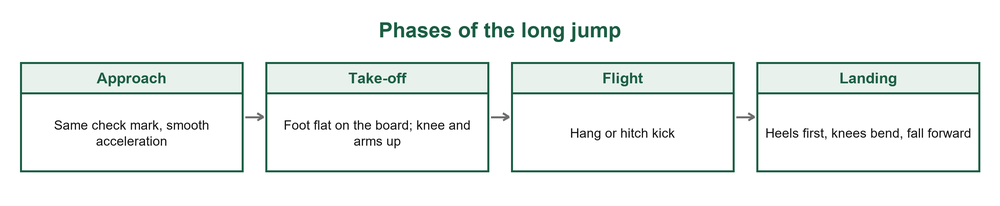
The long jump turns sprint speed into distance. A good jump depends on four phases joined smoothly: the approach, the take-off, the flight and the landing. In this topic we learn the long jump facility and equipment, each phase including the hang and hitch-kick flights, how a jump is measured and the safety rules.
The facility and equipment
| Part | Detail |
|---|---|
| Runway | Straight track about 1.22 m wide; 20 to 30 m long at school |
| Take-off board | About 20 cm wide and 1.22 m long, level with the runway |
| Take-off line | Edge of the board nearest the pit; stepping over it is a foul |
| Landing pit | Loose sand, at least 2.75 m wide and 9 m long |
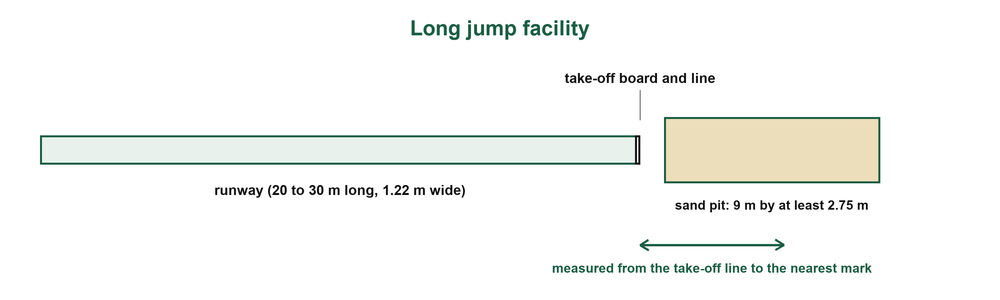
- Equipment: tape measure, rake or jembe to level the sand, white and red flags, cones for check marks.
- Improvise: dig and loosen the soil or fill the pit with sand; use a plank or painted line as the board.
- Measuring: from the take-off line to the nearest mark in the sand made by any part of the body, at right angles to the line.
The approach and the take-off
The approach
- Start from a measured check mark, the same every time.
- Accelerate smoothly with an even rhythm, reaching top controllable speed near the board.
- Shorten the last stride slightly and lower the hips to prepare for take-off.
The take-off
- Plant the take-off foot flat and firmly on the board.
- Drive the free knee up to hip height and swing the arms up.
- Keep the head and chest up; jump up and forward, not only forward.
Finding your check mark
Stand on the board and run back along the runway for your number of strides (for example 12). Where your take-off foot lands is your check mark. Adjust it until you hit the board without looking down.
The flight and the landing
| Flight technique | How it is done | Purpose |
|---|---|---|
| Hang | Arms and legs stretch back and up, body forms an arch, then legs come forward together for landing | Simple to learn; stops forward rotation |
| Hitch kick | The athlete "runs in the air" with 1.5 to 2.5 strides, then brings the legs together | Keeps balance and controls rotation for longer jumps |
Landing and recovery
- Swing the legs forward and stretch them out in front with heels first.
- Bring the arms forward and down.
- Bend the knees on contact and let the hips move forward past the heels.
- Fall forward or to the side, never back, and walk out of the front of the pit.
Rules, safety and fair play
| Foul | Why |
|---|---|
| Stepping over the take-off line | The jumper gained extra distance |
| Running across the side of the pit | Not a valid jump |
| Walking back through the pit | Leaves a mark nearer the board |
| Falling back into the pit | The nearest mark is measured, so the jump is shorter |
- Dig and level the sand before every session; remove stones and sharp objects.
- Only one jumper on the runway at a time; others wait away from the pit.
- Warm up well, and keep the rake out of the landing area with its teeth facing down.
The long jump builds speed, leg power and coordination, and seeing distances improve builds self-esteem.
Key points to remember
- Facility: runway, take-off board and line, sand landing pit at least 9 m long.
- Phases: approach, take-off, flight, landing.
- Take-off: foot flat on the board, free knee and arms driven up, jump up and forward.
- Flight: hang (arch then legs forward) or hitch kick (running in the air).
- Measured from the take-off line to the nearest mark in the sand; stepping over the line is a foul.
Practice questions
Name the three parts of a long jump facility. (3 marks)
Show the answer
Runway, take-off board, landing pit.
Describe the take-off in the long jump. (3 marks)
Show the answer
Plant the foot flat on the board; drive the free knee to hip height and swing the arms up; keep head and chest up and jump up and forward.
Distinguish between the hang and the hitch-kick techniques. (4 marks)
Show the answer
- Hang: arms and legs stretch back to form an arch, then the legs come forward together.
- Hitch kick: the athlete makes running strides in the air before bringing the legs together.
Explain how a long jump is measured. (2 marks)
Show the answer
From the take-off line to the nearest mark in the sand made by any part of the body, at right angles to the line.
State three fouls in the long jump. (3 marks)
Show the answer
Any three: stepping over the take-off line; running across the side of the pit; walking back through the pit; leaving the pit backwards.
Explain why a jumper should fall forward on landing. (2 marks)
Show the answer
Falling back leaves a mark nearer the board, which shortens the measured jump.
This is one topic. Get the whole year. The full Grade 10 Physical Education notes cover every sub-strand of Terms 1, 2 and 3 like this one, with pictures, key points and practice questions with answers, as a printable PDF for KSh 150. Pay with M-Pesa and download at once.
Get the full Grade 10 Physical Education notes · All Grade 10 Physical Education resources · Notes for every grade