
Grade 11 Biology · Strand 1.0 Cell Biology and Biodiversity · Sub-strand 1.4 Cell Division
These are free study notes for Grade 11 learners, written to the KICD curriculum design and taken from our full Grade 11 Biology notes. Examiners love "compare mitosis and meiosis" tables and "name the stage shown" diagrams. Make your own flash cards for each stage.
You grew from a single cell, a zygote, into a body of trillions of cells. Your skin heals after a cut. A potato grows new shoots, and yeast makes dough rise. All of these depend on cell division. In this topic we learn the structure of chromosomes, the two types of cell division, mitosis and meiosis, why each is important (including in tissue culture), and how simple organisms divide by budding and binary fission.
Cell division and chromosomes
Cell division
The process by which a parent cell divides to form new (daughter) cells.
Chromosome
A thread-like structure in the nucleus made of DNA and protein; it carries genes.
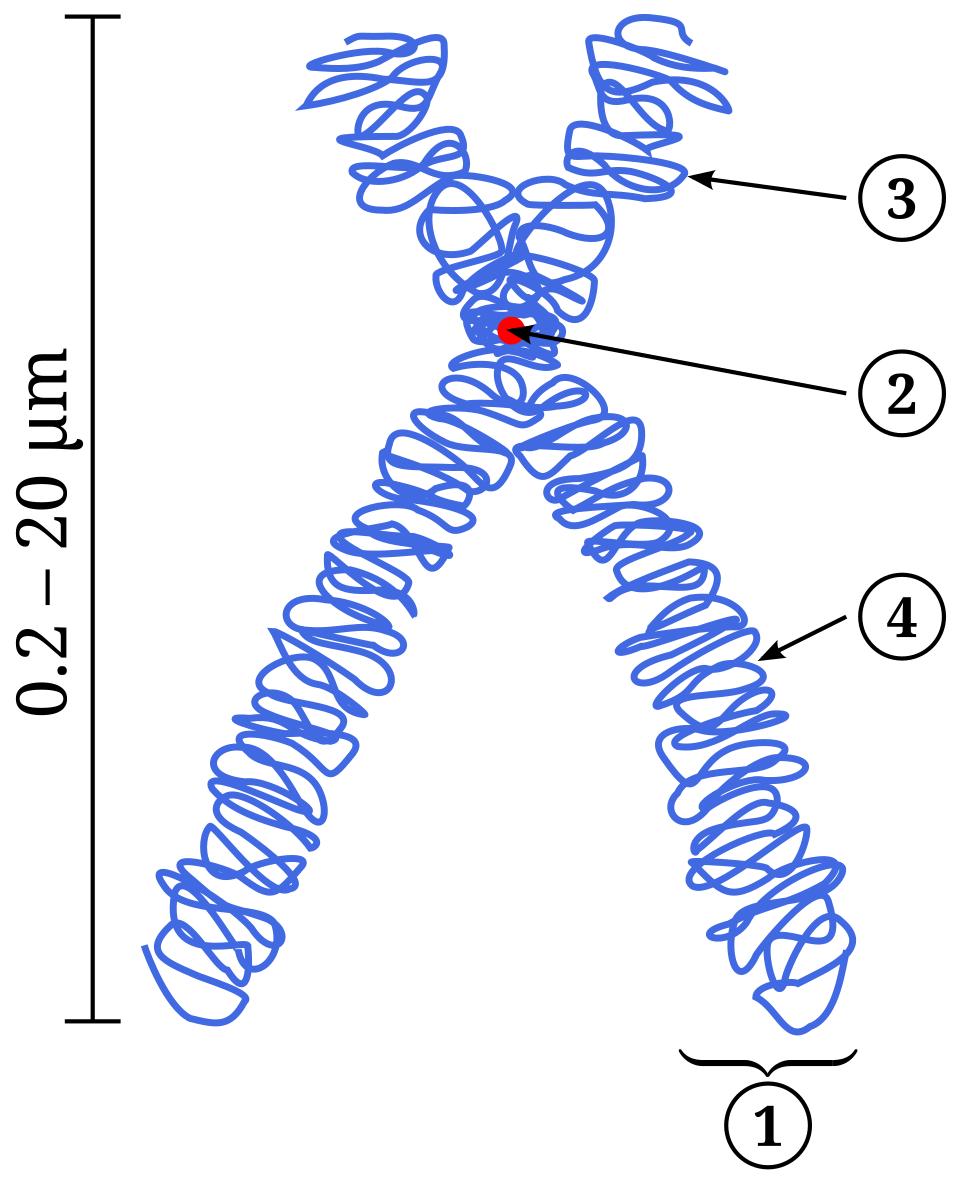
- Before division each chromosome copies itself, forming two identical CHROMATIDS joined at the CENTROMERE.
- GENES are lengths of DNA on a chromosome; each controls a characteristic.
- Body cells contain chromosomes in matching pairs called HOMOLOGOUS chromosomes, one from each parent.
- The DIPLOID number (2n) is the number in a body cell: humans 46, maize 20, bean 22. The HAPLOID number (n) is half: human gametes have 23.
Remember
Chromosomes are only clearly visible during division, when they coil up and become short and thick. In a resting cell the DNA is spread out as fine chromatin.
Mitosis
Mitosis
Cell division that produces two daughter cells with the same number and type of chromosomes as the parent cell (2n gives 2n).
Mitosis takes place in growing regions: root and shoot tips (meristems), the cambium, the skin, bone marrow and the early embryo.

| Stage | What happens |
|---|---|
| Interphase | Not a division stage: the cell grows, DNA copies itself, organelles increase and energy is stored |
| Prophase | Chromosomes shorten and thicken and are seen as two chromatids; nuclear membrane and nucleolus disappear; spindle fibres form (centrioles move to the poles in animal cells) |
| Metaphase | Chromosomes line up on the equator of the spindle, attached by their centromeres |
| Anaphase | Centromeres split; spindle fibres pull the chromatids to opposite poles |
| Telophase | Chromatids (now chromosomes) reach the poles; nuclear membranes re-form; the cytoplasm divides (cytokinesis): a furrow in animal cells, a cell plate in plant cells |
Observing mitosis in a root tip
- Grow onion roots in water for a few days and cut the last 5 mm of a root tip.
- Warm it in dilute acid (done by the teacher) to soften it, then rinse.
- Stain with a few drops of acetic orcein or iodine, and squash gently under a cover slip.
- Observe under low then high power and draw cells in different stages.
Meiosis
Meiosis
Cell division that produces four daughter cells each with half the number of chromosomes of the parent cell (2n gives n). It is also called reduction division.
Meiosis takes place in reproductive organs: the testes and ovaries of animals, and the anthers and ovules of flowering plants. It has two divisions, meiosis I and meiosis II.
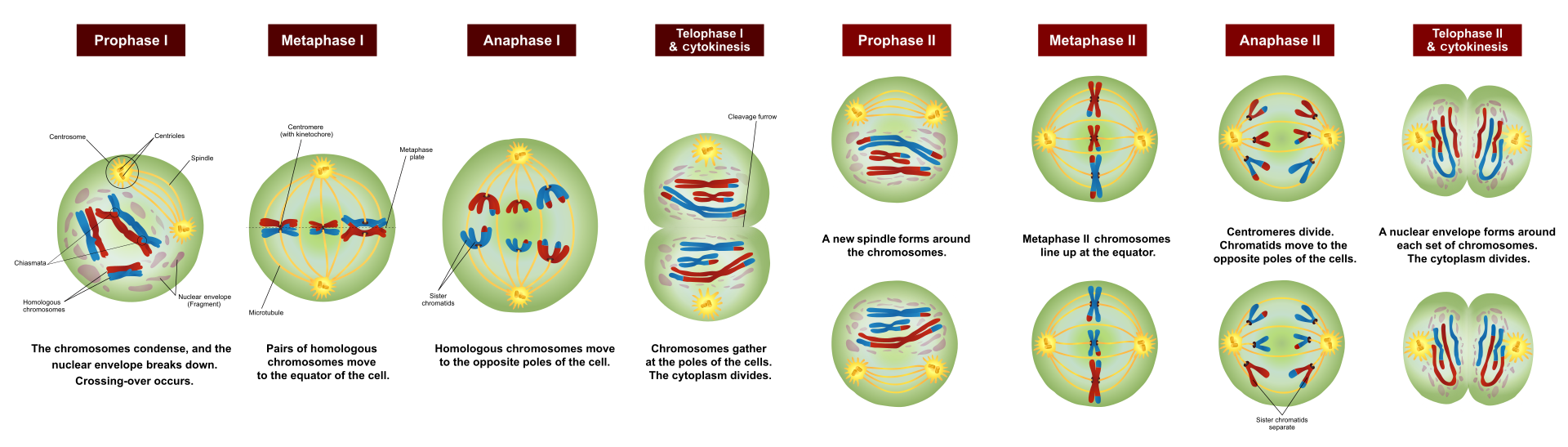
- Prophase I: homologous chromosomes pair up (synapsis); chromatids of a pair cross over at points called chiasmata and exchange segments (CROSSING OVER).
- Metaphase I: pairs of homologous chromosomes line up on the equator.
- Anaphase I: one chromosome of each pair moves to each pole (the number is halved).
- Telophase I: two cells form, each haploid.
- Meiosis II (like mitosis): in each cell the chromatids separate, giving four haploid cells in all.
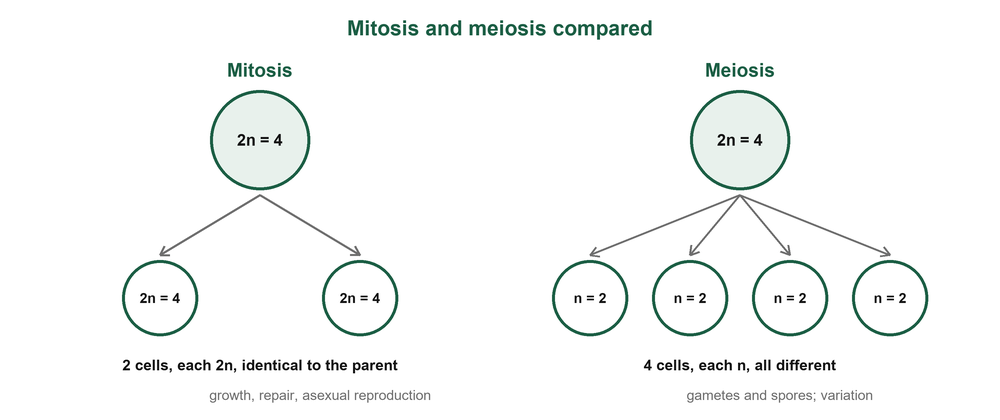
| Mitosis | Meiosis |
|---|---|
| One division | Two divisions |
| Two daughter cells | Four daughter cells |
| Chromosome number kept (2n to 2n) | Chromosome number halved (2n to n) |
| Daughter cells identical to the parent | Daughter cells differ (crossing over and independent assortment) |
| No pairing of homologous chromosomes | Homologous chromosomes pair and cross over |
| In body cells: growth and repair | In reproductive organs: gametes and spores |
Significance of cell division, including tissue culture
Significance of mitosis
- Growth: increases the number of cells.
- Repair and replacement of damaged or worn-out cells (healing of wounds, new skin and blood cells).
- Asexual reproduction and vegetative propagation produce offspring identical to the parent.
- Keeps the chromosome number constant in body cells, so all cells carry the same genetic information.
Significance of meiosis
- Forms haploid gametes, so the diploid number is restored at fertilisation and stays constant from generation to generation.
- Crossing over and independent assortment produce VARIATION, which helps species survive changing conditions and is the basis of evolution and plant and animal breeding.
Tissue culture
Growing many new plants from small pieces of tissue (explants) on a sterile nutrient medium containing hormones. The cells multiply by mitosis.
Tissue culture
Advantages
- Many identical plants are produced quickly from one good parent (bananas, pyrethrum, potatoes, flowers in Kenya).
- Plantlets are free from diseases.
- Rare or endangered plants can be multiplied; can be done at any time of year.
Disadvantages
- Needs a costly sterile laboratory, skills and chemicals.
- All plants are identical, so one disease can wipe out the whole crop (no variation).
- Contamination by fungi or bacteria can destroy whole batches.
Budding and binary fission
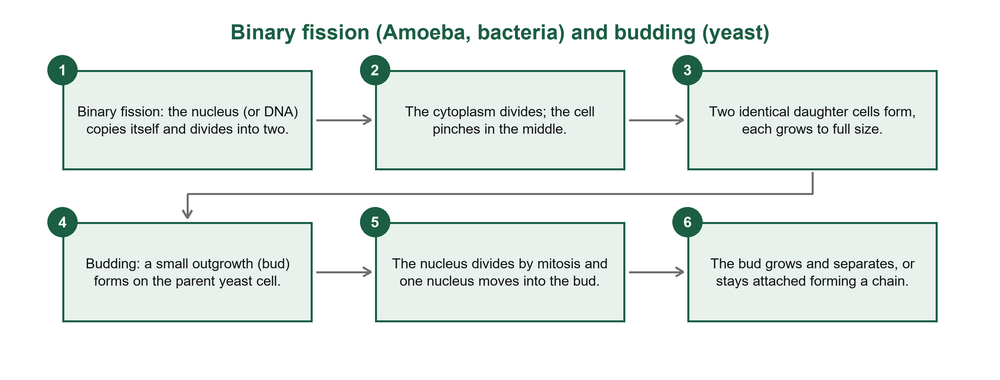
Binary fission
Asexual reproduction in which a single-celled organism divides into two equal daughter cells, e.g. bacteria and Amoeba.
Budding
Asexual reproduction in which a small outgrowth (bud) forms on the parent, grows, and separates as a new individual, e.g. yeast and Hydra.
| Binary fission | Budding |
|---|---|
| Parent divides into two equal halves | A small bud grows out of the parent |
| Parent disappears as an individual | Parent remains and can form more buds |
| Bacteria, Amoeba, Paramecium | Yeast, Hydra |
Why it matters
Bacteria can divide every 20 minutes in good conditions, so one cell can become millions in a few hours. This is why food left warm spoils quickly and why yeast multiplies fast in dough.
Key points to remember
- Chromosomes are made of DNA and protein, carry genes and occur in homologous pairs in body cells.
- Mitosis gives two identical diploid cells and is used for growth, repair and asexual reproduction.
- The stages of mitosis are prophase, metaphase, anaphase and telophase (after interphase).
- Meiosis gives four different haploid cells for gametes; crossing over causes variation.
- Meiosis keeps the chromosome number constant over generations; mitosis keeps it constant in body cells.
- Tissue culture uses mitosis to produce many disease-free identical plants quickly.
- Bacteria and Amoeba reproduce by binary fission; yeast and Hydra by budding.
Practice questions
Distinguish between a chromosome and a gene. (2 marks)
Show the answer
A chromosome is a thread-like structure of DNA and protein in the nucleus, while a gene is a short length of DNA on a chromosome that controls one characteristic.
Describe what happens during anaphase of mitosis. (2 marks)
Show the answer
The centromeres split and the spindle fibres pull the chromatids of each chromosome to opposite poles of the cell.
Give four differences between mitosis and meiosis. (4 marks)
Show the answer
- One division vs two divisions.
- Two daughter cells vs four.
- Chromosome number kept (2n) vs halved (n).
- Identical daughter cells vs different (also: no pairing vs pairing and crossing over).
A body cell of a maize plant has 20 chromosomes. How many chromosomes are in (a) a pollen grain nucleus (b) a root tip cell after mitosis? (2 marks)
Show the answer
(a) 10 (haploid) (b) 20.
Explain why meiosis is important in sexual reproduction. (3 marks)
Show the answer
- It halves the chromosome number in gametes.
- So the diploid number is restored at fertilisation and kept constant from one generation to the next.
- Crossing over and independent assortment produce variation.
State two advantages and one disadvantage of tissue culture. (3 marks)
Show the answer
- Advantages: many plants quickly; disease-free plantlets; rare plants multiplied.
- Disadvantage: costly laboratory needed, or no variation so all plants may be wiped out by one disease.
Name the type of asexual reproduction in (a) yeast (b) Amoeba. (2 marks)
Show the answer
(a) Budding (b) binary fission.
Why are root tips used to observe mitosis? (2 marks)
Show the answer
Root tips contain meristems where cells are dividing actively by mitosis, so many cells are found in different stages of division.
This is one topic. Get the whole year. The full Grade 11 Biology notes cover every sub-strand of Terms 1, 2 and 3 like this one, with pictures, key points and practice questions with answers, as a printable PDF for KSh 150. Pay with M-Pesa and download at once.
Get the full Grade 11 Biology notes · All Grade 11 Biology resources · Notes for every grade


