Grade 11 Biology · Strand 1.0 Cell Biology and Biodiversity · Sub-strand 1.2 Ecology
These are free study notes for Grade 11 learners. They follow the official KICD curriculum design for Grade 11 Biology (the same topics, in the same order, that your teacher uses) and are taken from our full Grade 11 Biology notes. Capture-recapture and quadrat calculations are favourite exam questions. Work each example yourself before reading the answer.
No organism lives alone. Every plant, animal and microorganism depends on other living things and on the soil, water, air and climate around it. Ecology studies these relationships. In this topic we look at the main kinds of ecosystems, how organisms are adapted to their habitats, how to describe and estimate populations, the factors that change population size, the nitrogen and carbon cycles, and the effects of pollution, including global warming and climate change.
Ecosystems and their components
Ecology
The study of the relationships between organisms and between organisms and their environment.
Ecosystem
A community of organisms interacting with each other and with their non-living (abiotic) environment, for example a forest, a pond or a grassland.
Habitat
The place where an organism lives, for example the bark of a tree or the bottom of a river.
Population
All the organisms of one species living in an area at the same time.
Community
All the populations of different species living and interacting in an area.
| Ecosystem | Main features | Kenyan example |
|---|---|---|
| Forest | Many tall trees; much rainfall; layers of plants; high biodiversity | Kakamega Forest, Mau Forest |
| Grassland (savanna) | Grasses with scattered trees; wet and dry seasons; large grazers | Maasai Mara, Nairobi National Park |
| Desert / semi-desert | Very little rain; high day temperatures; sparse plants | Chalbi Desert, parts of Turkana |
| Aquatic (fresh or marine) | Organisms live in water; light, oxygen and salt levels matter | Lake Victoria, Lake Naivasha, the Indian Ocean coast |
Every ecosystem has living (biotic) parts - producers, consumers and decomposers - and non-living (abiotic) parts such as light, temperature, water, soil, wind and pH.
Adaptations to habitats
Adaptation
A feature of structure, function or behaviour that helps an organism survive and reproduce in its habitat.
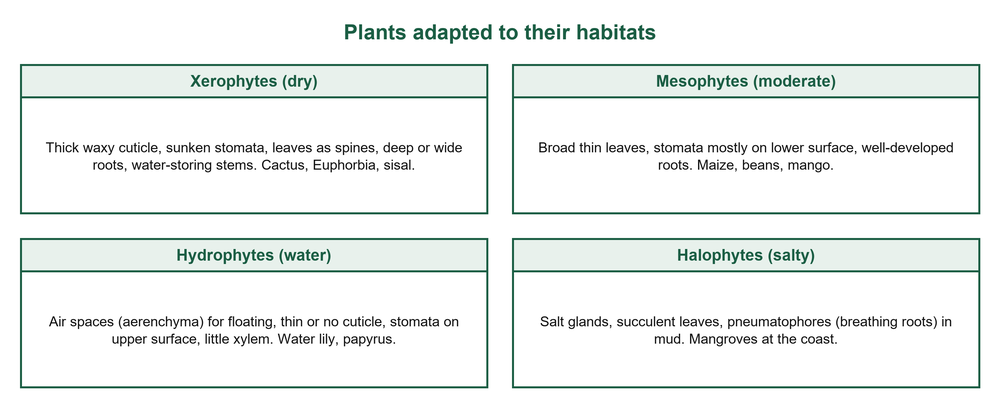
| Plant group | Adaptations | Examples |
|---|---|---|
| Xerophytes (dry places) | Thick waxy cuticle; few, sunken stomata; leaves reduced to spines or rolled; long or widespread roots; fleshy stems storing water; shedding leaves in drought | Cactus, Euphorbia, sisal, Acacia |
| Mesophytes (moderate water) | Broad thin leaves; stomata mostly on the lower surface; well-developed roots and xylem; thin cuticle | Maize, bean, mango |
| Hydrophytes (in water) | Large air spaces (aerenchyma) for buoyancy and oxygen; thin or no cuticle; stomata on the upper surface of floating leaves; little xylem and support tissue | Water lily, papyrus, water hyacinth |
| Halophytes (salty soils) | Salt glands that remove salt; succulent leaves storing water; breathing roots (pneumatophores) in waterlogged mud; prop roots | Mangroves at the Kenyan coast |
| Animal group | Adaptations | Examples |
|---|---|---|
| Desert animals | Concentrated urine and dry faeces; get water from food; active at night; burrow in the day; large ears to lose heat; fat stored in a hump | Camel, desert rat, fennec fox, lizards |
| Aquatic animals | Streamlined body; fins; gills for gas exchange; swim bladder for buoyancy; webbed feet (ducks, frogs); scales and mucus | Tilapia, frog, duck, hippopotamus |
Populations and how to estimate them
Characteristics of a population
- Population size: the number of individuals.
- Population density: the number per unit area (e.g. 4 plants per square metre).
- Distribution (dispersion): how individuals are spread out - clumped, uniform or random.
- Birth rate (natality) and death rate (mortality).
- Age structure and sex ratio.
- Growth rate and migration (immigration and emigration).
A DIRECT COUNT (counting every individual) is used for large animals or small areas, such as trees on a school compound or wildebeest counted from an aircraft. For most populations we use SAMPLING: count a small part and estimate the whole.
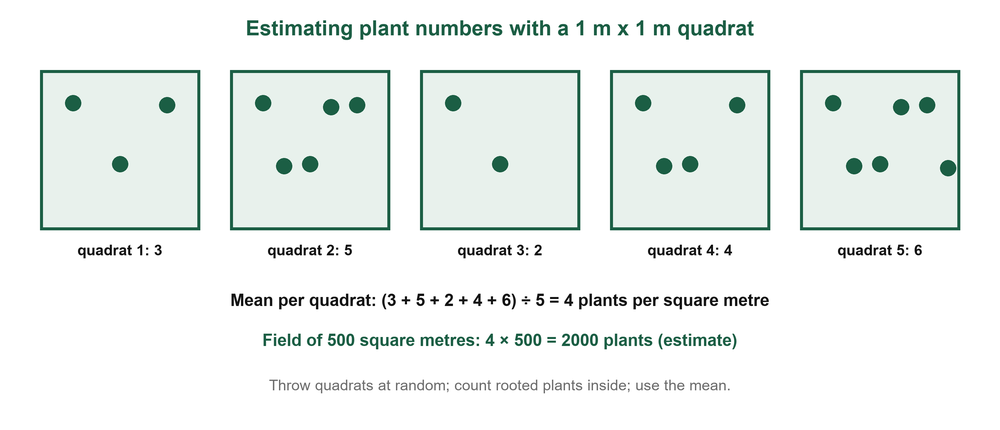
Quadrat estimate
Five 1 m x 1 m quadrats thrown at random contain 3, 5, 2, 4 and 6 plants.
Mean per quadrat: (3 + 5 + 2 + 4 + 6) ÷ 5 = 4 plants per square metre.
Field of 500 square metres: 4 × 500 = 2000 plants (estimate).
| Method | How it is done | Used for |
|---|---|---|
| Quadrat | A square frame (often 1 m x 1 m) is placed at random; organisms inside are counted; the mean is multiplied by the total area | Plants and slow-moving animals such as snails |
| Line transect | A string is stretched across the area; organisms touching the line at regular intervals are recorded | Showing how vegetation changes across a habitat, e.g. from a river bank to dry land |
| Belt transect | Two parallel lines (or quadrats placed along a line) make a strip; organisms in the strip are counted | More detailed changes along a gradient |
| Capture-recapture | Animals are caught, marked, released, then a second sample is caught and marked ones counted | Mobile animals: grasshoppers, beetles, fish |
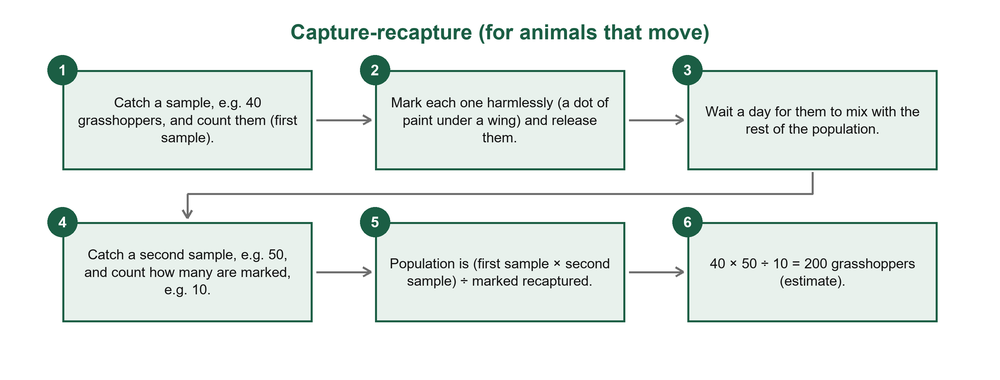
Capture-recapture estimate
First sample caught and marked: 40 grasshoppers. Second sample: 50, of which 10 are marked.
Population = (first sample × second sample) ÷ marked recaptured.
40 × 50 ÷ 10 = 200 grasshoppers.
Assumptions
Capture-recapture assumes marks do not fall off or harm the animal, marked animals mix fully with the rest, and there are no births, deaths or migration between samples.
Factors affecting populations
| Abiotic factors | Biotic factors |
|---|---|
| Temperature: affects enzyme activity and survival | Food availability |
| Rainfall and water availability | Predation (predators reduce prey numbers) |
| Light intensity: affects photosynthesis | Competition within and between species |
| Soil: pH, nutrients, texture, aeration | Parasites and diseases |
| Wind, humidity and salinity | Human activities: farming, hunting, deforestation, pollution |
Predator and prey numbers rise and fall in turn: when prey (e.g. gazelles) are plentiful, predators (e.g. cheetahs) increase; more predators then reduce the prey, so later the predators also decline.
Effects of human activity on populations
Advantages
- Conservation, game reserves and tree planting increase populations of threatened species.
- Controlled harvesting (fishing seasons, licensed logging) keeps populations stable.
Disadvantages
- Deforestation and settlement destroy habitats.
- Poaching and overfishing reduce numbers sharply.
- Pollution and pesticides kill organisms, including useful insects such as bees.
Nutrient cycles
Nutrients such as carbon and nitrogen are not used up; they are recycled between living things and the environment. Decomposers (bacteria and fungi) are essential because they release nutrients locked in dead bodies and wastes.
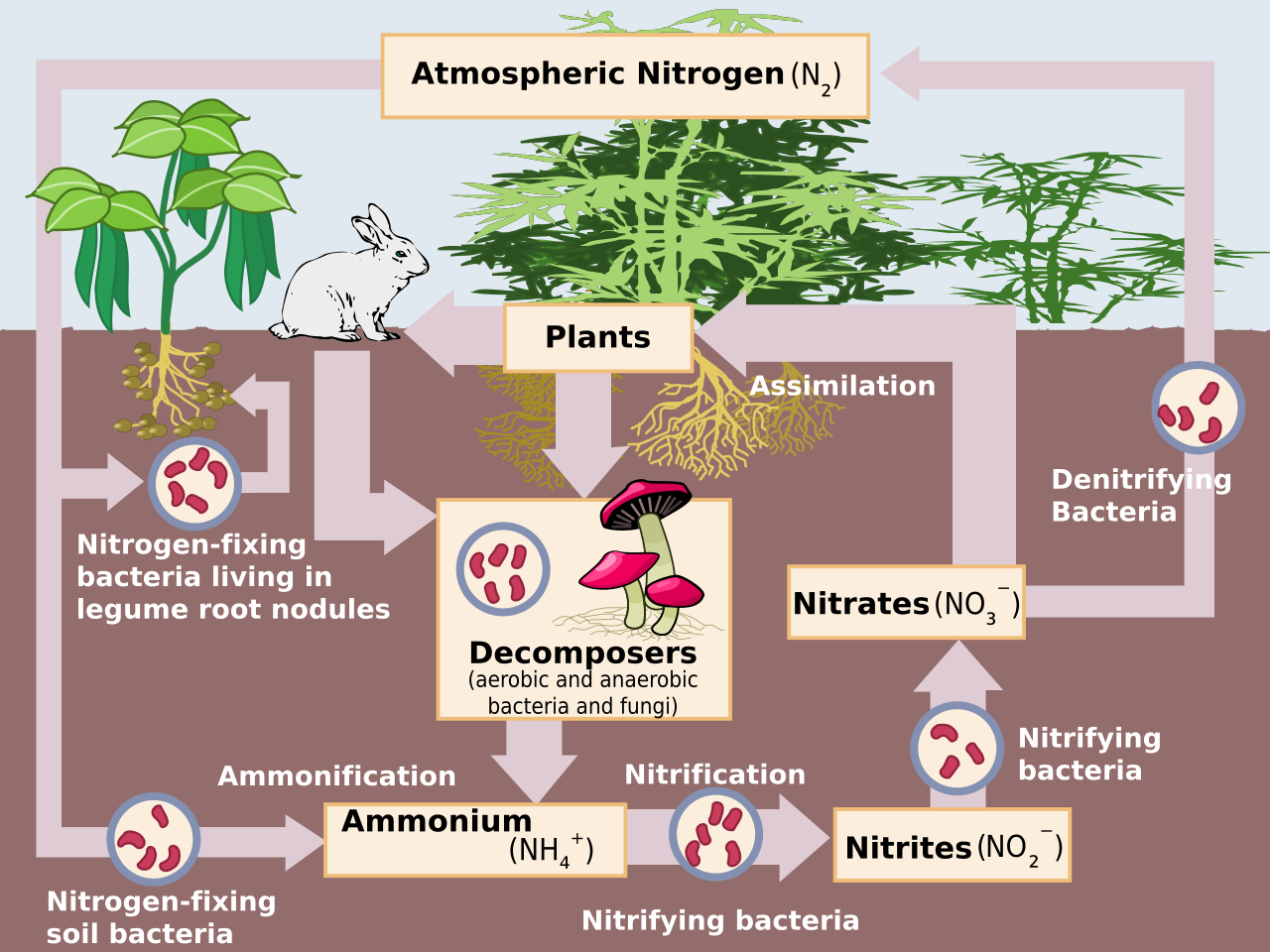
Main stages of the nitrogen cycle
- Nitrogen fixation: nitrogen gas (78% of air) is changed into nitrogen compounds by Rhizobium in legume root nodules, free-living soil bacteria (Azotobacter), lightning, and the Haber process for fertilisers.
- Assimilation: plants absorb nitrates and use them to make proteins; animals get nitrogen by eating plants.
- Ammonification (decay): decomposers break down proteins in dead organisms and wastes into ammonium compounds.
- Nitrification: nitrifying bacteria change ammonium to nitrites (Nitrosomonas) and nitrites to nitrates (Nitrobacter).
- Denitrification: in waterlogged soils, denitrifying bacteria change nitrates back into nitrogen gas, which returns to the air.
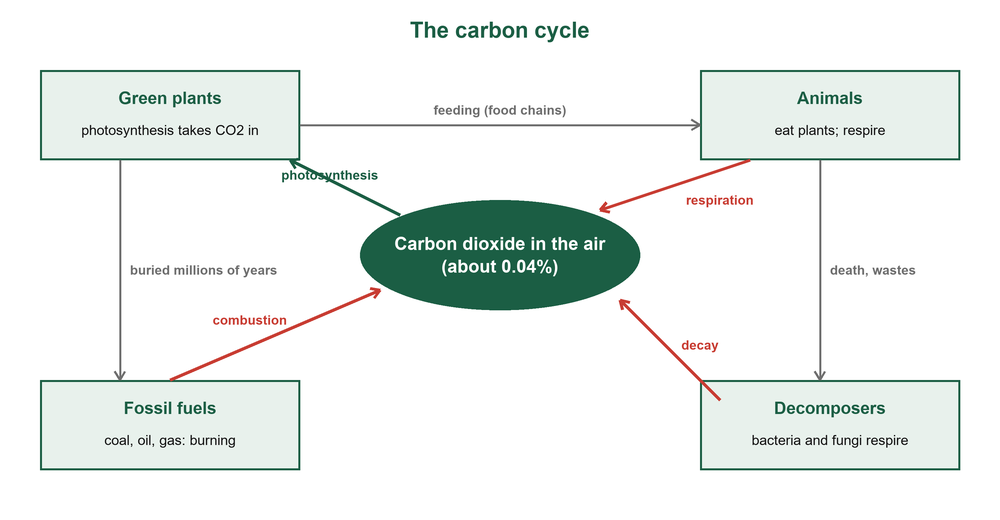
- Carbon dioxide is removed from the air by photosynthesis in green plants and algae.
- Carbon passes along food chains as animals eat plants.
- Respiration by plants, animals and decomposers returns carbon dioxide to the air.
- Dead remains buried for millions of years form fossil fuels; burning (combustion) releases their carbon as carbon dioxide.
Importance of nutrient cycles
They keep nutrients available for new growth, maintain the balance of gases in the air, and prevent the build-up of dead matter.
Pollution, global warming and climate change
Pollution
The release of harmful substances or energy (pollutants) into the environment in amounts that damage living things.
| Type | Main pollutants and sources | Effects |
|---|---|---|
| Air | Smoke, carbon monoxide, sulphur dioxide, nitrogen oxides from vehicles, factories and burning rubbish | Breathing diseases; acid rain damages plants and buildings; smog |
| Water | Sewage, fertilisers, pesticides, oil, industrial waste, plastics | Water-borne diseases; eutrophication (algal blooms use up oxygen and fish die); poisoning |
| Soil (land) | Plastics, pesticides, heavy metals, oil, poor waste disposal | Reduced fertility; poisoning of crops and animals |
| Noise | Loud machines, vehicles, music | Hearing loss, stress, disturbance of wildlife |
Global warming
The rise in the average temperature of the Earth caused mainly by increased greenhouse gases (carbon dioxide, methane, nitrous oxide) that trap heat in the atmosphere.
Climate change
Long-term changes in temperature, rainfall and weather patterns, largely caused by global warming.
- Effects in Kenya and the world: longer droughts and more floods; melting of glaciers (Mount Kenya's ice is shrinking); rising sea levels at the coast; crop failure and food shortage; spread of malaria to highland areas; loss of biodiversity.
- Control: plant trees; use renewable energy (geothermal, solar, wind); reduce burning of fossil fuels and charcoal; use energy efficiently; manage waste and recycle; treat sewage and industrial waste; use fertilisers and pesticides correctly.
Key points to remember
- Ecology studies relationships between organisms and their environment; an ecosystem includes a community and its abiotic environment.
- Kenya has forest, grassland, desert and aquatic ecosystems.
- Xerophytes, mesophytes, hydrophytes and halophytes, and desert and aquatic animals, have adaptations that suit their habitats.
- Populations are described by size, density, distribution, birth and death rates; they are estimated by direct count, quadrats, transects and capture-recapture.
- Abiotic factors (temperature, water, light, soil) and biotic factors (food, predators, competition, disease, humans) change population size.
- Nitrogen and carbon are recycled through living things and the environment, with decomposers playing a key role.
- Pollution harms air, water and soil; greenhouse gases cause global warming and climate change.
Practice questions
Distinguish between a population and a community. (2 marks)
Show the answer
A population is all the organisms of one species in an area, while a community is all the populations of different species living and interacting in an area.
State three adaptations of xerophytes to dry habitats. (3 marks)
Show the answer
- Thick waxy cuticle to reduce water loss.
- Few, sunken stomata.
- Leaves reduced to spines (also: deep roots; fleshy water-storing stems).
Six quadrats of 1 m x 1 m contained 2, 4, 3, 5, 3 and 1 Bidens plants. Estimate the number of Bidens plants in a plot of 300 square metres. (3 marks)
Show the answer
- Mean: (2 + 4 + 3 + 5 + 3 + 1) ÷ 6 = 3 plants per square metre.
- Estimate: 3 × 300 = 900 plants.
In a capture-recapture study, 60 beetles were marked and released. Later 45 beetles were caught, of which 9 were marked. Estimate the population and state one assumption made. (3 marks)
Show the answer
- Population: 60 × 45 ÷ 9 = 300 beetles.
- Assumption: marked beetles mix evenly with the others (or marks do not harm them or fall off; no births, deaths or migration).
Explain the role of bacteria in the nitrogen cycle. (4 marks)
Show the answer
- Nitrogen-fixing bacteria (Rhizobium, Azotobacter) change nitrogen gas into nitrogen compounds.
- Decomposers change proteins in dead matter into ammonium compounds.
- Nitrifying bacteria change ammonium to nitrites and then to nitrates for plants.
- Denitrifying bacteria change nitrates back to nitrogen gas.
Name two processes that add carbon dioxide to the atmosphere and one that removes it. (3 marks)
Show the answer
Added by respiration and combustion (also decay); removed by photosynthesis.
Explain how excess fertiliser washed into a lake can kill fish. (3 marks)
Show the answer
- Nitrates and phosphates cause rapid growth of algae (algal bloom / eutrophication).
- When the algae die, decomposing bacteria multiply and use up the dissolved oxygen.
- Fish die from lack of oxygen.
State two effects of climate change in Kenya and two ways of reducing global warming. (4 marks)
Show the answer
- Effects: longer droughts, floods, crop failure, melting glaciers on Mount Kenya, spread of malaria to highlands.
- Ways: plant trees; use renewable energy such as geothermal and solar; reduce burning of fossil fuels and charcoal.
This is one topic. Get the whole year. The full Grade 11 Biology notes cover every sub-strand of Terms 1, 2 and 3 like this one, with pictures, key points and practice questions with answers, as a printable PDF for KSh 150. Pay with M-Pesa and download at once.
Get the full Grade 11 Biology notes · All Grade 11 Biology resources · Notes for every grade