Grade 11 Chemistry · Strand 2.0 Physical Chemistry · Sub-strand 2.2 Gas Laws
These are free study notes for Grade 11 learners. They follow the official KICD curriculum design for Grade 11 Chemistry (the same topics, in the same order, that your teacher uses) and are taken from our full Grade 11 Chemistry notes. Almost every gas-law error comes from temperature in degrees Celsius. Convert to kelvin (add 273) before you substitute, every single time.
Gases behave in a predictable way: squeeze them and their pressure rises; heat them and they expand; lighter gases spread faster than heavy ones. These patterns are summed up in the gas laws. In this topic we explain gas behaviour using the kinetic theory, apply Boyle's, Charles' and the combined gas laws, study diffusion and Graham's law, relate reacting volumes of gases to mole ratios using Avogadro's and Gay-Lussac's laws, and look at everyday and industrial applications.
Kinetic theory and gas pressure
- Gas particles are far apart, move randomly at high speed and collide with each other and with the walls of their container.
- Gas PRESSURE is caused by particles hitting the walls; more collisions per second give higher pressure.
- When the temperature rises, particles move faster (their average kinetic energy is proportional to the kelvin temperature).
| Unit | Equivalent |
|---|---|
| 1 atmosphere (atm) | 760 mmHg |
| 1 atmosphere | about 101.3 kPa |
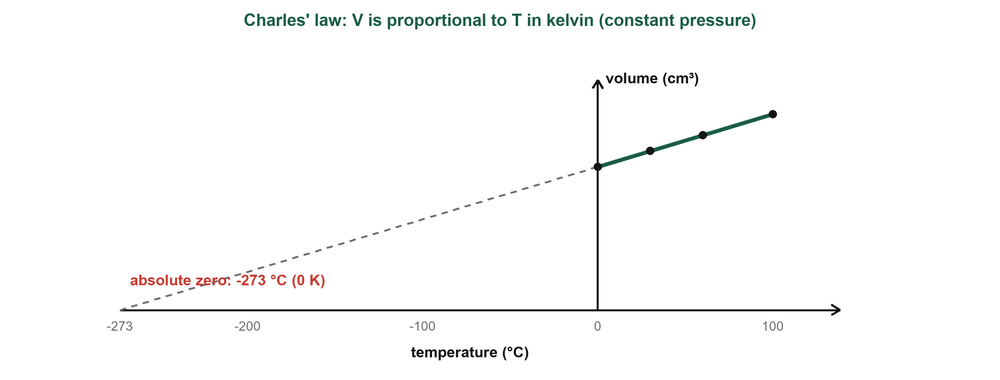
| Kelvin temperature | °C + 273 (0 K is absolute zero, -273 °C) |
Always use kelvin
Gas law sums only work with absolute temperatures: 27 °C is 27 + 273 = 300 K.
Boyle's law, Charles' law and the combined gas law
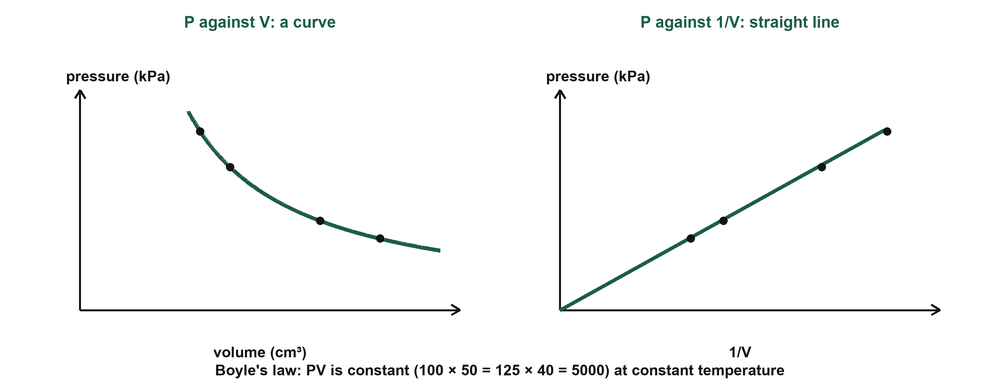
Boyle's law
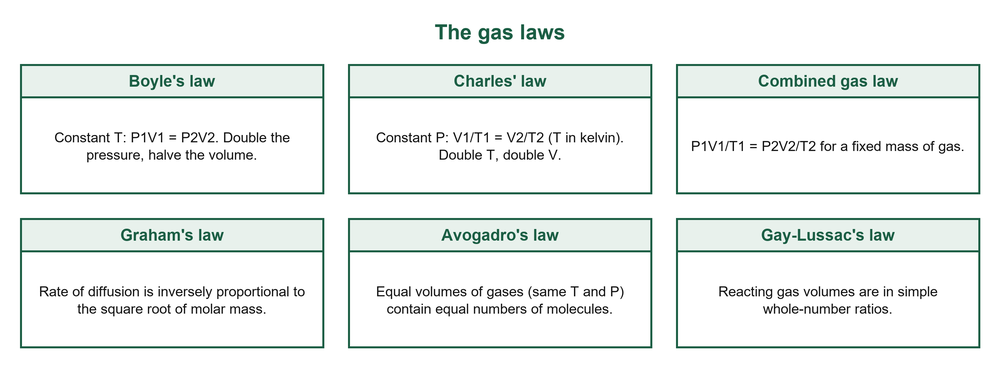
The volume of a fixed mass of gas is inversely proportional to its pressure at constant temperature: P1V1 = P2V2.
Charles' law
The volume of a fixed mass of gas is directly proportional to its absolute (kelvin) temperature at constant pressure: V1/T1 = V2/T2.
Combined gas law
For a fixed mass of gas, P1V1/T1 = P2V2/T2.
Gas law calculations
Boyle: 300 cm³ at 100 kPa compressed to 150 kPa. New volume: 100 × 300 ÷ 150 = 200 cm³.
Charles: 200 cm³ at 27 °C (300 K) heated to 127 °C (400 K). New volume: 200 × 400 ÷ 300 = 266.7 cm³.
Combined: 600 cm³ at 100 kPa and 300 K changed to 200 kPa and 400 K. New volume: 600 × 100 ÷ 200 × 400 ÷ 300 = 400 cm³.
To s.t.p.: 300 cm³ at 760 mmHg and 91 °C (364 K). New volume: 300 × 273 ÷ 364 = 225 cm³.
Sense check
Higher pressure must give a smaller volume; higher temperature must give a larger volume. If your answer does not, you have inverted a ratio.
Diffusion and Graham's law
Diffusion
The movement of particles from a region of high concentration to a region of low concentration until they are evenly spread.
A crystal of potassium manganate(VII) in still water slowly colours the whole beaker; perfume spreads across a room in minutes. Diffusion is faster in gases than in liquids because gas particles move faster and are further apart.
- Factors: lighter (smaller molar mass) gases diffuse faster; higher temperature increases the rate; a steeper concentration gradient increases the rate.
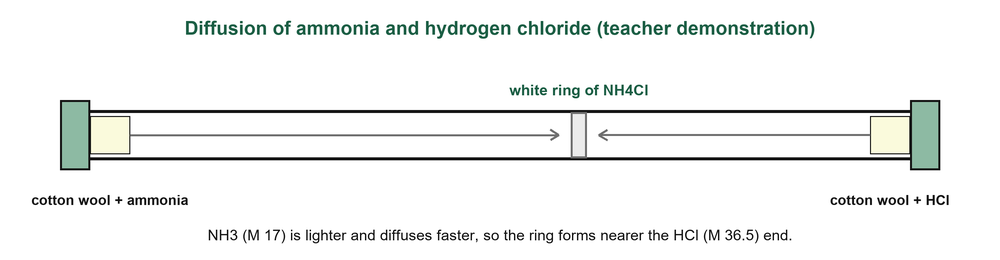
- In the tube, the white ring of ammonium chloride (NH3 + HCl -> NH4Cl) forms nearer the hydrogen chloride end because ammonia (M 17) diffuses faster than hydrogen chloride (M 36.5).
Graham's law
The rate of diffusion of a gas is inversely proportional to the square root of its density (or molar mass), at the same temperature and pressure.
Graham's law
Hydrogen (M 2) and oxygen (M 32): rate of H2 ÷ rate of O2 is the square root of 32 ÷ 2, the square root of 16, which is 4. Hydrogen diffuses 4 times faster.
For the same volume, time is proportional to the square root of molar mass. Oxygen takes 40 s; sulphur dioxide (M 64) takes 40 × 1.414 = 56.6 s.
Gas X takes 30 s and oxygen 15 s for the same volume: 30 ÷ 15 = 2, and 2 squared is 4, so M of X is 32 × 4 = 128.
Avogadro's law, Gay-Lussac's law and reacting volumes
Avogadro's law
Equal volumes of all gases at the same temperature and pressure contain equal numbers of molecules.
Gay-Lussac's law
When gases react, the volumes of the reacting gases and of any gaseous products are in a simple whole-number ratio, measured at the same temperature and pressure.
Together these laws mean that the ratio of gas volumes equals the mole ratio in the balanced equation. For example, N2 + 3H2 -> 2NH3 is 1 volume : 3 volumes : 2 volumes.
Reacting volumes
CH4 + 2O2 -> CO2 + 2H2O: 50 cm³ of methane needs 50 × 2 = 100 cm³ of oxygen and gives 50 cm³ of CO2 (water condenses at room temperature).
C3H8 + 5O2 -> 3CO2 + 4H2O: 10 cm³ of propane needs 10 × 5 = 50 cm³ of oxygen and gives 10 × 3 = 30 cm³ of CO2.
20 cm³ of a hydrocarbon burnt completely gave 40 cm³ of CO2: 40 ÷ 20 = 2, so each molecule has 2 carbon atoms.
Applications of the gas laws
| Situation | Gas law | Explanation |
|---|---|---|
| Tyre pressure rises on a hot day | Pressure law (constant volume) | Hotter air hits the walls harder and more often; check pressure when cold |
| Aerosol cans and gas cylinders must not be heated | Pressure law | Pressure rises with temperature and the container may burst |
| Divers must rise slowly and breathe out | Boyle's law | Air in the lungs expands as pressure falls |
| Hot-air balloons rise | Charles' law | Heated air expands and becomes less dense |
| Weather balloons burst high up | Boyle's law | Low outside pressure lets the gas expand |
| Smell added to LPG | Diffusion | A leak is quickly smelt as the gas diffuses |
Safety and security
Store gas cylinders upright in a cool, ventilated place; test for leaks with soapy water, never a flame; never puncture or burn aerosol cans.
Key points to remember
- Gas pressure comes from particle collisions with the walls; temperature must be in kelvin (°C + 273).
- Boyle's law: P1V1 = P2V2 at constant temperature. Charles' law: V1/T1 = V2/T2 at constant pressure. Combined: P1V1/T1 = P2V2/T2.
- Diffusion is faster for lighter gases and at higher temperatures; Graham's law: rate is inversely proportional to the square root of molar mass.
- Avogadro's law: equal volumes contain equal numbers of molecules; Gay-Lussac's law: reacting gas volumes are in simple ratios equal to mole ratios.
- Gas laws explain tyres, aerosols, diving, balloons and gas safety.
Practice questions
State Boyle's law. (1 mark)
Show the answer
The volume of a fixed mass of gas is inversely proportional to its pressure at constant temperature.
A gas occupies 120 cm³ at 750 mmHg. Calculate its volume at 600 mmHg at the same temperature. (2 marks)
Show the answer
New volume: 750 × 120 ÷ 600 = 150 cm³.
A gas occupies 500 cm³ at 250 K. Find its volume at 300 K at constant pressure. (2 marks)
Show the answer
New volume: 500 × 300 ÷ 250 = 600 cm³.
400 cm³ of a gas at 100 kPa and 200 K is changed to 50 kPa and 300 K. Calculate the new volume. (3 marks)
Show the answer
New volume: 400 × 100 ÷ 50 × 300 ÷ 200 = 1200 cm³.
Explain why the white ring forms nearer the hydrogen chloride end when ammonia and hydrogen chloride diffuse along a tube. (2 marks)
Show the answer
Ammonia has a smaller molar mass (17) than hydrogen chloride (36.5), so it diffuses faster and travels further before the gases meet.
How many times faster does methane (M 16) diffuse than sulphur dioxide (M 64)? (2 marks)
Show the answer
Square root of 64 ÷ 16 is the square root of 4, which is 2: methane diffuses twice as fast.
What volume of oxygen is needed to burn 30 cm³ of propane completely (C3H8 + 5O2 -> 3CO2 + 4H2O), and what volume of carbon dioxide forms? (2 marks)
Show the answer
Oxygen: 30 × 5 = 150 cm³; carbon dioxide: 30 × 3 = 90 cm³.
Explain why aerosol cans carry the warning "do not heat". (2 marks)
Show the answer
The volume of the can is fixed, so heating raises the pressure of the gas inside (pressure law), which may make the can burst.
This is one topic. Get the whole year. The full Grade 11 Chemistry notes cover every sub-strand of Terms 1, 2 and 3 like this one, with pictures, key points and practice questions with answers, as a printable PDF for KSh 150. Pay with M-Pesa and download at once.
Get the full Grade 11 Chemistry notes · All Grade 11 Chemistry resources · Notes for every grade