
Grade 11 Chemistry · Strand 1.0 Inorganic Chemistry · Sub-strand 1.1 The Mole
These are free study notes for Grade 11 learners, written to the KICD curriculum design and taken from our full Grade 11 Chemistry notes. Mole calculations run through all of Senior School Chemistry. Follow each worked example line by line and always write units.
Atoms are far too small to count, yet chemists need to know exactly how much of each substance reacts. The mole solves this problem: it lets us count particles by weighing them. In this topic we learn what a mole is, how it links mass, number of particles, gas volume and concentration, how to find the formulae of compounds, how to prepare standard solutions, how to carry out acid-base and redox titrations, and how redox titrations are used in industry.
The mole as a unit of measurement
Mole (mol)
The SI unit for the amount of substance: the amount that contains 6.0 × 10^23 particles (atoms, molecules or ions).
Avogadro's constant (L)
The number of particles in one mole: 6.0 × 10^23 (more exactly 6.02 × 10^23).
Relative atomic mass (Ar)
The average mass of an atom of an element compared with one-twelfth of the mass of a carbon-12 atom. It has no units.
Relative formula mass (Mr)
The sum of the relative atomic masses of all the atoms in a formula. The MOLAR MASS is Mr in grams per mole (g/mol).
Just as a dozen eggs and a dozen melons contain the same number of items but have different masses, one mole of carbon (12 g) and one mole of magnesium (24 g) contain the same number of atoms.
Relative atomic mass from isotopes
Chlorine is 75% chlorine-35 and 25% chlorine-37.
Ar: (35 × 75 + 37 × 25) ÷ 100, which is (2625 + 925) ÷ 100 = 35.5.
Relative formula masses
Water, H2O: 1 × 2 + 16 = 18.
Calcium carbonate, CaCO3: 40 + 12 + 16 × 3 = 100.
Sodium carbonate, Na2CO3: 23 × 2 + 12 + 16 × 3 = 106.
Calcium hydroxide, Ca(OH)2: 40 + (16 + 1) × 2 = 74.
Converting between mass, moles, particles and gas volume
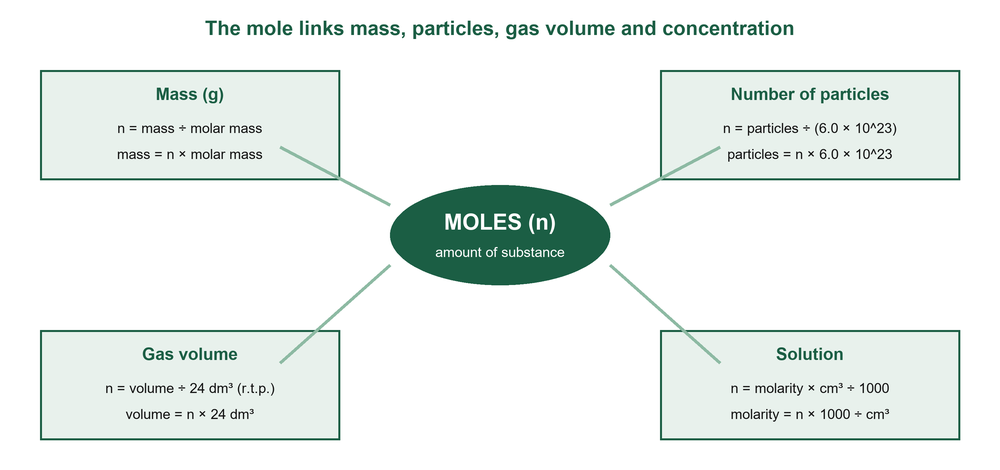
| To find | Use | Example |
|---|---|---|
| Moles from mass | moles = mass ÷ molar mass | 4 g of NaOH: 4 ÷ 40 = 0.1 mol |
| Mass from moles | mass = moles × molar mass | 0.25 mol CaCO3: 0.25 × 100 = 25 g |
| Particles from moles | particles = moles × 6.0 × 10^23 | 0.5 mol CO2: 3.0 × 10^23 molecules |
| Moles of a gas | moles = volume ÷ molar gas volume | 4.8 dm³ at r.t.p.: 4.8 ÷ 24 = 0.2 mol |
Molar gas volume
The volume occupied by one mole of any gas: 24 dm³ at room temperature and pressure (r.t.p.) and 22.4 dm³ at standard temperature and pressure (s.t.p., 0 °C and 1 atmosphere).
Counting atoms in water
Moles of water in 9 g: 9 ÷ 18 = 0.5 mol of molecules.
Each molecule has 3 atoms: 0.5 × 3 = 1.5 mol of atoms.
Number of atoms: 1.5 × 6.0 × 10^23 gives 9.0 × 10^23 atoms.
Exam method
Always write the formula, work out the molar mass, convert the given quantity to moles, then convert moles to what is asked. Give units at every step.
Empirical and molecular formulae
Empirical formula
The simplest whole-number ratio of atoms of each element in a compound.
Molecular formula
The actual number of atoms of each element in one molecule; a whole-number multiple of the empirical formula.
Finding an empirical formula
- Write the mass (or percentage) of each element.
- Divide each by its relative atomic mass to get moles.
- Divide every answer by the smallest number of moles.
- If a ratio ends in .5, multiply all by 2; if it ends in .33 or .67, multiply by 3.
Magnesium oxide by experiment
Magnesium 0.24 g burnt to give 0.40 g of oxide; oxygen 0.40 - 0.24 = 0.16 g.
Mg: 0.24 ÷ 24 = 0.01 mol; O: 0.16 ÷ 16 = 0.01 mol. Ratio 1 : 1, so MgO.
From percentages, then the molecular formula
A compound is 40% C, 6.7% H and 53.3% O, with Mr 180.
C: 40 ÷ 12 = 3.33; H: 6.7 ÷ 1 = 6.7; O: 53.3 ÷ 16 = 3.33. Ratio 1 : 2 : 1, so CH2O (mass 30).
n: 180 ÷ 30 = 6, so the molecular formula is C6H12O6.
Water of crystallisation
Hydrated copper(II) sulphate, 2.50 g, gave 1.60 g of anhydrous salt on heating; water 2.50 - 1.60 = 0.90 g.
CuSO4 (M 159.5): 1.60 ÷ 159.5 = 0.010 mol; water 0.90 ÷ 18 = 0.05 mol. Ratio 1 : 5, so CuSO4.5H2O.
Practical points
Clean magnesium ribbon with sandpaper, lift the crucible lid only slightly so smoke is not lost, and heat to constant mass so the reaction is complete.
Standard solutions, concentration and dilution
Standard solution
A solution whose concentration is accurately known.
Molarity (M)
Concentration in moles per cubic decimetre (mol/dm³). 1 dm³ is 1000 cm³.
- Moles in a solution = molarity × volume in cm³ ÷ 1000.
- Concentration in g/dm³ = molarity × molar mass.
- Dilution: moles stay the same, so M1 × V1 (before) equals M2 × V2 (after).
Dilution
50 cm³ of 2 M HCl is diluted to 500 cm³. New concentration: 2 × 50 ÷ 500 = 0.2 M.
Volume of 2 M HCl needed to make 250 cm³ of 0.1 M: 0.1 × 250 ÷ 2 = 12.5 cm³.
Safety
Always add acid to water, never water to concentrated acid. Use a pipette filler, never your mouth. Sodium hydroxide is not used as a primary standard because it absorbs water and carbon dioxide from the air.
Acid-base titrations
Titration
A method of finding the volume of one solution that reacts exactly with a known volume of another solution.
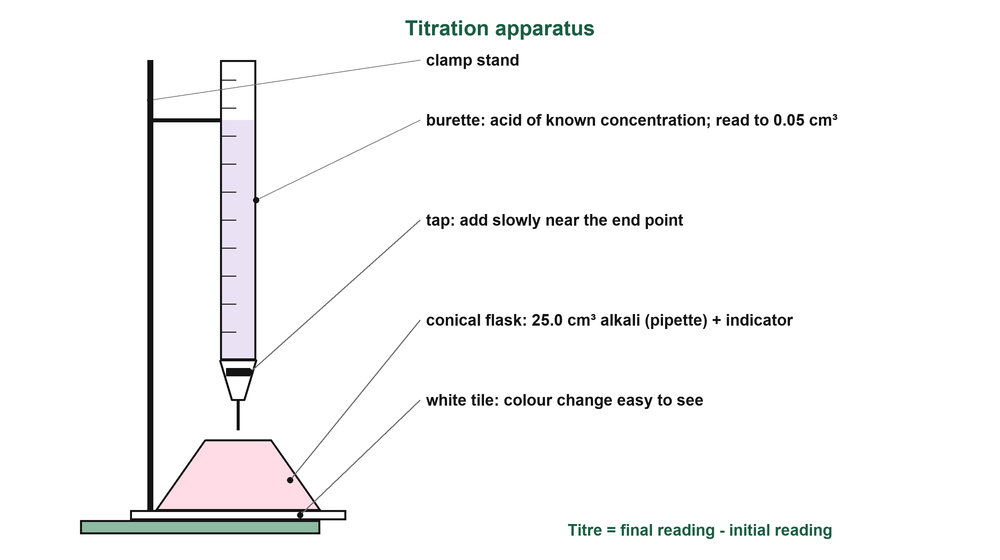
Carrying out a titration
- Rinse the burette with the acid and the pipette with the alkali (not with water).
- Pipette 25.0 cm³ of alkali into a conical flask; add 2-3 drops of indicator.
- Run acid from the burette while swirling, drop by drop near the end point (colour just changes).
- Record the initial and final burette readings to 0.05 cm³; titre = final - initial.
- Repeat until titres agree within 0.1 cm³ and average them.
Finding the concentration of sodium hydroxide
NaOH + HCl -> NaCl + H2O (ratio 1 : 1). 25.0 cm³ of NaOH needed 20.0 cm³ of 0.1 M HCl.
Moles of HCl: 0.1 × 20 ÷ 1000 = 0.002, so moles of NaOH: 0.002.
Concentration of NaOH: 0.002 × 1000 ÷ 25 = 0.08 M.
A 1 : 2 ratio
H2SO4 + 2NaOH -> Na2SO4 + 2H2O. 25.0 cm³ of 0.1 M NaOH needed 12.5 cm³ of H2SO4.
Moles NaOH: 0.1 × 25 ÷ 1000 = 0.0025; moles H2SO4: 0.0025 ÷ 2 = 0.00125.
Concentration of H2SO4: 0.00125 × 1000 ÷ 12.5 = 0.1 M.
Redox titrations, mole ratios and their applications
Oxidation and reduction
Oxidation is loss of electrons (or gain of oxygen); reduction is gain of electrons (or loss of oxygen). A redox reaction has both.
Acidified potassium manganate(VII), purple MnO4-, oxidises iron(II) and is itself reduced to almost colourless Mn2+: MnO4- + 5Fe2+ + 8H+ -> Mn2+ + 5Fe3+ + 4H2O. It is self-indicating: the end point is the first permanent pale pink colour.
Redox titration
25.0 cm³ of Fe2+ solution needed 20.0 cm³ of 0.02 M KMnO4.
Moles MnO4-: 0.02 × 20 ÷ 1000 = 0.0004; moles Fe2+: 0.0004 × 5 = 0.002.
Concentration of Fe2+: 0.002 × 1000 ÷ 25 = 0.08 M, which is 0.08 × 56 = 4.48 g/dm³ of iron.
Reacting masses and gas volumes
CaCO3 -> CaO + CO2. From 50 g of CaCO3: 50 ÷ 100 = 0.5 mol, giving 0.5 × 56 = 28 g of CaO.
and 0.5 × 24 = 12 dm³ of CO2 at r.t.p.
Mg + 2HCl -> MgCl2 + H2. From 0.12 g of Mg: 0.12 ÷ 24 = 0.005 mol of H2, which is 0.005 × 24000 = 120 cm³.
| Industry | Use of redox titrations |
|---|---|
| Pharmaceuticals | Checking iron in iron tablets and vitamin C in tablets and juices |
| Mining | Finding the iron content of ores |
| Water treatment | Measuring dissolved oxygen and chemical oxygen demand (pollution) |
| Bleach manufacture | Checking chlorine content (iodine and sodium thiosulphate) |
| Food and drinks | Measuring sulphur dioxide preservative |
Waste and safety
Neutralised solutions can be diluted and washed away; collect excess reagents and coloured manganate waste in labelled containers for the teacher. KMnO4 stains skin, so wear gloves and goggles.
Key points to remember
- One mole contains 6.0 × 10^23 particles; its mass in grams equals the relative formula mass.
- Moles = mass ÷ molar mass; particles = moles × 6.0 × 10^23; one mole of gas occupies 24 dm³ at r.t.p.
- Empirical formulae come from mass or percentage data; the molecular formula is a whole-number multiple found using Mr.
- Standard solutions are made accurately in volumetric flasks; moles = molarity × cm³ ÷ 1000; dilution keeps moles constant.
- Titrations use the balanced equation's mole ratio to find unknown concentrations.
- In redox titrations MnO4- reacts with Fe2+ in a 1 : 5 ratio and is self-indicating; such titrations are used for quality control in industry.
Practice questions
Calculate the number of moles in 11.7 g of sodium chloride (Na 23, Cl 35.5). (2 marks)
Show the answer
Mr = 23 + 35.5 = 58.5; moles = 11.7 ÷ 58.5 = 0.2 mol.
How many molecules are present in 64 g of oxygen gas (O 16, L = 6.0 × 10^23)? (2 marks)
Show the answer
Mr of O2 is 32; 64 ÷ 32 = 2 mol; 2 × 6.0 × 10^23 gives 1.2 × 10^24 molecules.
A hydrocarbon contains 80% carbon and has a relative molecular mass of 30. Find (a) its empirical formula (b) its molecular formula. (4 marks)
Show the answer
- (a) C: 80 ÷ 12 = 6.67; H: 20 ÷ 1 = 20; ratio 1 : 3, so CH3.
- (b) CH3 has mass 15; 30 ÷ 15 = 2, so C2H6.
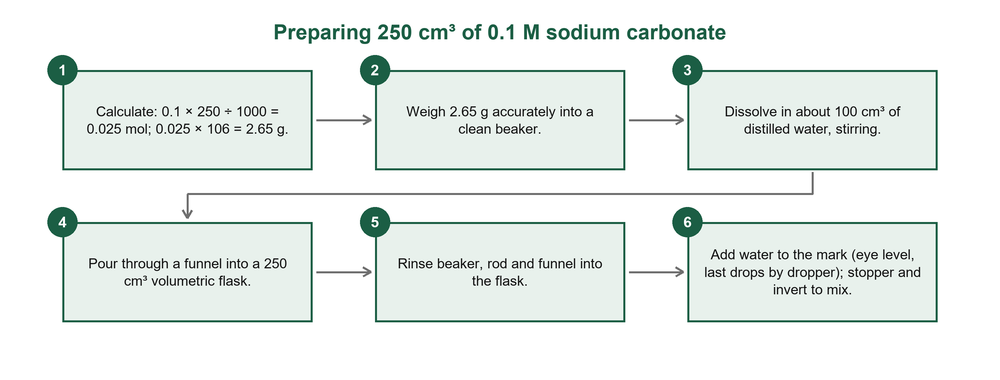
Describe how you would prepare 250 cm³ of 0.1 M sodium carbonate solution (Na2CO3, Mr 106). (4 marks)
Show the answer
- Calculate the mass: 0.1 × 250 ÷ 1000 = 0.025 mol; 0.025 × 106 = 2.65 g.
- Weigh 2.65 g and dissolve in about 100 cm³ of distilled water in a beaker.
- Transfer to a 250 cm³ volumetric flask, rinsing the beaker and funnel into it.
- Make up to the mark with distilled water and invert to mix.
20.0 cm³ of 0.1 M sulphuric acid neutralised 25.0 cm³ of sodium hydroxide solution. Calculate the concentration of the sodium hydroxide. (3 marks)
Show the answer
- Moles H2SO4: 0.1 × 20 ÷ 1000 = 0.002.
- Ratio 1 : 2, so moles NaOH: 0.004.
- Concentration: 0.004 × 1000 ÷ 25 = 0.16 M.
Why is no indicator needed in titrations with acidified potassium manganate(VII)? (2 marks)
Show the answer
It is self-indicating: purple MnO4- is decolourised as it reacts, and the first excess drop gives a permanent pale pink colour at the end point.
What volume of carbon dioxide at r.t.p. is produced when 10 g of calcium carbonate is heated strongly? (Ca 40, C 12, O 16; molar gas volume 24 dm³) (3 marks)
Show the answer
- CaCO3 -> CaO + CO2; Mr of CaCO3 is 100.
- Moles: 10 ÷ 100 = 0.1 mol of CO2.
- Volume: 0.1 × 24 = 2.4 dm³.
Give two industrial applications of redox titrations. (2 marks)
Show the answer
Any two: checking iron or vitamin C in tablets; finding iron in ores; measuring dissolved oxygen or chemical oxygen demand in water; checking chlorine in bleach.
This is one topic. Get the whole year. The full Grade 11 Chemistry notes cover every sub-strand of Terms 1, 2 and 3 like this one, with pictures, key points and practice questions with answers, as a printable PDF for KSh 150. Pay with M-Pesa and download at once.
Get the full Grade 11 Chemistry notes · All Grade 11 Chemistry resources · Notes for every grade


