Based on the Competency-Based Curriculum (CBC) Guidelines
Unit 1: Living Things
1. Classification of Plants
Classification is the act or process of dividing plants into groups based on specific shared features.
Categories of Plants
- Flowering Plants: Plants that produce flowers (e.g., maize, pawpaw, beans).
- Non-Flowering Plants: Plants that do not produce flowers (e.g., mosses, ferns, algae).
Safety Precautions When Handling Harmful Plants
- Wear protective clothing (gloves, long sleeves).
- Wash hands thoroughly with soap and water after handling plants.
- Do not eat, taste, or smell unfamiliar or poisonous plants.
Importance of Flowering Plants
- Provide food and nutrients.
- Offer shelter and shade.
- Source of natural medicine.
- Enhance environmental beauty.
2. Fungi
Fungi are unique organisms that belong to neither the plant nor animal kingdoms. They obtain nutrients by growing on dead and decaying organic matter in soil, water, or rotting food.
- Examples: Bread mould (black or green patches on bread), yeast, mushrooms.
AspectDetailsSafety PrecautionsWear gloves, wash hands after handling, avoid tasting wild fungi.Human UsesFood (mushrooms), baking (yeast for rising dough), medicine, fermentation.Economic ValueMushroom farming for domestic sale and export, biological pest control.
3. Animals: Vertebrates
Animals are broadly divided into vertebrates (possessing a backbone/vertebral column) and invertebrates (lacking a backbone). The vertebral column extends from the skull to the lower limbs, supporting the rib cage and body frame.
                    ┌─────────────────────────┐
                    │       Vertebrates       │
                    └────────────┬────────────┘
                                 │
     ┌─────────────────┬─────────┴───────┬─────────────────┬──────────────┐
     │                 │                 │                 │              │
┌────┴─────┐      ┌────┴─────┐      ┌────┴─────┐      ┌────┴─────┐   ┌────┴──────┐
│ Mammals  │      │  Birds   │      │   Fish   │      │ Reptiles │   │Amphibians │
└──────────┘      └──────────┘      └──────────┘      └──────────┘   └───────────┘
Warm-Blooded vs. Cold-Blooded Vertebrates
- Warm-Blooded (Endothermic): Body temperature remains constant regardless of the environment.
- Mammals: Have memory (mammary) glands, fur/hair, produce live young (except egg-laying monotremes like the duck-billed platypus and spiny anteater).
- Birds: Covered in feathers, possess wings and beaked mouths, lay eggs (e.g., eagles, ostriches).
- Cold-Blooded (Ectothermic): Body temperature changes according to external surroundings.
- Fish: Live in water, possess scales and fins, breathe through gills.
- Reptiles: Dry scaly skin, breathe through lungs, mostly lay eggs on land (e.g., snakes, lizards).
- Amphibians: Moist skin, live partly in water and on land; breathe via gills when young (tadpoles) and lungs/skin when mature (e.g., frogs, toads).
Unit 2: Human Body Systems
1. Sense Organs
Sense organs gather information from the environment and send signals to the brain.
- Tongue: Taste (sweet, sour, salty, bitter, umami).
- Ears: Hearing and balance.
- Nose: Smell and air filtering.
- Skin: Touch, feeling, temperature, and pressure.
Maintenance & Hygiene
- Bath daily with clean water and soap.
- Keep skin hydrated with appropriate oils.
- Clean teeth and tongue regularly.
- Use a clean handkerchief for the nose; use cotton buds gently for outer ear care.
- Avoid inserting sharp objects into nostrils or ear canals.
2. Skeleton and Muscles
The human skeleton is a rigid framework of bones, cartilage, and connective tissues that provides structure, support, and protection.
Major Skeleton Parts & Functions
- Skull: Encloses and protects the brain from physical injury.
- Backbone (Spine): Consists of 33 vertebrae stretching from the neck to the pelvis. Protects the spinal cord and allows bending, twisting, and upright stance.
- Rib Cage: Composed of 12 pairs of curved rib bones in the chest; protects the heart and lungs.
- Limbs (Bones of Arms and Legs):
- Upper Limb (Arm): Humerus (upper arm), Radius and Ulna (forearm).
- Lower Limb (Leg): Femur (thigh bone - connects to hip socket), Tibia and Fibula (lower leg), Tarsals, Metatarsals, and Phalanges.
Types of Muscles
Muscles contract and relax to create movement, maintain posture, and generate power.
- Cardiac Muscle: Involuntary muscle forming the walls of the heart; controls rhythmic heartbeats.
- Skeletal Muscle: Voluntary muscle attached to bones via tendons; enables conscious movement, posture, and body temperature regulation.
- Smooth Muscle: Involuntary muscle found in blood vessels, stomach, intestines, and urinary bladder.
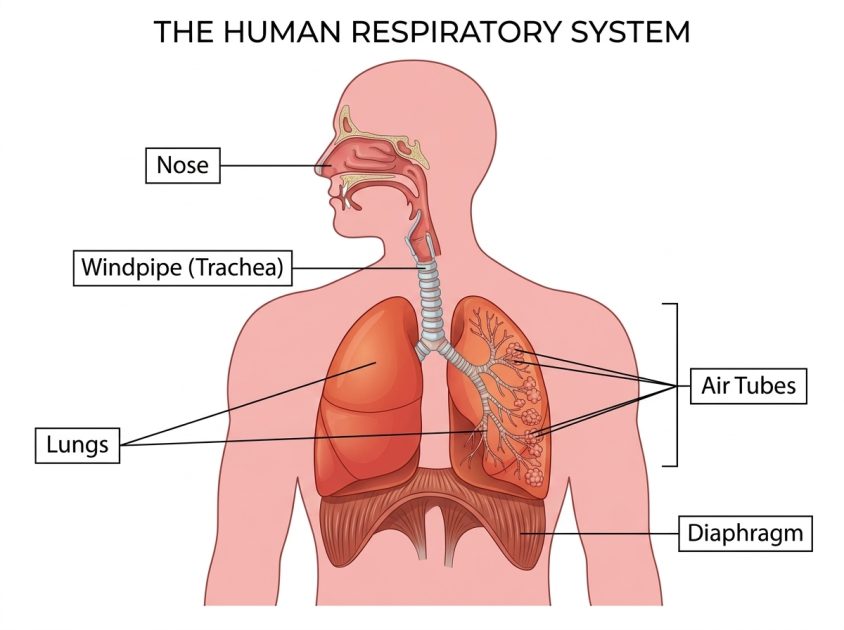
3. Breathing System
Organs of the Breathing System
- Nose & Nostrils: Air enters here. Tiny hairs trap dust while mucus-producing membranes warm, moisten, and clean the incoming air.
- Trachea (Windpipe): Air passage reinforced with C-shaped cartilaginous rings to keep it open. Lined with cilia and mucus to trap remaining particles.
- Lungs: Pair of spongy organs in the chest that facilitate gas exchange—absorbing oxygen into the bloodstream and expelling carbon dioxide.
- Diaphragm: Dome-shaped muscle under the lungs separating the chest from the abdomen. Contracts to pull air into the lungs and relaxes to push air out.
Common Respiratory Diseases
DiseaseCausePrimary SymptomsKey PreventionTuberculosis (TB)BacteriaPersistent cough (>3 weeks), coughing blood, night sweats, weight lossBCG vaccination, well-ventilated rooms, completing full antibiotic coursePneumoniaBacteria / Viruses / FungiChest pain, fever, chills, shortness of breath, mucus coughVaccination, strong immune health, proper hygieneCommon ColdVirusStuffy/running nose, sneezing, mild fever, sore throatFrequent handwashing, covering mouth, avoiding shared utensilsAsthmaTriggers (pollen, dust, smoke)Wheezing, whistling sound when breathing, chest tightnessAvoiding known triggers, prescribed inhalersInfluenza (Flu)VirusHigh fever, muscle aches, fatigue, persistent dry coughAnnual flu vaccine, hygiene, avoiding crowded placesCOVID-19CoronavirusFever, dry cough, loss of taste/smell, tirednessHandwashing/sanitizing, masks, social distancing (2m)
Unit 3: Health Education
1. Waterborne Diseases
Waterborne diseases are caused by pathogenic microorganisms transmitted through contaminated water or food.
- Typhoid: Bacterial infection causing high fever, headache, body weakness, abdominal rash, and vomiting.
- Prevention: Drink boiled/treated water, wash hands and food, control flies.
- Bilharzia (Schistosomiasis): Parasitic worm infection contracted via skin contact with freshwater containing infected snails.
- Prevention: Avoid wading in stagnant water, wear boots/gloves in waterlogged areas, drink clean water.
- Cholera: Severe bacterial infection causing sudden watery diarrhoea, rapid dehydration, and vomiting.
- Prevention: Proper sanitation, boiling drinking water, washing hands before eating.
- Dysentery: Bacterial or amoebic infection causing severe abdominal cramps, fever, and bloody diarrhoea.
- Prevention: Maintain food hygiene, boil water, wash hands thoroughly.
2. Body Parasites
External Parasites
Parasites living on the outer skin or hair of the host.
- Lice: Small insects inhabiting clothing, bedding, or hair, feeding on blood. Cause intense itching and red scalp/skin bumps.
- Management: Regular bathing, washing linens in hot water, combing out eggs (nits), avoiding shared combs, shaving head if severe.
- Scabies: Microscopic mites burrowing into the skin, causing severe itching (worse at night) and red rashes/blisters.
- Management: Medicated skin creams, washing all garments and bedding in hot water.
- Jiggers: Pinhead-sized sand fleas whose larvae burrow into feet and toes. Cause severe pain, swelling, ulcers, and deformed nails.
- Management: Wearing shoes, smearing mud floors with cow dung, maintaining floor hygiene, treating infected areas with antiseptics and petroleum jelly.
Internal Parasites
Parasites living inside the human digestive tract.
┌────────────────────────────────────────────────────────────────────────┐
│                        Common Internal Parasites                        │
├──────────────┬───────────────────────────────┬─────────────────────────┤
│ Parasite     │ Transmission Method           │ Major Symptoms          │
├──────────────┼───────────────────────────────┼─────────────────────────┤
│ Roundworms   │ Ingesting soil-contaminated   │ Abdominal pain, slow    │
│              │ food or water                 │ growth, visible worms   │
├──────────────┼───────────────────────────────┼─────────────────────────┤
│ Pinworms     │ Ingesting eggs via dirty      │ Anal itching at night,  │
│              │ fingers, bedding, or toys     │ disturbed sleep         │
├──────────────┼───────────────────────────────┼─────────────────────────┤
│ Tapeworms    │ Eating raw or undercooked     │ Segmented stool, weight │
│              │ meat containing larvae        │ loss, dizziness         │
├──────────────┼───────────────────────────────┼─────────────────────────┤
│ Hookworms    │ Larvae penetrating bare skin  │ Anaemia, itchy skin     │
│              │ from contaminated soil        │ rash, stunted growth    │
└──────────────┴───────────────────────────────┴─────────────────────────┘
Unit 4: Environment & Computing
1. Solid Waste Management
Solid waste refers to discarded household, commercial, and industrial rubbish. Management involves collection, processing, and converting waste into reusable resources.
Waste Classification
- Decomposable (Biodegradable): Waste that rots and breaks down into soil nutrients (e.g., food scraps, vegetable peels).
- Non-Decomposable (Non-biodegradable): Synthetic waste that does not break down over time (e.g., plastic bottles, glass, metal cans).
The 3 Rs Strategy
- Reduce: Minimizing waste creation at the source.
- Use reusable shopping baskets instead of plastic bags.
- Buy durable, repairable items and choose products with minimal packaging.
- Reuse: Finding new uses for items without processing them.
- Refilling glass bottles, repurposing cardboard boxes, donating old clothes.
- Recycle: Processing waste materials to create raw stock for new products.
- Composting organic waste into fertilizer; reprocessing plastics, metals, and paper.