Grade 5 Science and Technology · Strand 2.0 Matter · Sub-strand 2.1 Mixtures
These are free study notes for Grade 5 learners. They follow the official KICD curriculum design for Grade 5 Science and Technology (the same topics, in the same order, that your teacher uses) and are taken from our full Grade 5 Science and Technology notes. Exams love "which method would you use to separate ...?" The table of methods and the trick box answer every version of that question.
A cup of tea, a plate of githeri and a bucket of muddy water are all mixtures. In this topic we learn what a mixture is, sort mixtures into homogeneous and heterogeneous, look at examples of solid-solid, solid-liquid and liquid-liquid mixtures, and practise the methods we use to separate heterogeneous mixtures at home, on the farm and at school.
What a mixture is
Mixture
Two or more substances put together without joining into a new substance. Each substance keeps its own features and the mixture can be separated.
- At home: tea with sugar, salt in cooking water, maize and beans for githeri, rice with small stones.
- At school: chalk dust in water, sand and sawdust, soil (sand, clay, humus, water and air).
- Air itself is a mixture of gases.
Homogeneous and heterogeneous mixtures
| Type | What it looks like | Examples |
|---|---|---|
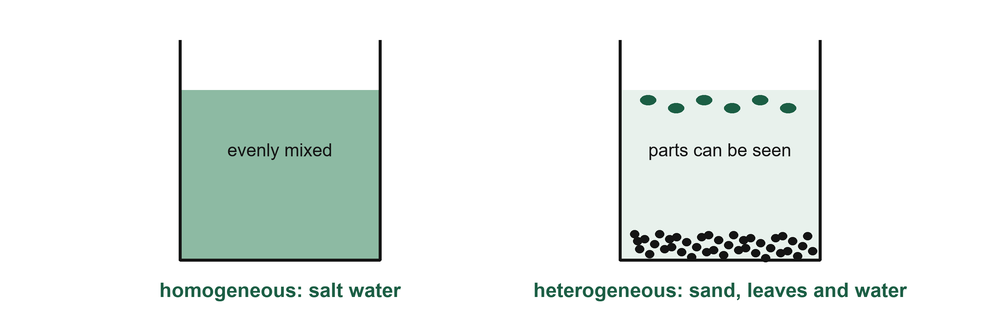
| Homogeneous (uniform) | looks the same all through; the parts cannot be seen separately | salt in water, sugar in tea, juice concentrate in water |
| Heterogeneous (non-uniform) | the different parts can be seen; some may settle or float | sand and water, maize and beans, oil and water, sand and iron filings |
Activity: which type?
- Put a spoon of salt in a glass of water and stir. The salt disappears and the water looks the same all through: homogeneous.
- Put a spoon of sand in another glass of water and stir. The sand can be seen and settles at the bottom: heterogeneous.
- Do the same with cooking oil. The oil floats as a separate layer: heterogeneous.
Kinds of mixtures by state
| Kind | Examples |
|---|---|
| Solid-solid | maize and beans; rice and stones; sand and iron filings; flour and bran |
| Solid-liquid | sand and water; salt and water; tea leaves and tea; chalk dust and water |
| Liquid-liquid | oil and water (do not mix); kerosene and water (do not mix); juice concentrate and water (mix evenly) |
Separating heterogeneous mixtures (1)
| Method | How it works | Example |
|---|---|---|
| Picking | the unwanted pieces are picked out by hand | stones from beans or rice |
| Sieving | small particles fall through the holes of a sieve; big ones stay on top | flour from bran; sand from gravel |
| Winnowing | the mixture is tossed in the wind; light chaff blows away and heavy grain falls back | chaff from maize, beans or green grams |
| Using a magnet | a magnet pulls out iron pieces and leaves the rest | iron filings from sand; pins from sawdust |
Separating heterogeneous mixtures (2)
| Method | How it works | Example |
|---|---|---|
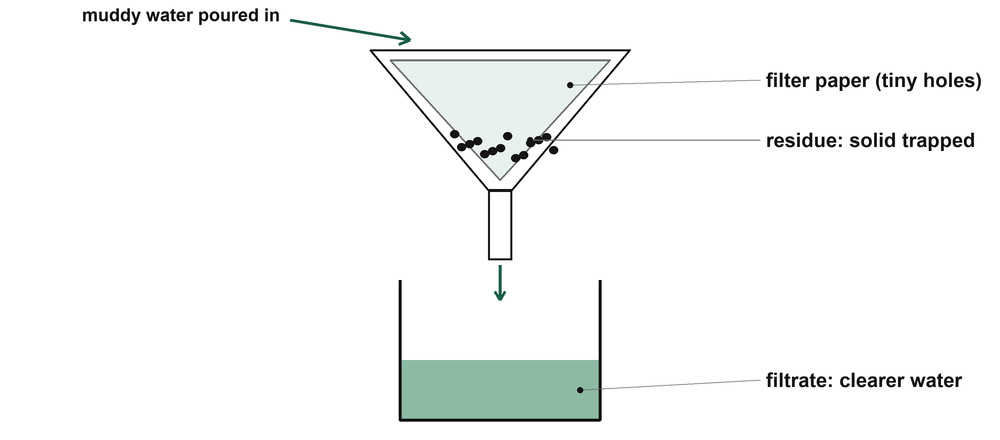
| Filtering | the liquid passes through tiny holes in filter paper or cloth; the solid (residue) is trapped | sand or soil from water; tea leaves from tea |
| Decanting | the solid is left to settle, then the clear liquid is poured off gently | water from mud or sand at the bottom of a pot |
| Separating funnel | two liquids that do not mix form layers; the bottom layer is run out through the tap | oil and water; kerosene and water |
Residue and filtrate
The residue is the solid left on the filter. The filtrate is the liquid that passes through.
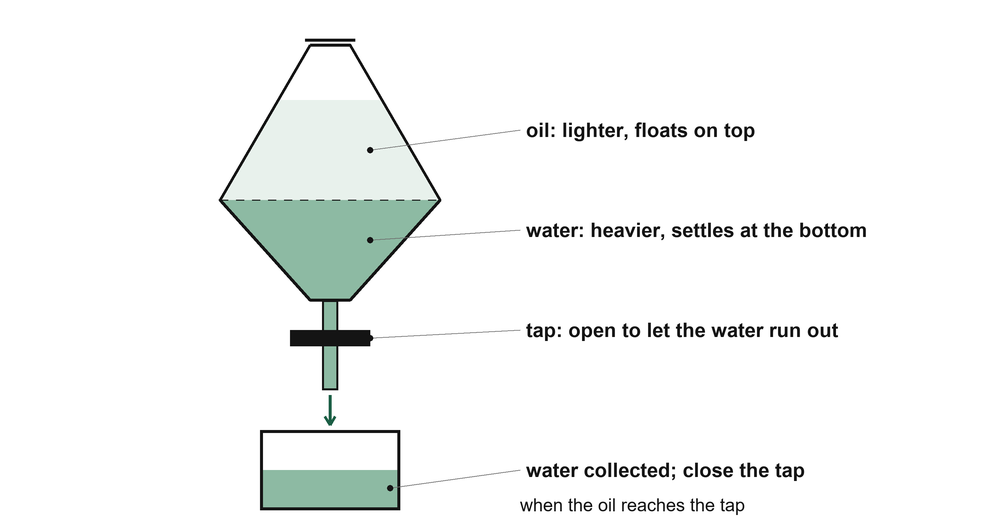
Salt water does not filter
Salt water is homogeneous: the salt passes through filter paper with the water. These methods are for heterogeneous mixtures.
Practical: separating a mixture step by step
Sand, iron filings, beans and water
- Pick out the beans by hand.
- Run a magnet (wrapped in paper) over the wet mixture to pull out the iron filings.
- Leave the sand to settle, then decant the water.
- Filter the water to remove the last fine sand.
- Wash hands afterwards and share the work so every group member has a turn.
Separating mixtures in day-to-day life
- Farmers winnow maize, beans and green grams after threshing.
- Millers and cooks sieve flour; builders sieve sand to remove stones.
- Cooks pick stones out of rice and beans before cooking.
- We strain (filter) tea leaves from tea; farmers strain milk and honey to remove dirt.
- We decant clear water from a pot after the mud settles, then filter and boil it.
- Scrap metal dealers use magnets to pick out iron.
- Garages separate oil from water before it is thrown away.
Tricks and more examples
Trick: match the method to the difference
Different SIZE: sieve or pick. Different WEIGHT: winnow or decant. MAGNETIC: magnet. SOLID in LIQUID: filter or decant. Two LIQUIDS that do not mix: separating funnel.
Trick: homo = same
HOMOgeneous: the same all through. HETERogeneous: different parts you can see.
Exam trap
Winnowing needs wind or blowing; it separates by weight, not size. A magnet only pulls iron and steel, not aluminium cans or copper.
Exam-style: choose the method
Which method would you use to separate chaff from green grams? Winnowing.
Iron nails mixed with sawdust? A magnet.
Cooking oil floating on water? A separating funnel (or pour the oil off carefully).
Key points to remember
- A mixture is two or more substances put together that can be separated.
- Homogeneous mixtures look the same all through (salt water); heterogeneous mixtures have parts you can see (sand and water).
- Mixtures can be solid-solid, solid-liquid or liquid-liquid.
- Heterogeneous mixtures are separated by picking, sieving, winnowing, a magnet, filtering, decanting and a separating funnel.
- We use these methods every day: winnowing grain, sieving flour, straining tea, milk and honey.
Test yourself: multiple choice
Which of these is a homogeneous mixture?
Show the answer
D: Dissolved sugar cannot be seen; the tea looks the same all through.
Which method is BEST for separating chaff from beans?
Show the answer
B: Light chaff is blown away by the wind; the heavier beans fall back.
Iron filings mixed with sand can be separated by
Show the answer
C: A magnet pulls the iron filings and leaves the sand.
In filtering, the solid left on the filter paper is called the
Show the answer
A: The residue stays on the filter; the filtrate passes through.
Which mixture is a liquid-liquid mixture?
Show the answer
D: Both kerosene and water are liquids.
A farmer pours milk through a clean cloth to remove dirt. This is
Show the answer
C: Straining through cloth is filtering: the dirt is trapped.
Practice questions
What is a mixture? Give two examples found at home. (3 marks)
Show the answer
- Two or more substances put together that can be separated.
- Any two: tea with sugar, salt water, maize and beans, rice and stones.
Give one difference between a homogeneous and a heterogeneous mixture, with an example of each. (3 marks)
Show the answer
- Homogeneous looks the same all through (salt water).
- Heterogeneous has parts that can be seen (sand and water).
Name the method used to separate each mixture: (a) stones from rice (b) flour from bran (c) sand from water (d) oil from water. (4 marks)
Show the answer
(a) picking (b) sieving (c) filtering or decanting (d) separating funnel.
Describe how to separate muddy water by decanting. (2 marks)
Show the answer
Leave the muddy water to stand until the mud settles at the bottom, then gently pour off the clear water into another container.
Give two ways in which separating mixtures is used in day-to-day life. (2 marks)
Show the answer
Any two: winnowing grain; sieving flour; picking stones from beans; straining tea, milk or honey; decanting water.
This is one topic. Get the whole year. The full Grade 5 Science and Technology notes cover every sub-strand of Terms 1, 2 and 3 like this one, with pictures, key points and practice questions with answers, as a printable PDF for KSh 150. Pay with M-Pesa and download at once.
Get the full Grade 5 Science and Technology notes · All Grade 5 Science and Technology resources · Notes for every grade