
Grade 8 English · Theme 14 Sports · Sub-strand 14.3.1 Active and Passive Voice
These are free study notes for Grade 8 learners, written to the KICD curriculum design and taken from our full Grade 8 English notes. Rewriting sentences from active to passive is a classic exam question. The key is keeping the same tense: check the tense first, then change the verb.
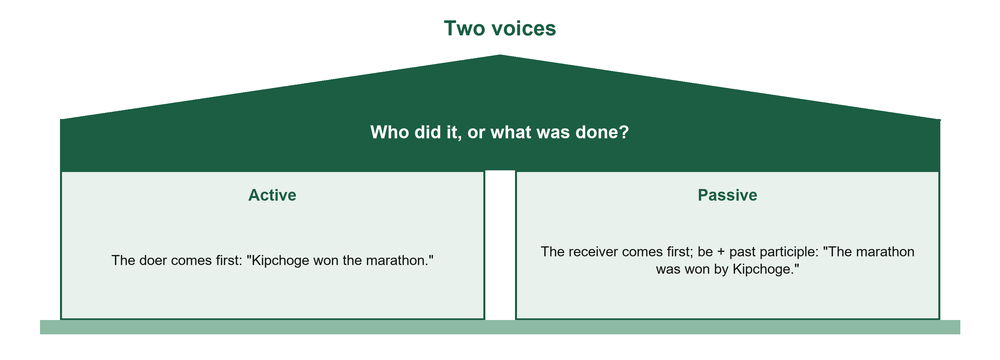
A sentence can focus on who did something or on what was done. "Kipchoge won the marathon" focuses on the runner; "The marathon was won by Kipchoge" focuses on the race. In this topic we identify active and passive sentences and change one into the other.
Active and passive voice
| Active | Passive |
|---|---|
| Kipchoge won the marathon. | The marathon was won by Kipchoge. |
| The coach trains the athletes. | The athletes are trained by the coach. |
When to use the passive
The passive is useful when the doer is unknown or unimportant: "The stadium was built in 1987." It is common in reports and news.
Prefer active
Most of the time the active voice is clearer and more direct.
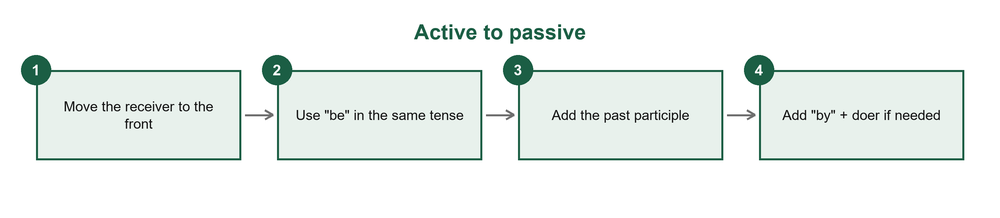
Transforming sentences
| Active | Passive |
|---|---|
| Kip Keino won gold in 1968. | Gold was won by Kip Keino in 1968. |
| The referee is checking the line. | The line is being checked by the referee. |
| Rudisha set a world record in London. | A world record was set by Rudisha in London. |
Passive to active
Reverse the steps: put the doer first, use the main verb in the right tense and put the receiver after it. "The ball was kicked by Wanjiku" becomes "Wanjiku kicked the ball."
Key points to remember
- Active: the doer comes first.
- Passive: the receiver comes first; be + past participle; "by" + doer.
- Keep the same tense when changing voice.
- Use the passive when the doer is unknown or unimportant.
- The active voice is usually clearer.
Test yourself: multiple choice
Which sentence is in the passive voice?
Show the answer
B: The receiver comes first with be + past participle.
Change to passive: "The coach trains the athletes."
Show the answer
A: Present tense: are trained.
The passive of "The referee is checking the line" is
Show the answer
D: Present continuous: is being checked.
When is the passive most useful?
Show the answer
C: "The stadium was built in 1987."
Change to active: "The ball was kicked by Wanjiku."
Show the answer
A: Doer first, same tense.
Practice questions
Change to the passive: (a) Kip Keino won gold in 1968. (b) The fans painted the banner. (2 marks)
Show the answer
(a) Gold was won by Kip Keino in 1968. (b) The banner was painted by the fans.
Change to the active: (a) The trophy was lifted by the captain. (b) The match is being watched by millions. (2 marks)
Show the answer
(a) The captain lifted the trophy. (b) Millions are watching the match.
State the four steps for changing active to passive. (4 marks)
Show the answer
Move the receiver to the front; use the right form of "be" in the same tense; add the past participle; add "by" + doer if needed.
Write one sentence in the passive where the doer is not needed. (1 mark)
Show the answer
Example: "The new track was opened last year."
This is one topic. Get the whole year. The full Grade 8 English notes cover every sub-strand of Terms 1, 2 and 3 like this one, with pictures, key points and practice questions with answers, as a printable PDF for KSh 150. Pay with M-Pesa and download at once.
Get the full Grade 8 English notes · All Grade 8 English resources · Notes for every grade


