Grade 8 Integrated Science · Strand 3.0 Force and Energy · Sub-strand 3.2 Pressure
These are free study notes for Grade 8 learners. They follow the official KICD curriculum design for Grade 8 Integrated Science (the same topics, in the same order, that your teacher uses) and are taken from our full Grade 8 Integrated Science notes. Why does a camel not sink in sand while a stiletto heel marks the floor? Keep that question in mind: the whole topic answers it.
Why does a sharp knife cut better than a blunt one, and why is a dam wall thicker at the bottom? The answer is pressure. In this topic we demonstrate pressure in solids and liquids, calculate it and identify its many applications.
Pressure
Pressure
The force acting at right angles on a unit area of a surface. Pressure = force ÷ area. Unit: newtons per square metre (N/m^2), called the pascal (Pa).
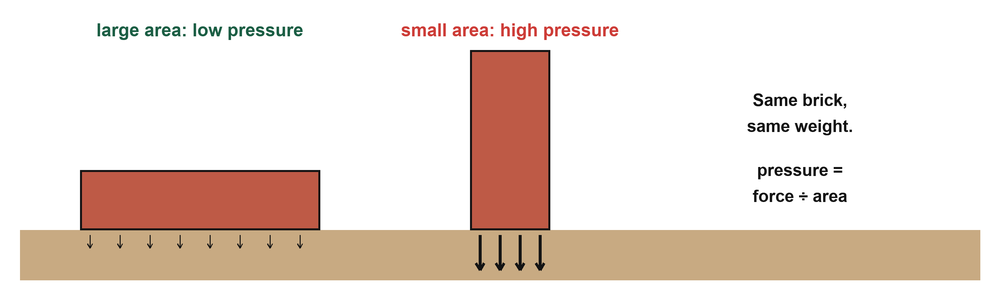
A brick pressed into smooth sand on its smallest face makes the deepest dent: the weight is the same, but a smaller area gives a greater pressure. For the same area, a greater force gives a greater pressure.
Calculating pressure
A brick of weight 20 N
Largest face 0.02 m^2: 20 ÷ 0.02 = 1,000 Pa.
Middle face 0.01 m^2: 20 ÷ 0.01 = 2,000 Pa.
Smallest face 0.005 m^2: 20 ÷ 0.005 = 4,000 Pa.
People and objects
A box of 600 N on 2 m^2: 600 ÷ 2 = 300 Pa.
A learner of 500 N on two feet (0.05 m^2): 500 ÷ 0.05 = 10,000 Pa; on one foot (0.025 m^2): 20,000 Pa.
A 500 N woman on one high heel of 0.0001 m^2: 500 ÷ 0.0001 = 5,000,000 Pa, far more than an elephant's foot.
Rearranging
Force = pressure × area; area = force ÷ pressure.
Applications in solids
Using pressure in solids
High pressure (small area)
- Knives, pangas, axes: thin edges cut easily
- Needles, nails, drawing pins: sharp points pierce
- Football studs and running spikes grip the ground
Low pressure (large area)
- Wide tractor tyres and caterpillar tracks do not sink
- Wide foundations stop buildings sinking
- Wide bag straps; broad feet of camels and ostriches
Pressure in liquids
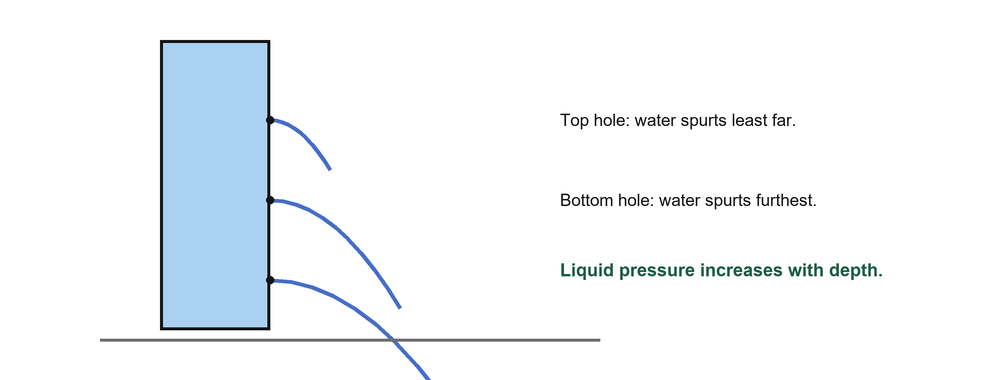
- Water spurts furthest from the lowest hole of a bottle: pressure increases with depth.
- Water squirts out in all directions from a pricked bag: liquid pressure acts in all directions.
- Dam walls are thicker at the base, where pressure is greatest.
- Raised tanks give taps below higher water pressure.
- Divers and submarines need strong suits and hulls at great depths.
Applications of pressure in liquids and air
| Device | How it uses pressure |
|---|---|
| Syringe | Pulling the plunger lowers pressure inside; outside air pressure pushes liquid in |
| Drinking straw | Sucking lowers pressure in the straw; air pressure on the drink pushes it up |
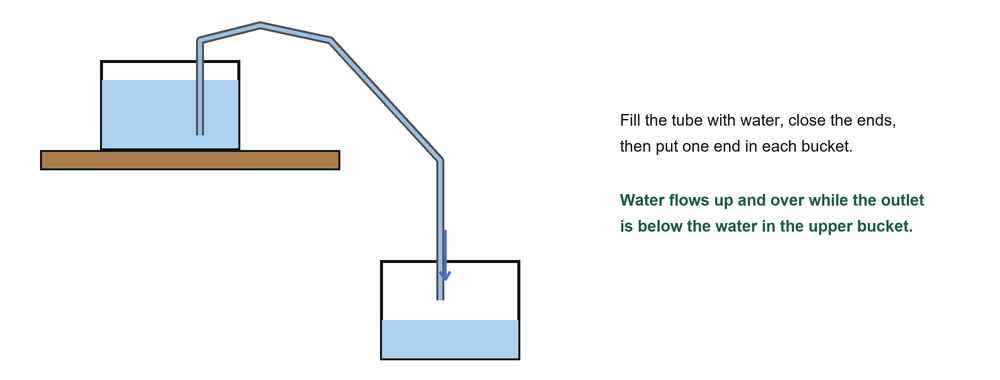
| Siphon | Water flows over the rim to a lower outlet while the tube is full |
| Hydraulic car brakes | Pressure on the pedal passes through brake fluid to the wheels |
| Bicycle pump | Pushing raises air pressure; a valve lets air into the tyre only |
Key points to remember
- Pressure = force ÷ area; unit: pascal (Pa).
- Small area, high pressure (knives, needles); large area, low pressure (wide tyres, foundations).
- Liquid pressure increases with depth and acts in all directions.
- Liquids pass pressure on (hydraulic brakes).
- Applications: dams, tanks, syringes, straws, siphons, pumps.
Test yourself: multiple choice
A force of 40 N acts on an area of 0.5 m^2. The pressure is
Show the answer
B: 40 ÷ 0.5 = 80 Pa.
Why is a dam wall thicker at the bottom?
Show the answer
A: Pressure increases with depth.
Tractors have wide tyres to
Show the answer
D: A large area lowers pressure.
The unit of pressure is the
Show the answer
C: 1 Pa = 1 N/m^2.
A drinking straw works because
Show the answer
A: Atmospheric pressure does the pushing.
Practice questions
A box of weight 900 N rests on an area of 3 m^2. Calculate the pressure. (2 marks)
Show the answer
900 ÷ 3 = 300 Pa.
A pressure of 2,000 Pa acts on 0.25 m^2. Find the force. (2 marks)
Show the answer
Force = 2,000 × 0.25 = 500 N.
Explain why a sharp knife cuts better than a blunt one. (2 marks)
Show the answer
A sharp edge has a smaller area, so the same force gives a greater pressure.
Describe an experiment to show that liquid pressure increases with depth. (4 marks)
Show the answer
Make three equal holes one above another in a bottle, tape them, fill with water, remove the tape: water from the lowest hole spurts furthest.
This is one topic. Get the whole year. The full Grade 8 Integrated Science notes cover every sub-strand of Terms 1, 2 and 3 like this one, with pictures, key points and practice questions with answers, as a printable PDF for KSh 150. Pay with M-Pesa and download at once.
Get the full Grade 8 Integrated Science notes · All Grade 8 Integrated Science resources · Notes for every grade