
Grade 8 Integrated Science · Strand 2.0 Living Things and Their Environment · Sub-strand 2.1 The Cell
These are free study notes for Grade 8 learners, written to the KICD curriculum design and taken from our full Grade 8 Integrated Science notes. Expect to label a plant or animal cell, compare the two in a table, and calculate magnification. All three are covered below.
Every living thing is made of cells, the smallest units that can carry out life processes. Most are too small to see without a microscope. In this topic we use the light microscope, prepare and observe plant and animal cells, describe their parts and functions, compare them and calculate magnification.
Cells and the light microscope
Cell
The smallest unit of a living thing that can carry out the processes of life. Unicellular organisms (amoeba) have one cell; multicellular organisms (people, plants) have millions.
Using a microscope
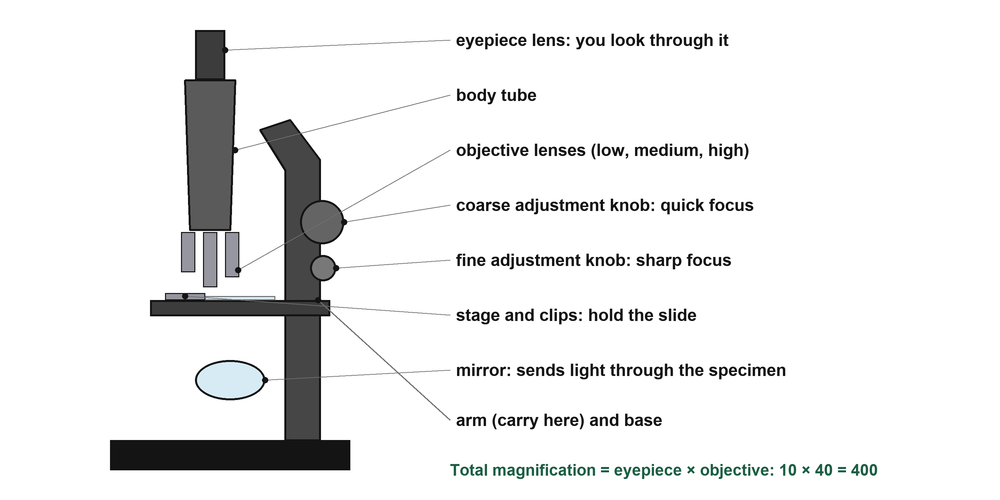
- Carry it with one hand on the arm and the other under the base.
- Start with the low-power objective; adjust the mirror for bright light; clip the slide.
- Looking from the side, lower the objective close to the slide with the coarse knob.
- Look through the eyepiece and raise it slowly until the image is clear; use the fine knob at high power.
Care
Clean lenses only with lens tissue; never point the mirror at direct sunlight (it can damage the eyes); cover and store after use.
Plant cells
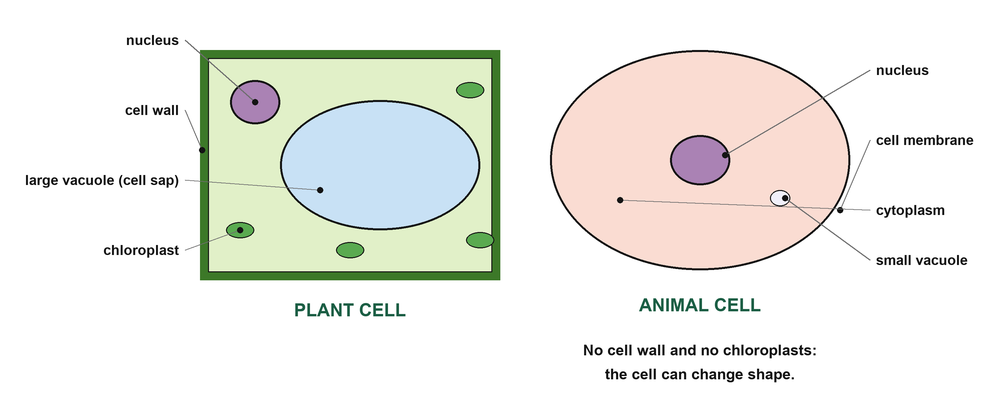
For onion cells: lay the thin inner skin of an onion scale leaf in a drop of water, lower a cover slip at an angle to avoid air bubbles, and draw iodine under it to stain the parts. The cells look like rows of bricks. Onion cells have no chloroplasts because the scale leaf grows underground; a moss leaf shows many green chloroplasts without staining.
| Part | Function |
|---|---|
| Cell wall (cellulose) | Gives shape and support |
| Cell membrane | Controls what enters and leaves the cell |
| Cytoplasm | Where most chemical reactions take place |
| Nucleus | Controls the cell and carries hereditary information |
| Large vacuole | Stores cell sap; keeps the cell firm |
| Chloroplasts | Carry out photosynthesis |
Animal cells and comparison
Animal cells (such as cheek cells) are irregular or round, with a cell membrane, cytoplasm and a nucleus but no cell wall, so they can change shape. Vacuoles are small and temporary, if present.
| Feature | Plant cell | Animal cell |
|---|---|---|
| Cell wall | Present | Absent |
| Cell membrane, cytoplasm, nucleus | Present | Present |
| Vacuole | Large, central | Small or none |
| Chloroplasts | In green parts | Absent |
| Shape | Usually regular | Often irregular |
Magnification
Magnification
How many times larger the image is than the real object. Total magnification = eyepiece power × objective power.
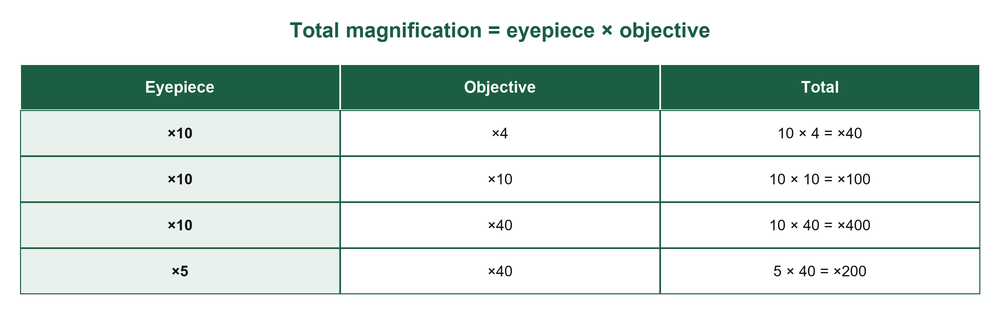
At higher magnification fewer cells are seen, but each is larger and more detailed; the image is darker, so open the diaphragm a little.
Drawing, organisation and specialised cells
- Biological drawing: sharp pencil; single continuous lines; no shading; at least half a page; ruled label lines that do not cross; a title and the magnification.
- Specialised cells: root hair cells (absorb water), red blood cells (carry oxygen; no nucleus when mature), nerve cells (carry messages), guard cells (open and close leaf pores).
- Safety: plant waste to the compost pit; broken glass picked up with a brush and pan into a labelled container; wash and dry slides.
Key points to remember
- The cell is the basic unit of life.
- Both cells have a membrane, cytoplasm and nucleus; plant cells also have a wall, a large vacuole and chloroplasts.
- Total magnification = eyepiece × objective (10 × 40 = 400).
- Draw with clear lines, ruled labels, a title and magnification.
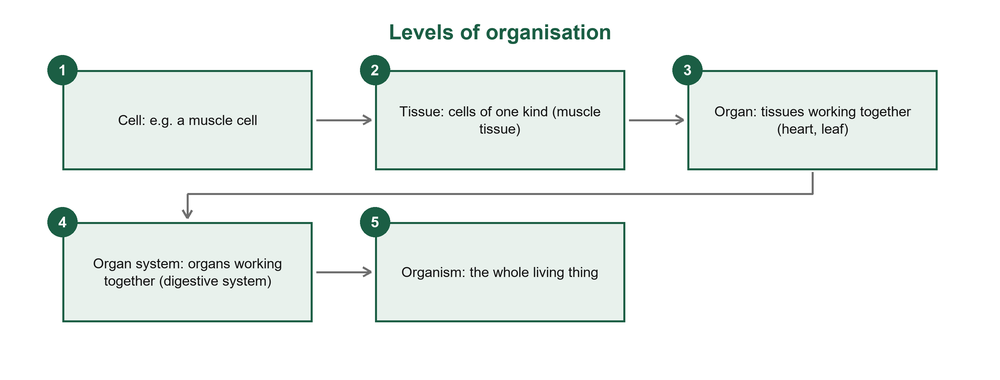
- Cells form tissues, organs, systems and organisms.
Test yourself: multiple choice
Which part is found in plant cells but NOT in animal cells?
Show the answer
B: Animal cells have no wall.
Eyepiece ×10 and objective ×40 give a total magnification of
Show the answer
A: 10 × 40 = 400.
Which part controls the activities of the cell?
Show the answer
D: The nucleus controls the cell.
Why are there no chloroplasts in onion scale cells?
Show the answer
C: No light, no chloroplasts.
Which knob is used for sharp focusing at high power?
Show the answer
D: Fine adjustment.
Practice questions
State the function of: cell wall, vacuole, chloroplast, cell membrane. (4 marks)
Show the answer
Wall: shape and support; vacuole: stores sap, keeps cell firm; chloroplast: photosynthesis; membrane: controls entry and exit.
Give two similarities and three differences between plant and animal cells. (5 marks)
Show the answer
- Similar: membrane, cytoplasm, nucleus (any two)
- Different: plant cells have a wall, a large vacuole and chloroplasts; animal cells do not
Calculate the total magnification: (a) eyepiece ×5, objective ×40 (b) eyepiece ×10, objective ×10. (2 marks)
Show the answer
(a) 5 × 40 = ×200 (b) 10 × 10 = ×100.
Describe how to prepare a temporary slide of onion cells. (4 marks)
Show the answer
Put a drop of water on a slide; lay the thin onion skin flat in it; lower a cover slip at an angle; stain with iodine drawn under the cover slip.
This is one topic. Get the whole year. The full Grade 8 Integrated Science notes cover every sub-strand of Terms 1, 2 and 3 like this one, with pictures, key points and practice questions with answers, as a printable PDF for KSh 150. Pay with M-Pesa and download at once.
Get the full Grade 8 Integrated Science notes · All Grade 8 Integrated Science resources · Notes for every grade


