
Grade 8 Mathematics · Strand 1.0 Numbers · Sub-strand 1.5 Rates, Ratio, Proportions and Percentages
These are free study notes for Grade 8 learners, written to the KICD curriculum design and taken from our full Grade 8 Mathematics notes. These skills appear in almost every Mathematics paper from Grade 8 to KJSEA, often hidden inside money, shopping and farming problems.
How fast is a matatu going? Which packet of sugar is better value? How should an inheritance be shared? Rates, ratios, percentages and proportion answer questions like these. In this topic we work out rates, use ratios to compare, share and change quantities, find percentage change, and solve direct and indirect proportion problems.
Rates
Rate
A comparison of two quantities of different kinds, such as shillings per minute or kilometres per hour.
Working out rates
A car uses 30 litres for 360 km: 360 ÷ 30 = 12 km per litre.
A bus covers 240 km in 4 hours: 240 ÷ 4 = 60 km/h.
Best value: 2 kg for Ksh 340 is 170 per kg; 1 kg for Ksh 175 is 175 per kg. The 2 kg packet is better.
Exchange: if 1 US dollar is Ksh 130, then 50 dollars is 50 × 130 = Ksh 6,500.
Ratios
Ratio
A comparison of quantities of the same kind. Ksh 40 to Ksh 60 is 40 : 60 = 2 : 3.
If boys are 3/7 of a class, girls are 4/7, and boys : girls = 3 : 4. To compare 3 : 5 and 4 : 7, write them as fractions with a common denominator: 21/35 and 20/35, so 3 : 5 is greater.
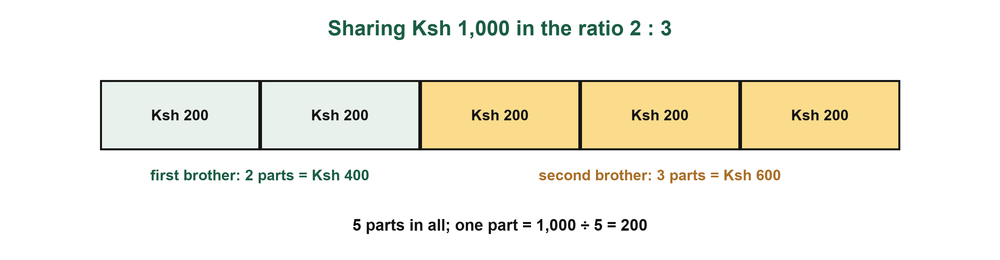
Sharing in a ratio
Share 84 kg of beans in the ratio 3 : 4: 7 parts; one part = 84 ÷ 7 = 12 kg; shares 36 kg and 48 kg.
Share 90 in the ratio 2 : 3 : 4: 9 parts; one part = 10; shares 20, 30 and 40.
Combining a : b = 2 : 3 and b : c = 4 : 5: make b equal (12): 8 : 12 and 12 : 15, so a : b : c = 8 : 12 : 15.
Increasing and decreasing in a ratio
Changing quantities
Increase 300 g in the ratio 3 : 2: 300 × 3/2 = 450 g.
Decrease Ksh 800 in the ratio 3 : 4: 800 × 3/4 = Ksh 600.
A price rises from Ksh 50 to Ksh 60: ratio new : old = 60 : 50 = 6 : 5.
Percentage change
Percentage change
(change ÷ original amount) × 100.
Increase and decrease
From Ksh 50 to Ksh 60: increase 10; 10 ÷ 50 × 100 = 20% increase.
From Ksh 800 to Ksh 600: decrease 200; 200 ÷ 800 × 100 = 25% decrease.
Increase Ksh 2,000 by 15%: 2,000 × 115/100 = Ksh 2,300.
Decrease 5,000 by 12%: 5,000 × 88/100 = 4,400.
Direct and indirect proportion
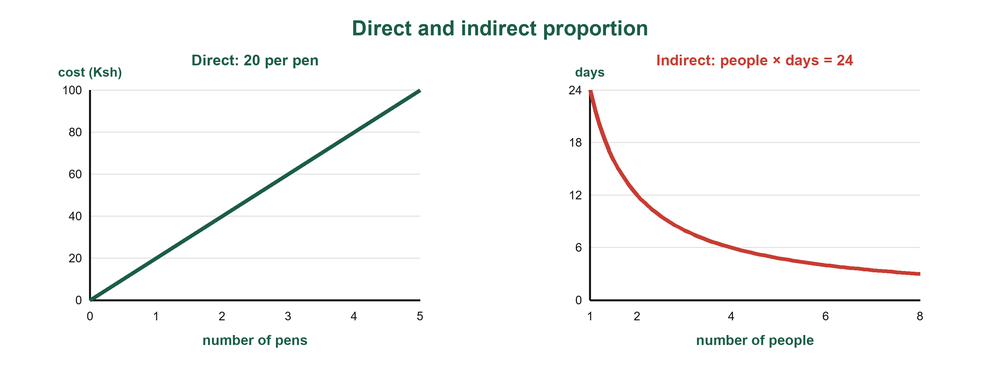
| Direct proportion | Indirect (inverse) proportion |
|---|---|
| One doubles, the other doubles | One doubles, the other halves |
| Kilograms and cost; litres and distance | Workers and days; speed and time |
| 3 pens cost Ksh 60, so 1 pen costs 20 and 5 pens cost 100 | 4 people take 6 days: 24 person-days; 8 people take 24 ÷ 8 = 3 days |
Mixed problems
A car uses 8 litres for 96 km. For 150 km: 150 × 8 ÷ 96 = 12.5 litres (direct).
Feed for 20 cows lasts 15 days: 300 cow-days. For 25 cows: 300 ÷ 25 = 12 days (indirect).
A journey takes 3 hours at 80 km/h. At 60 km/h: 3 × 80 ÷ 60 = 4 hours (indirect).
Key points to remember
- A rate compares different kinds of quantity; a ratio compares the same kind.
- To share in a ratio, find the total parts, then the value of one part.
- Percentage change = change ÷ original × 100.
- Direct proportion: both increase together; use the unitary method.
- Indirect proportion: one increases as the other decreases; the product stays the same.
Test yourself: multiple choice
Share Ksh 4,500 in the ratio 2 : 3 : 4. What is the largest share?
Show the answer
D: 9 parts of 500; 4 × 500 = 2,000.
A price rises from Ksh 250 to Ksh 300. What is the percentage increase?
Show the answer
A: 50 ÷ 250 × 100 = 20%.
6 workers finish a job in 10 days. How long would 15 workers take?
Show the answer
C: 60 worker-days ÷ 15 = 4 days.
A typist types 1,200 words in 30 minutes. What is the rate?
Show the answer
B: 1,200 ÷ 30 = 40.
Which pair is in indirect proportion?
Show the answer
C: Faster speed, less time.
Practice questions
Musa, Jane and Ali share Ksh 7,200 in the ratio 3 : 4 : 5. How much does each get? (3 marks)
Show the answer
- 12 parts; one part = 7,200 ÷ 12 = 600
- Musa 1,800; Jane 2,400; Ali 3,000
The price of a bag of flour fell from Ksh 2,400 to Ksh 2,100. Find the percentage decrease. (2 marks)
Show the answer
Decrease 300; 300 ÷ 2,400 × 100 = 12.5%.
12 m of cloth cost Ksh 1,800. Find the cost of 20 m. (2 marks)
Show the answer
1 m costs 1,800 ÷ 12 = 150; 20 m cost 20 × 150 = Ksh 3,000.
5 taps fill a tank in 12 hours. How long would 6 taps take? (2 marks)
Show the answer
5 × 12 = 60 tap-hours; 60 ÷ 6 = 10 hours.
This is one topic. Get the whole year. The full Grade 8 Mathematics notes cover every sub-strand of Terms 1, 2 and 3 like this one, with pictures, key points and practice questions with answers, as a printable PDF for KSh 150. Pay with M-Pesa and download at once.
Get the full Grade 8 Mathematics notes · All Grade 8 Mathematics resources · Notes for every grade


