
Grade 8 Social Studies · Strand 5.0 Political Developments and Governance · Sub-strand 5.1 The Constitution of Kenya
These are free study notes for Grade 8 learners, written to the KICD curriculum design and taken from our full Grade 8 Social Studies notes. This topic leads straight into human rights and citizenship. Learn the main features well; Grade 9 builds on them with the Bill of Rights.
The Constitution is the supreme law of Kenya. It says how the country is governed, shares power among three arms of government and sets the standard of integrity expected of leaders. In this topic we explore the components of the Constitution, illustrate the roles of the three arms of government, examine the principles of leadership and integrity, and practise assertiveness in upholding integrity.
Why we need a constitution
Constitution
The supreme law of a country: a set of rules that shows how the country is governed and protects the rights of citizens.
Kenya's current Constitution was passed in a referendum and promulgated on 27 August 2010.
- Limits the power of leaders.
- Protects human rights.
- Sets out how leaders are chosen.
- Shares power and resources, including to counties.
- Provides for justice and unity.
Components of the Constitution
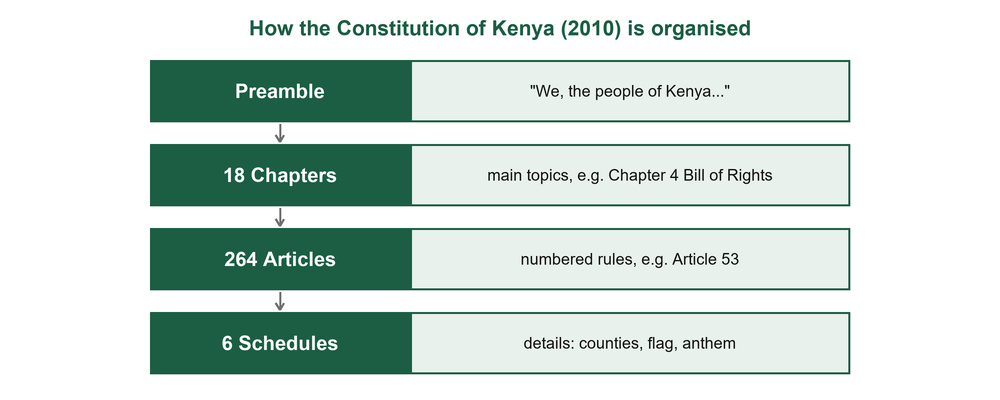
| Chapter | Title |
|---|---|
| 1 | Sovereignty of the people and supremacy of the Constitution |
| 2 | The Republic |
| 3 | Citizenship |
| 4 | The Bill of Rights (Article 53: children's rights) |
| 6 | Leadership and Integrity |
| 8, 9, 10 | The Legislature, the Executive, the Judiciary |
| 11 | Devolved Government |
The three arms of government
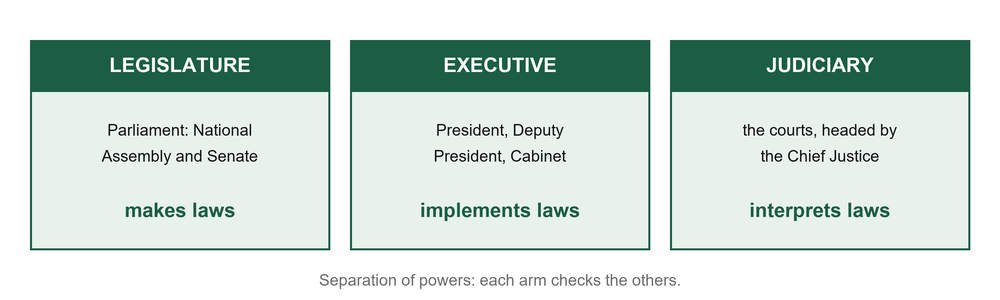
| Arm | Made up of | Roles |
|---|---|---|
| Legislature (Chapter 8) | Parliament: National Assembly and Senate | Makes and amends laws; approves the budget; represents the people; oversees the Executive; the Senate protects county interests |
| Executive (Chapter 9) | President, Deputy President, Cabinet, public service | Implements laws and policies; runs ministries; conducts foreign affairs; the President is Head of State and Government and Commander-in-Chief |
| Judiciary (Chapter 10) | Courts headed by the Chief Justice, from the Supreme Court to magistrates' courts | Interprets the Constitution and laws; settles disputes; protects rights; can declare actions unconstitutional |
Separation of powers
Power is shared so that no arm can abuse it. Checks and balances: Parliament can impeach; courts can overturn unlawful actions.
Leadership and integrity (Chapter Six)
Guiding principles (Article 73) include selection on the basis of integrity, competence and suitability; objective and impartial decisions without favouritism or corruption; selfless service in the public interest; accountability to the public; and discipline and commitment in service.
Officers must not use their office for personal gain, accept bribes or favour relatives unfairly. The Ethics and Anti-Corruption Commission (EACC) enforces this chapter.
Assertiveness in upholding integrity
Assertiveness
Expressing your views and standing up for what is right, clearly and respectfully, without aggression.
Being assertive
Refusing to cheat: "No, I will not share answers."
Refusing a bribe: a learner offered sweets to vote for a classmate in the prefect election says, "I will vote for the person I think will lead best."
Reporting dishonesty; speaking up when someone is treated unfairly.
Key points to remember
- The Constitution (2010) is Kenya's supreme law.
- It has a preamble, 18 chapters, 264 articles and 6 schedules.
- Legislature makes laws, Executive implements them, Judiciary interprets them.
- Chapter Six demands integrity; the EACC enforces it.
- Assertiveness helps uphold integrity.
Test yourself: multiple choice
Kenya's current Constitution was promulgated on
Show the answer
B: After the referendum.
Which arm of government interprets the law?
Show the answer
C: The courts.
Chapter Six of the Constitution deals with
Show the answer
D: Leadership and Integrity.
Parliament in Kenya is made up of the
Show the answer
A: Two houses.
Saying "No, I will not share answers" calmly is
Show the answer
C: Clear and respectful.
Practice questions
Give four reasons why a country needs a constitution. (4 marks)
Show the answer
Limits leaders' power; protects rights; sets how leaders are chosen; shares power and resources; provides for justice (any four).
Name the components of the Constitution of Kenya. (4 marks)
Show the answer
Preamble; chapters (18); articles (264); schedules (6).
State two roles of each arm of government. (6 marks)
Show the answer
Legislature: makes laws; approves the budget; oversees the Executive. Executive: implements laws; runs ministries; foreign affairs. Judiciary: interprets laws; settles disputes; protects rights (any two each).
State four guiding principles of leadership under Article 73. (4 marks)
Show the answer
Integrity, competence and suitability; objective, impartial decisions; selfless service; accountability; discipline and commitment (any four).
This is one topic. Get the whole year. The full Grade 8 Social Studies notes cover every sub-strand of Terms 1, 2 and 3 like this one, with pictures, key points and practice questions with answers, as a printable PDF for KSh 150. Pay with M-Pesa and download at once.
Get the full Grade 8 Social Studies notes · All Grade 8 Social Studies resources · Notes for every grade


