Grade 8 Social Studies · Strand 4.0 Natural and Historic Built Environments · Sub-strand 4.2 Weather and Climate
These are free study notes for Grade 8 learners. They follow the official KICD curriculum design for Grade 8 Social Studies (the same topics, in the same order, that your teacher uses) and are taken from our full Grade 8 Social Studies notes. Link each climatic region to a place you know: the Kenyan highlands, the coast, the dry north. Real examples make the regions easy to remember.
Africa has hot rainforests, dry deserts, cool highlands and lands with wet winters. Climate shapes how people farm, build, dress and travel. In this topic we examine the factors that influence climate in Africa, describe the major climatic regions, look at climate change and explore positive ways of managing disaster-related stress.
Weather and climate
Weather
The condition of the atmosphere at a place over a short time (hours or days).
Climate
The average weather of a place over a long period, usually 30 years or more.
Elements of weather: temperature, rainfall, humidity, wind (speed and direction), sunshine, cloud cover and air pressure. The Kenya Meteorological Department records them daily.
Factors influencing climate
- Latitude: places near the equator get the overhead sun and are hot all year; places further away are cooler and have seasons.
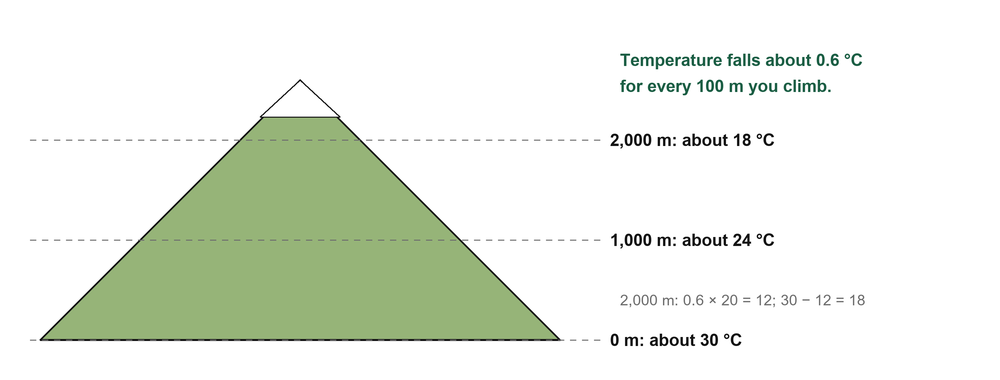
- Altitude: temperature falls about 0.6 °C for every 100 m rise.
- Prevailing winds: winds from the sea bring moisture; winds from land are dry (the Harmattan from the Sahara).
- Ocean currents: warm currents (Mozambique, Agulhas) bring warmth and moisture; cold currents (Benguela, Canary) cool the air and reduce rain, helping form the Namib.
- Distance from the sea: coastal places have a smaller temperature range than interior places.
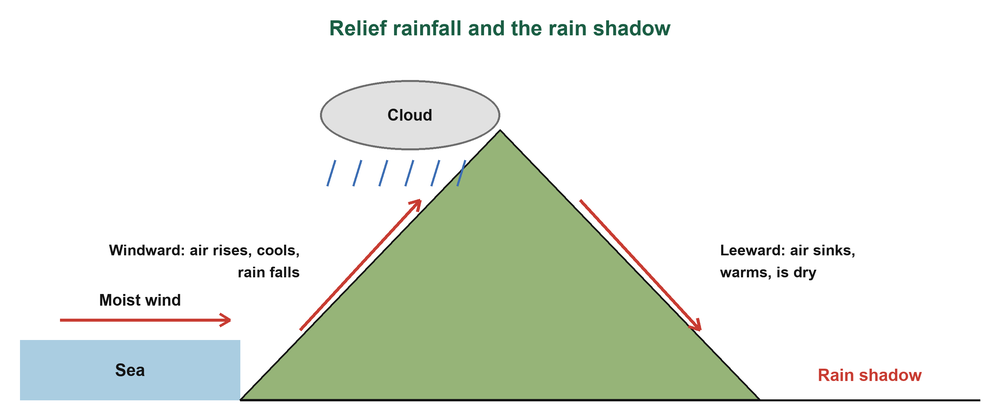
- Relief: moist winds rise up the windward slope, cool and bring rain; the leeward side is a dry rain shadow.
Altitude sum
It is 30 °C at the coast. A town is 2,000 m high.
Drop = 2,000 ÷ 100 × 0.6 = 20 × 0.6 = 12 °C.
Temperature in the town = 30 - 12 = 18 °C.
Major climatic regions
| Region | Characteristics | Where |
|---|---|---|
| Equatorial | Hot all year (25-28 °C), rain throughout (over 1,500 mm), humid, small range | Congo Basin, coastal West Africa |
| Tropical savanna | Hot; distinct wet and dry seasons; 750-1,500 mm | Much of East and Southern Africa |
| Semi-desert | Hot; low, unreliable rain (250-500 mm); droughts | Sahel, northern Kenya, the Horn |
| Desert | Under 250 mm; very hot days, cold nights; clear skies | Sahara, Namib, Kalahari |
| Mediterranean | Hot, dry summers; warm, wet winters; 500-900 mm | Morocco, Algeria, Tunisia coasts; Cape region |
| Mountain | Cool to cold; wet windward slopes; snow on peaks | Ethiopian and Kenya Highlands, Kilimanjaro |
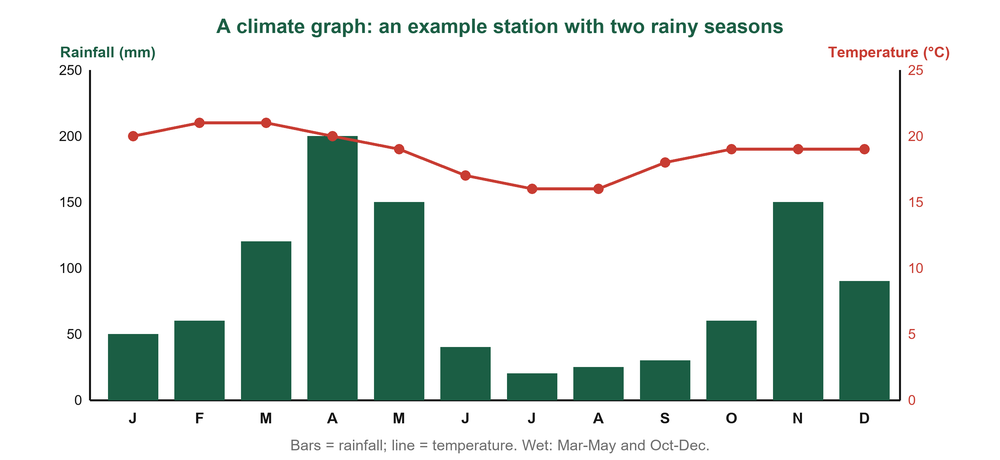
Much of Kenya has two rainy seasons: the long rains (about March to May) and the short rains (about October to December). Mount Kenya (5,199 m) and Kilimanjaro (5,895 m) have snow near their peaks although they are near the equator.
Effects of climate on human activities
- Farming: tea and coffee in cool, wet highlands; pastoralism in dry areas; wheat in cooler, drier highlands; grapes in Mediterranean areas.
- Settlement: dense in wet, fertile areas; sparse in deserts.
- Tourism: sunny beaches, savanna wildlife, mountain climbing.
- Housing and dress: thick walls and loose clothing in deserts; warm clothes in highlands.
- Health: malaria is common in warm, wet lowlands.
Climate change and disaster-related stress
Climate change
A long-term change in global or regional climate, especially warming caused largely by greenhouse gases from burning fossil fuels and cutting forests.
Climate change in Africa
Effects
- Longer droughts and floods
- Shrinking glaciers on Kilimanjaro and Mount Kenya
- Crop failure and loss of pasture
- Conflict over water
Solutions
- Plant and protect trees
- Renewable energy
- Water harvesting
- Drought-resistant crops and early warning
Floods, droughts and landslides cause loss, fear and stress. Positive ways to cope: talk about feelings with family, friends or a counsellor; keep routines (school, meals, sleep); help others; get information from trusted sources; rest and play. Help comes from the Kenya Red Cross, county disaster teams and the school counsellor.
Key points to remember
- Climate is average weather over about 30 years.
- Factors: latitude, altitude, winds, ocean currents, distance from the sea, relief.
- Temperature falls about 0.6 °C per 100 m.
- Regions: equatorial, savanna, semi-desert, desert, Mediterranean, mountain.
- Climate change brings droughts and floods; cope with stress by talking and keeping routines.
Test yourself: multiple choice
Temperature falls by about how much for every 100 m rise?
Show the answer
C: The lapse rate is about 0.6 °C per 100 m.
The Namib Desert is partly caused by the
Show the answer
A: Cold currents reduce rain.
Hot, dry summers and warm, wet winters describe the
Show the answer
D: Found at the far north and south.
The dry side of a mountain is the
Show the answer
B: Descending air is dry.
If it is 28 °C at sea level, the temperature at 1,500 m is about
Show the answer
C: 15 × 0.6 = 9; 28 - 9 = 19.
Practice questions
Distinguish between weather and climate. (2 marks)
Show the answer
Weather is the condition of the atmosphere over a short time; climate is the average weather over a long period, about 30 years.
Explain how relief influences rainfall. (3 marks)
Show the answer
Moist winds rise up the windward slope, cool and condense, bringing rain; the air descends on the leeward side, warms and is dry, forming a rain shadow.
A coastal town is 31 °C. Find the likely temperature of a town 2,500 m above sea level. (3 marks)
Show the answer
Drop = 25 × 0.6 = 15 °C; 31 - 15 = 16 °C.
Describe the characteristics of the equatorial climate. (4 marks)
Show the answer
Hot all year (25-28 °C); heavy rain throughout (over 1,500 mm); high humidity; small temperature range.
Give four positive ways of managing disaster-related stress. (4 marks)
Show the answer
Talk to family, friends or a counsellor; keep routines; help others; use trusted information; rest and play (any four).
This is one topic. Get the whole year. The full Grade 8 Social Studies notes cover every sub-strand of Terms 1, 2 and 3 like this one, with pictures, key points and practice questions with answers, as a printable PDF for KSh 150. Pay with M-Pesa and download at once.
Get the full Grade 8 Social Studies notes · All Grade 8 Social Studies resources · Notes for every grade