
Grade 9 English · Theme 3.0 Environmental Conservation · Sub-strand 3.3.1 Modal Auxiliaries
These are free study notes for Grade 9 learners, written to the KICD curriculum design and taken from our full Grade 9 English notes. Grammar questions in KJSEA English Paper 1 often test the meaning of a modal in a sentence. Learn what each one expresses, not just its spelling.
Words like must, should, may and could change the mood of a sentence: they make it a rule, a piece of advice, a polite request or a possibility. These are modal auxiliaries. In this topic we identify them and use them to express different moods.
What modal auxiliaries are
Modal auxiliary
A helping verb that comes before a main verb to show ability, permission, obligation, advice, possibility or a request: can, could, may, might, must, shall, should, will, would.
Environment club rules
"Members must attend the Friday clean-up. You should bring a jembe or a rake. Members may borrow seedlings from the nursery. Could you please water the trees during the holidays? Anyone can join the club."
Modals and their meanings
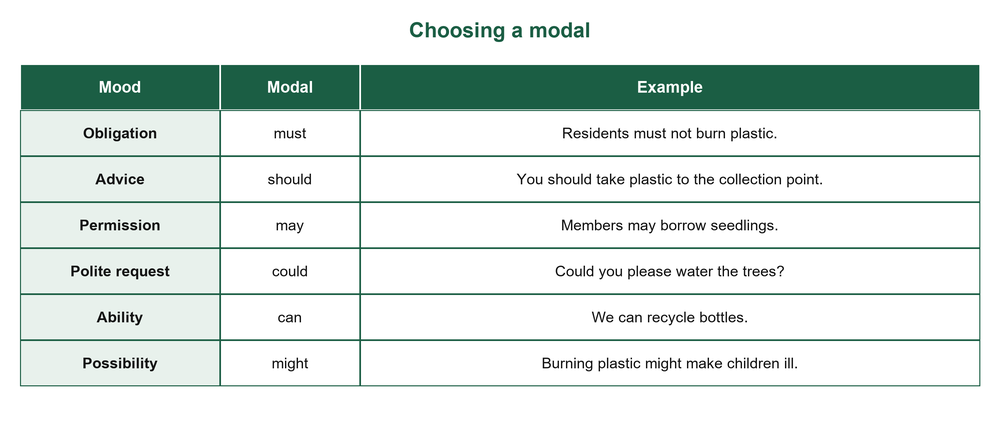
| Modal | Meaning | Example |
|---|---|---|
| can | Ability or possibility | We can recycle bottles at the market. |
| could | Polite request; past ability | Could you please avoid burning plastic? |
| may | Permission; possibility | Members may borrow seedlings. |
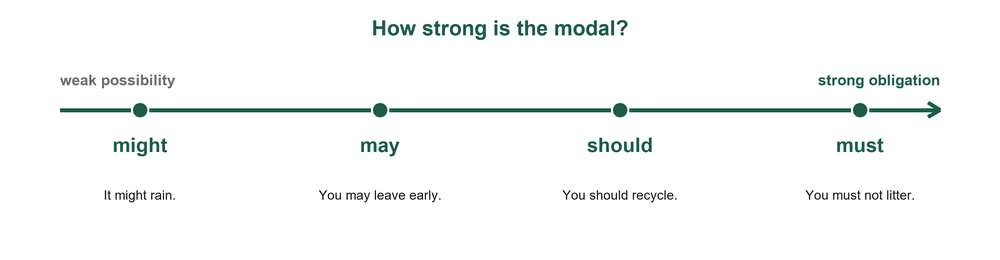
| might | Weak possibility | Burning plastic might make children ill. |
| must | Obligation; strong necessity | Residents must not burn plastic. |
| should | Advice | You should take plastic to the collection point. |
| will / shall | Future; promise | We shall plant 800 trees. |
| would | Polite offer or request | Would you like to join us? |
Rules for using modals
- A modal is followed by the base form of the verb: "She must water the trees", not "She must waters".
- Modals do not take -s: "He can swim", not "He cans swim".
- Make questions by putting the modal first: "May I go?"
- Make negatives with not: cannot (can't), must not (mustn't), should not (shouldn't).
Choosing the right tone
| Mood | Sentence |
|---|---|
| Firm rule | Residents must not burn plastic. |
| Friendly advice | You should take plastic to the collection point. |
| Polite request | Could you please avoid burning plastic? |
| Possibility | Burning plastic might make children ill. |
Key points to remember
- Modals: can, could, may, might, must, shall, should, will, would.
- must = obligation; should = advice; may = permission; could = polite request; can = ability; might = possibility.
- A modal is followed by the base verb and never takes -s.
- Choose the modal that gives the tone you want.
Test yourself: multiple choice
Which modal expresses obligation?
Show the answer
C: "Must" shows a rule or obligation.
Choose the polite request.
Show the answer
B: "Could you please" is polite.
Which sentence is correct?
Show the answer
D: Modal + base verb, with no -s.
"You should recycle bottles" gives
Show the answer
A: "Should" gives advice.
Which modal shows the weakest possibility?
Show the answer
C: "Might" shows a weak possibility.
Practice questions
Identify the modals in: "Members must attend. You should bring a rake. Members may borrow seedlings." and give the meaning of each. (3 marks)
Show the answer
must = obligation; should = advice; may = permission.
Rewrite as a polite request: "Water the seedlings." (1 mark)
Show the answer
"Could you please water the seedlings?"
Correct the errors: (a) He musts come early. (b) She can to swim. (2 marks)
Show the answer
(a) He must come early. (b) She can swim.
Write sentences about cutting trees showing (a) advice (b) obligation (c) possibility. (3 marks)
Show the answer
(a) You should plant a tree for every one you cut. (b) Loggers must get a permit. (c) Cutting trees might cause the river to dry up.
This is one topic. Get the whole year. The full Grade 9 English notes cover every sub-strand of Terms 1, 2 and 3 like this one, with pictures, key points and practice questions with answers, as a printable PDF for KSh 150. Pay with M-Pesa and download at once.
Get the full Grade 9 English notes · All Grade 9 English resources · Notes for every grade


