
Grade 9 Integrated Science · Strand 3.0 Force and Energy · Sub-strand 3.1 Curved Mirrors
These are free study notes for Grade 9 learners, written to the KICD curriculum design and taken from our full Grade 9 Integrated Science notes. Ray diagrams are easy marks once you know the three rules for rays. Practise drawing them with a ruler and a sharp pencil.
A car's side mirror, a torch reflector and a dentist's mirror are all curved mirrors. In this topic we study concave and convex mirrors, the terms used with them, how to draw ray diagrams to find their images, the characteristics of those images and how curved mirrors are used for safety, security and energy.
Types of curved mirrors
| Mirror | Shape | Everyday example |
|---|---|---|
| Concave | Curves inwards (inside of a spoon) | Shaving and dentists' mirrors |
| Convex | Bulges outwards (back of a spoon) | Car side mirrors, shop security mirrors |
| Parabolic | A deep concave mirror | Torches and car headlamps |
In the inside of a spoon held at arm's length your image is small and upside down; held very close it becomes upright and larger. In the back of a spoon your image is always upright and smaller.
Terms used with curved mirrors
| Term | Meaning |
|---|---|
| Pole (P) | The centre of the mirror surface |
| Centre of curvature (C) | The centre of the sphere the mirror is part of |
| Radius of curvature | The distance PC |
| Principal axis | The line through P and C |
| Principal focus (F) | Where rays parallel to the axis meet (concave) or seem to come from (convex) |
| Focal length (f) | The distance PF: half the radius of curvature |
| Aperture | The width of the mirror |
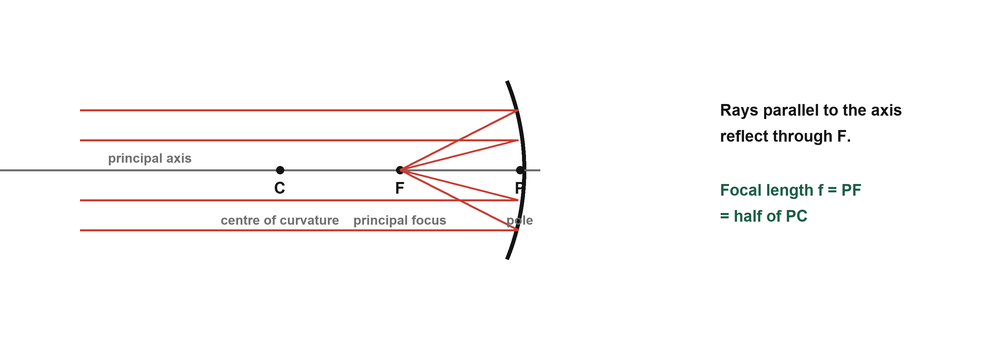
Finding the focal length roughly
Focus a distant window onto a card with a concave mirror: the distance mirror-to-card is about 12 cm.
Focal length = 12 cm; radius of curvature = 2 × 12 = 24 cm.
Never focus sunlight onto anything or look at the Sun.
Ray diagrams for concave mirrors
- Ray 1: parallel to the principal axis, reflects through F.
- Ray 2: through F, reflects parallel to the axis.
- Ray 3: through C, reflects back along itself.
- Any two rays are enough; where they meet is the top of the image.
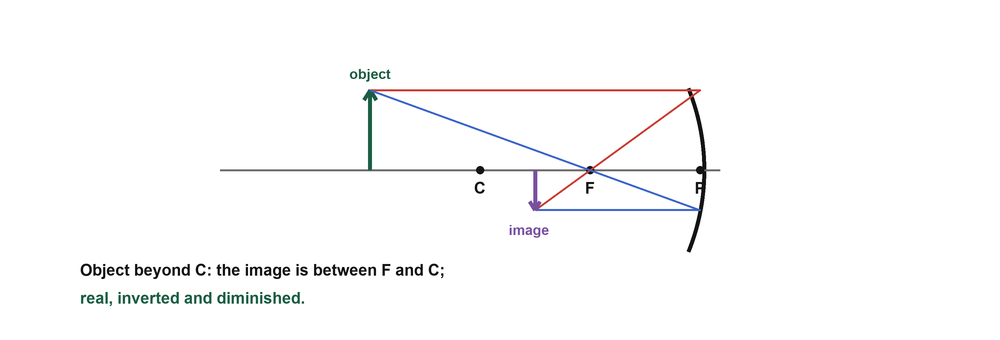
| Object position | Image position | Nature, orientation, size |
|---|---|---|
| At infinity | At F | Real, inverted, very small |
| Beyond C | Between F and C | Real, inverted, diminished |
| At C | At C | Real, inverted, same size |
| Between C and F | Beyond C | Real, inverted, magnified |
| At F | At infinity | No image on a screen (parallel beam) |
| Between F and P | Behind the mirror | Virtual, upright, magnified |
Convex mirrors and image characteristics
For a convex mirror, F and C are behind the mirror. A ray parallel to the axis reflects as if it came from F; a ray heading for C reflects back along itself. The image is always behind the mirror, virtual, upright and diminished, with a wide field of view.
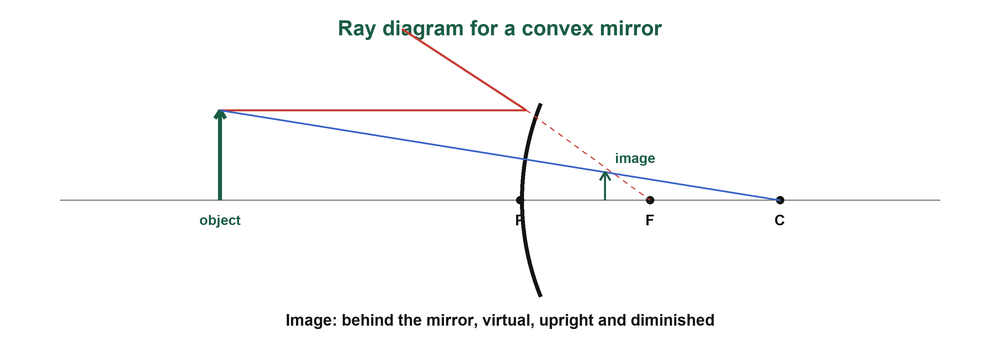
Describe an image by its position, nature (real or virtual), orientation (upright or inverted) and size. Magnification = image height ÷ object height.
Magnification
Object 3 cm tall, image 9 cm tall: magnification = 9 ÷ 3 = 3 (magnified).
A magnification less than 1 means the image is diminished.
Uses of curved mirrors
| Mirror | Use | Why |
|---|---|---|
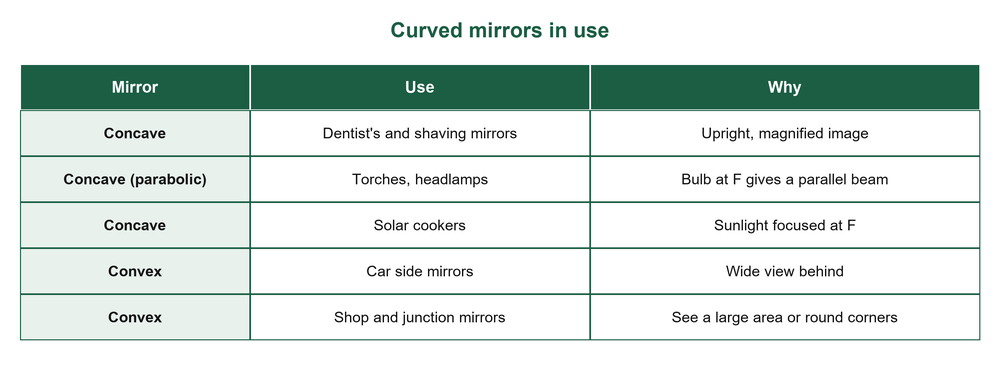
| Concave | Shaving, make-up and dentists' mirrors | Object between F and P gives an upright, magnified image |
| Concave (parabolic) | Torches, headlamps, projector lamps | A bulb at F gives a parallel beam |
| Concave | Solar cookers and concentrators | Sunlight is focused at F to heat food or water |
| Concave | Reflecting telescopes | Collect faint light from stars |
| Convex | Driving mirrors | Wide view of the road behind |
| Convex | Shop, bank and junction mirrors | See a large area or round corners |
Safety
The bright spot of a solar concentrator can burn skin and start fires. Never look into it or at the Sun.
Key points to remember
- Concave mirrors curve inwards; convex mirrors bulge outwards; parabolic mirrors are deep concave mirrors.
- Focal length = half the radius of curvature.
- Concave images depend on object position; between F and P the image is virtual, upright and magnified.
- Convex images are always virtual, upright and diminished, with a wide view.
- Magnification = image height ÷ object height.
Test yourself: multiple choice
A concave mirror has a radius of curvature of 30 cm. What is its focal length?
Show the answer
B: f = 30 ÷ 2 = 15 cm.
Which mirror is used as a car side mirror?
Show the answer
A: Convex mirrors give a wide view.
An object is placed at C of a concave mirror. The image is
Show the answer
C: Object at C gives an image at C of the same size.
Where is the bulb placed in a torch reflector?
Show the answer
D: A bulb at F gives a parallel beam.
An image is 2 cm tall and the object is 8 cm tall. What is the magnification?
Show the answer
B: 2 ÷ 8 = 0.25 (diminished).
Practice questions
Define (a) principal focus (b) focal length. (2 marks)
Show the answer
(a) The point where rays parallel to the axis meet (or seem to come from) after reflection. (b) The distance from the pole to the principal focus.
State the position and characteristics of the image when an object is between F and P of a concave mirror, and give one use. (4 marks)
Show the answer
Behind the mirror; virtual, upright, magnified. Use: shaving or dentists' mirror.
Give three differences between images formed by concave and convex mirrors. (3 marks)
Show the answer
Concave can be real or virtual; convex always virtual. Concave can be magnified; convex always diminished. Concave can be inverted; convex always upright.
Explain why convex mirrors are placed at sharp bends on roads. (2 marks)
Show the answer
They give a wide field of view, so drivers can see traffic coming round the bend and avoid accidents.
This is one topic. Get the whole year. The full Grade 9 Integrated Science notes cover every sub-strand of Terms 1, 2 and 3 like this one, with pictures, key points and practice questions with answers, as a printable PDF for KSh 150. Pay with M-Pesa and download at once.
Get the full Grade 9 Integrated Science notes · All Grade 9 Integrated Science resources · Notes for every grade


