
Grade 9 Integrated Science · Strand 2.0 Living Things and their Environment · Sub-strand 2.1 Nutrition in Plants
These are free study notes for Grade 9 learners, written to the KICD curriculum design and taken from our full Grade 9 Integrated Science notes. Photosynthesis experiments (testing a leaf for starch, variegated leaves, plants kept in the dark) are favourite KJSEA questions, so read the experiment sections twice.
Green plants make their own food using sunlight, a process called photosynthesis. All the food we eat comes from it, directly or indirectly. In this topic we study the external and internal parts of a leaf, how the leaf is adapted for photosynthesis, the process itself and the experiments that show which conditions it needs.
The leaf
| External part | Description |
|---|---|
| Lamina (leaf blade) | The broad, flat part |
| Midrib | The main vein down the middle |
| Veins | Branches carrying water and food |
| Petiole | The leaf stalk joining it to the stem |
| Apex and margin | The tip and the edge |
| Internal part | Function |
|---|---|
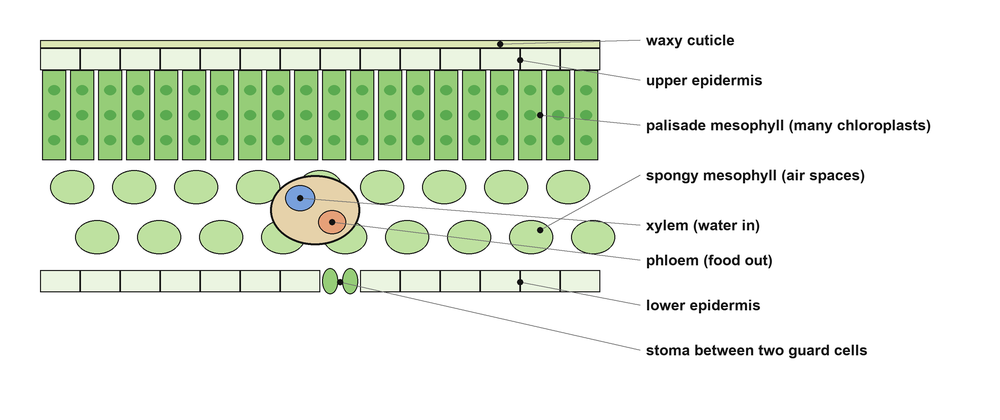
| Waxy cuticle | Waterproof; reduces water loss |
| Upper epidermis | Protects inner cells; lets light through |
| Palisade mesophyll | Main site of photosynthesis; packed with chloroplasts |
| Spongy mesophyll | Air spaces let gases move around |
| Lower epidermis and stomata | Stomata let carbon dioxide in and oxygen and water vapour out |
| Xylem and phloem (veins) | Xylem brings water in; phloem carries food away |
Adaptations of the leaf
| Adaptation | How it helps photosynthesis |
|---|---|
| Broad, flat lamina | Large surface to absorb light |
| Thin | Gases travel only a short distance |
| Many chloroplasts near the top | Trap as much light as possible |
| Stomata and air spaces | Let carbon dioxide in and oxygen out |
| Network of veins | Brings water and removes food |
| Leaf mosaic (arrangement on the stem) | Reduces shading of one leaf by another |
Guard cells open the stomata in light and close them in darkness or when the plant is short of water.
Chloroplasts and chlorophyll
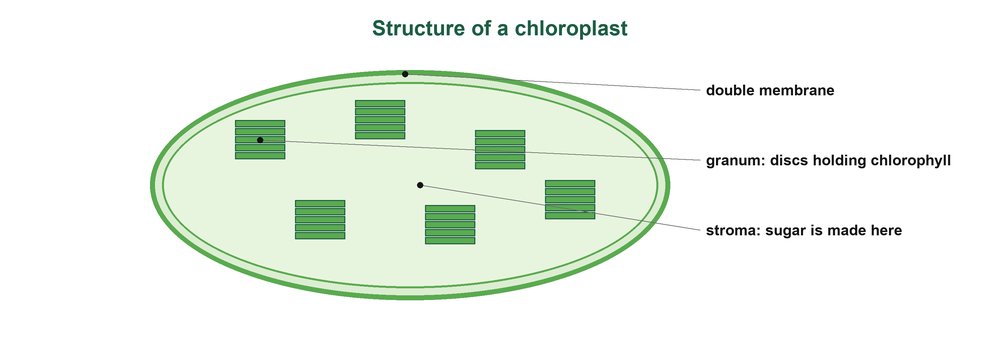
A chloroplast has a double membrane. Inside are stacks of discs called grana (one stack is a granum) that hold the green pigment chlorophyll, sitting in a jelly-like fluid called the stroma. Light is trapped in the grana; sugar is made in the stroma.
Chlorophyll absorbs mostly red and blue light and reflects green light, which is why leaves look green. A plant kept in darkness cannot make chlorophyll, turns pale yellow and cannot photosynthesise well.
The process of photosynthesis
Word equation
carbon dioxide + water → glucose + oxygen (in the presence of light and chlorophyll)
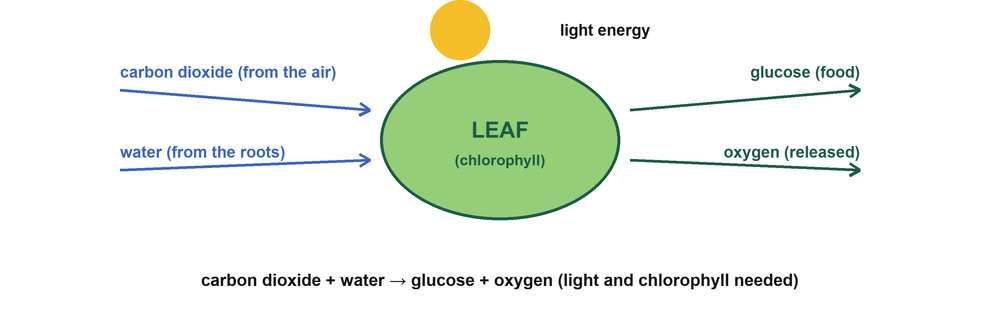
Light energy trapped by chlorophyll splits water; the hydrogen combines with carbon dioxide to make glucose and oxygen is released. Glucose is used for respiration, stored as starch (in leaves, cassava, potatoes, maize and beans) or used to make cellulose for cell walls.
Conditions for photosynthesis
Testing a leaf for starch
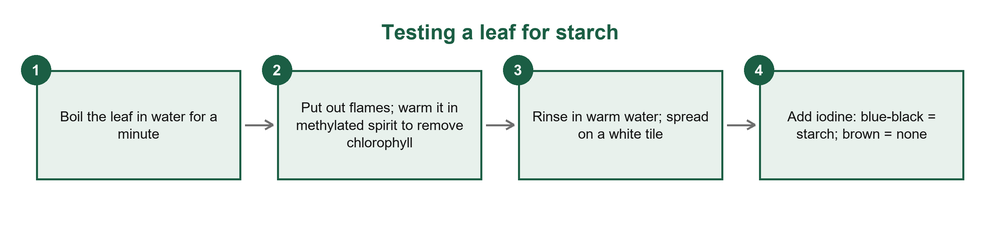
- Boil the leaf in water for about a minute to kill and soften it.
- Put out all flames, then place it in methylated spirit in hot water to remove the chlorophyll.
- Rinse it in warm water to soften it and spread it on a white tile.
- Add iodine solution: blue-black means starch present; brown means no starch.
| Condition | Experiment | Result |
|---|---|---|
| Light | Destarch a plant; cover part of a leaf with foil; leave in light; test for starch | Covered part brown; uncovered part blue-black |
| Chlorophyll | Test a variegated (green and white) leaf | Only green parts turn blue-black |
| Carbon dioxide | Plant with soda lime (absorbs CO2) and a control without | No starch with soda lime |
| Oxygen produced | Water plant under a funnel in light; test gas with a glowing splint | Splint relights: oxygen |
Fair tests
Change only one condition in each experiment and keep a control. Water and a suitable temperature are also needed. Soda lime is caustic: only the teacher handles it.
Photosynthesis gives all our food, releases the oxygen we breathe and removes carbon dioxide, and provides wood, charcoal, cotton and paper.
Key points to remember
- Leaf parts: lamina, midrib, veins, petiole; inside: cuticle, epidermis, palisade, spongy layer, stomata, xylem, phloem.
- A chloroplast has a double membrane, grana (chlorophyll) and stroma.
- carbon dioxide + water → glucose + oxygen (light, chlorophyll).
- Photosynthesis needs light, carbon dioxide, water, chlorophyll and a suitable temperature.
Test yourself: multiple choice
Which layer of the leaf carries out most photosynthesis?
Show the answer
C: It is packed with chloroplasts.
Gases enter and leave a leaf through the
Show the answer
A: Stomata are the pores for gas exchange.
What colour shows that starch is present when iodine is added?
Show the answer
D: Iodine turns blue-black with starch.
Why is a plant kept in darkness for 48 hours before a light experiment?
Show the answer
B: Destarching makes the test fair.
Which gas relights a glowing splint?
Show the answer
C: Oxygen relights a glowing splint.
Practice questions
Write the word equation for photosynthesis. (2 marks)
Show the answer
carbon dioxide + water → glucose + oxygen (light and chlorophyll).
State three adaptations of the leaf for photosynthesis. (3 marks)
Show the answer
Any three: broad lamina; thin; many chloroplasts near the top; stomata and air spaces; network of veins.
Describe how to show that light is necessary for photosynthesis. (4 marks)
Show the answer
Destarch a potted plant in darkness for 48 hours; cover part of a leaf with foil; leave in light for a day; test for starch: the covered part stays brown and the uncovered part turns blue-black.
Why is the leaf boiled in water and then placed in methylated spirit during the starch test? (2 marks)
Show the answer
Boiling kills and softens it; methylated spirit removes the chlorophyll so the colour change is seen.
This is one topic. Get the whole year. The full Grade 9 Integrated Science notes cover every sub-strand of Terms 1, 2 and 3 like this one, with pictures, key points and practice questions with answers, as a printable PDF for KSh 150. Pay with M-Pesa and download at once.
Get the full Grade 9 Integrated Science notes · All Grade 9 Integrated Science resources · Notes for every grade


