Grade 9 Integrated Science · Strand 2.0 Living Things and their Environment · Sub-strand 2.3 Reproduction in Plants
These are free study notes for Grade 9 learners. They follow the official KICD curriculum design for Grade 9 Integrated Science (the same topics, in the same order, that your teacher uses) and are taken from our full Grade 9 Integrated Science notes. Flower diagrams are examined every year. Learn the labels with their functions, then check yourself on a real flower such as a hibiscus.
Flowers are not only beautiful: they are the reproductive organs of flowering plants. In this topic we study the parts of a flower and their functions, pollination and how flowers are adapted to insects and wind, fertilisation and how fruits and seeds form, and the ways fruits and seeds are dispersed.
Parts of a flower
| Part | Function |
|---|---|
| Sepals | Protect the flower in the bud |
| Petals | Coloured and scented to attract pollinators |
| Stamen (anther on a filament) | Male part: the anther makes pollen; the filament holds it up |
| Stigma | Receives pollen |
| Style | Holds up the stigma |
| Ovary with ovules | Female part: ovules become seeds; the ovary becomes the fruit |
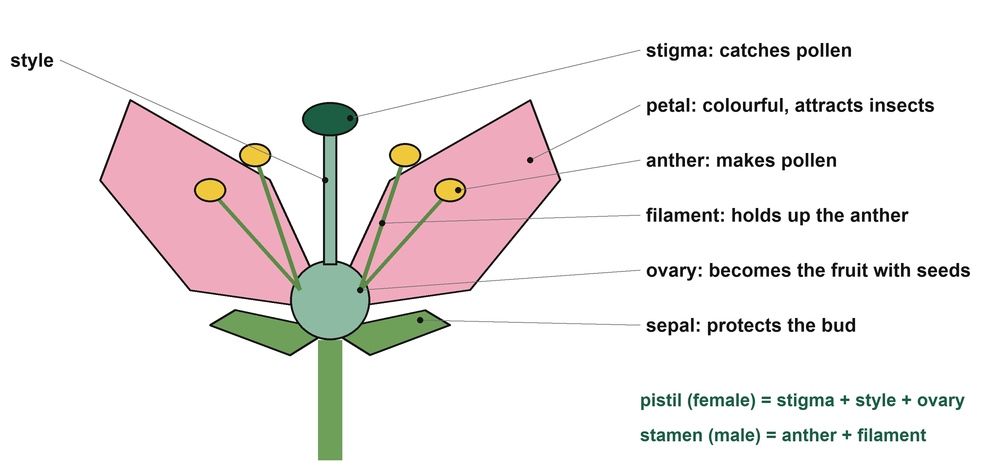
The stigma, style and ovary together form the pistil (carpel).
Pollination
Pollination
The transfer of pollen grains from an anther to a stigma.
| Type | Meaning | Result |
|---|---|---|
| Self-pollination | Pollen reaches a stigma of the same flower or plant | Offspring very like the parent |
| Cross-pollination | Pollen reaches a stigma of another plant of the same kind | More varied, often stronger offspring |
Agents of pollination: insects (beans, sunflowers, passion fruit, coffee), birds such as sunbirds, bats, wind (maize, grasses, sorghum, wheat) and, for a few plants, water.
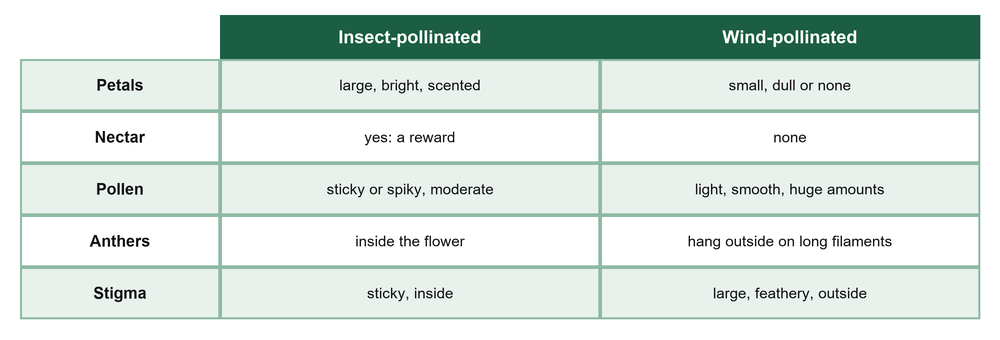
| Feature | Insect-pollinated | Wind-pollinated |
|---|---|---|
| Petals | Large, brightly coloured | Small, dull or absent |
| Scent and nectar | Present | Absent |
| Anthers | Inside the flower | Hang outside on long filaments |
| Pollen | Sticky or spiky; moderate amount | Light, smooth, dry; huge amounts |
| Stigma | Sticky, inside the flower | Large and feathery, hanging outside (maize silks) |
Protecting pollinators
Some pesticides kill bees. Spray only when needed, follow the label, spray in the evening when bees are not flying, and keep hedges and wild flowers. Fewer pollinators mean lower harvests.
Fertilisation and fruit formation
From pollen to seed
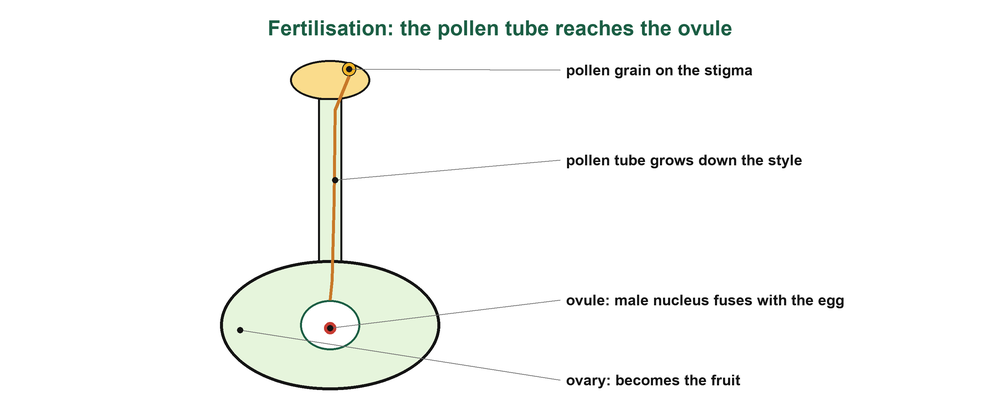
- A pollen grain on the stigma grows a pollen tube down the style to the ovary.
- The tube enters an ovule and a male nucleus passes in.
- Fertilisation: the male nucleus fuses with the female nucleus (egg).
- The fertilised ovule becomes a seed; the ovary becomes the fruit; petals and stamens wither.
In a bean pod the pod wall comes from the ovary wall and the seeds from the ovules. A seed shows a scar (hilum) where it was attached and a tiny hole (micropyle).
Dispersal of fruits and seeds
Dispersal spreads seeds away from the parent, reducing overcrowding and competition and letting plants colonise new areas.
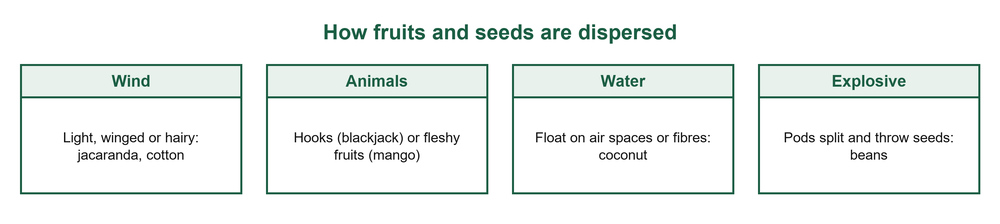
| Agent | Features | Examples |
|---|---|---|
| Wind | Small, light; wings or hairs | jacaranda, Nandi flame, cotton, sowthistle |
| Animals | Hooks that cling to fur; or fleshy, sweet, colourful fruits that are eaten | blackjack; mango, guava, tomato |
| Water | Air spaces or a fibrous waterproof covering so they float | coconut, water lily |
| Explosive (self) | Dry pods split suddenly and throw seeds | beans, peas, crotalaria |
Safety
Castor oil seeds are poisonous: never eat them. Do not taste any wild fruit or seed; wash hands after handling them.
Key points to remember
- Flower parts: sepals, petals, stamens (anther, filament), pistil (stigma, style, ovary with ovules).
- Pollination moves pollen from anther to stigma; cross-pollination gives varied offspring.
- Insect-pollinated flowers are colourful and scented; wind-pollinated ones have exposed anthers and feathery stigmas.
- Fertilisation: the pollen tube carries a male nucleus to fuse with the egg; ovule → seed, ovary → fruit.
- Dispersal: wind, animals, water, explosive.
Test yourself: multiple choice
Which part of a flower produces pollen?
Show the answer
B: Anthers make pollen.
Maize silks are the
Show the answer
C: They are feathery stigmas that catch pollen.
After fertilisation, the ovary becomes the
Show the answer
A: The ovary develops into the fruit.
Blackjack seeds are dispersed by
Show the answer
D: Their hooks cling to fur and clothes.
Which feature suits a wind-pollinated flower?
Show the answer
B: Wind carries light pollen.
Practice questions
State the function of (a) sepals (b) petals (c) stigma (d) ovary. (4 marks)
Show the answer
(a) protect the bud (b) attract pollinators (c) receives pollen (d) holds ovules; becomes the fruit.
Give three differences between insect-pollinated and wind-pollinated flowers. (6 marks)
Show the answer
Insect: bright petals, scent and nectar, sticky pollen, anthers inside. Wind: dull small petals, no scent, light pollen, anthers and feathery stigmas outside.
Describe how fertilisation takes place in a flowering plant. (4 marks)
Show the answer
Pollen grows a tube down the style to the ovary; it enters an ovule; the male nucleus fuses with the egg nucleus.
Name the method of dispersal and one feature for: (a) jacaranda (b) coconut (c) bean. (6 marks)
Show the answer
(a) wind: winged seeds (b) water: fibrous floating husk (c) explosive: pod splits open.
This is one topic. Get the whole year. The full Grade 9 Integrated Science notes cover every sub-strand of Terms 1, 2 and 3 like this one, with pictures, key points and practice questions with answers, as a printable PDF for KSh 150. Pay with M-Pesa and download at once.
Get the full Grade 9 Integrated Science notes · All Grade 9 Integrated Science resources · Notes for every grade