
Grade 9 Integrated Science · Strand 1.0 Mixtures, Elements and Compounds · Sub-strand 1.1 Structure of the Atom
These are free study notes for Grade 9 learners, written to the KICD curriculum design and taken from our full Grade 9 Integrated Science notes. This topic is the foundation for the rest of the strand and appears often in KJSEA papers, usually as a table to complete or an electron arrangement to draw.
Everything around us, from the air we breathe to the iron sheets on our roofs, is made of tiny particles called atoms. In this topic we study what an atom is made of, how to find its atomic number and mass number, how electrons are arranged, how to draw atoms with dot and cross diagrams, and how electron arrangement tells us whether an element is a metal or a non-metal.
Atoms and elements
Element
A substance made of only one kind of atom, such as copper, oxygen or carbon.
Atom
The smallest particle of an element that can take part in a chemical change.
| Element | Symbol | Element | Symbol |
|---|---|---|---|
| Hydrogen | H | Sodium | Na |
| Carbon | C | Magnesium | Mg |
| Oxygen | O | Chlorine | Cl |
| Nitrogen | N | Calcium | Ca |
Particles in an atom
| Particle | Charge | Relative mass | Where found |
|---|---|---|---|
| Proton | +1 | 1 | Nucleus |
| Neutron | 0 (no charge) | 1 | Nucleus |
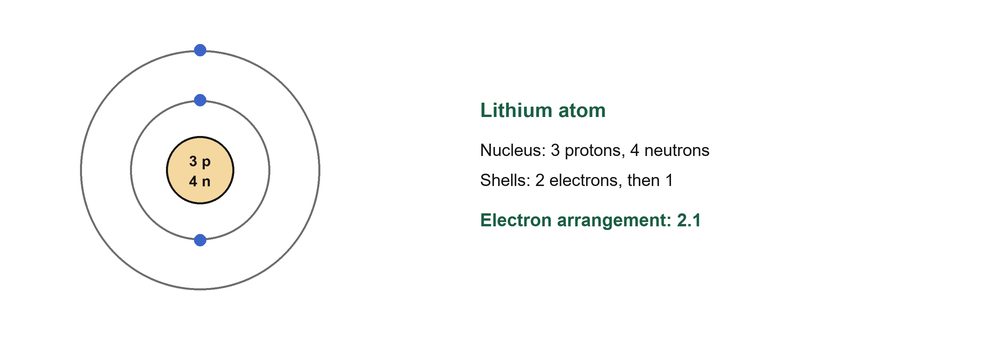
| Electron | -1 | about 1/1840 (very small) | Energy levels (shells) around the nucleus |
In a neutral atom the number of electrons equals the number of protons, so the charges cancel.
Atomic number and mass number
Atomic number
The number of protons in an atom. It also equals the number of electrons in a neutral atom.
Mass number
The number of protons plus neutrons in an atom.
Number of neutrons = mass number - atomic number. In notation, the mass number is written at the top left of the symbol and the atomic number at the bottom left.
| Element | Atomic no. | Mass no. | Protons | Neutrons | Electrons |
|---|---|---|---|---|---|
| Carbon | 6 | 12 | 6 | 12 - 6 = 6 | 6 |
| Sodium | 11 | 23 | 11 | 23 - 11 = 12 | 11 |
| Magnesium | 12 | 24 | 12 | 24 - 12 = 12 | 12 |
| Potassium | 19 | 39 | 19 | 39 - 19 = 20 | 19 |
Electron arrangement
For the first 20 elements, the first energy level holds up to 2 electrons, the second up to 8, the third up to 8, and any more go into the fourth.
| Element | Arrangement | Element | Arrangement |
|---|---|---|---|
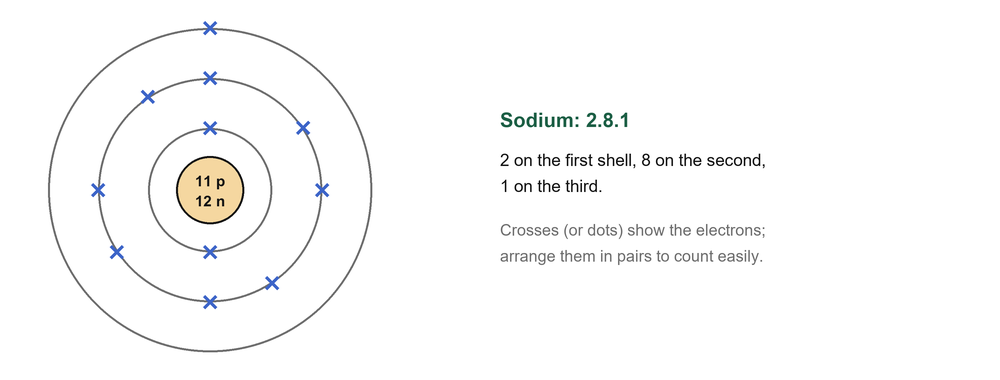
| H (1) | 1 | Na (11) | 2.8.1 |
| He (2) | 2 | Mg (12) | 2.8.2 |
| Li (3) | 2.1 | Al (13) | 2.8.3 |
| C (6) | 2.4 | P (15) | 2.8.5 |
| O (8) | 2.6 | Cl (17) | 2.8.7 |
| Ne (10) | 2.8 | Ca (20) | 2.8.8.2 |
Drawing a dot and cross diagram (sodium)
- Draw the nucleus and write 11p and 12n inside it.
- Draw three circles (energy levels) around it.
- Put 2 crosses on the first, 8 on the second and 1 on the third.
- Arrange the electrons in pairs so they are easy to count.
Metals and non-metals
| Outer electrons | Usually | Examples |
|---|---|---|
| 1, 2 or 3 | Metals | lithium, sodium, magnesium, aluminium, potassium, calcium |
| 4 to 8 | Non-metals | carbon, nitrogen, oxygen, phosphorus, sulphur, chlorine, argon |
Exceptions
Hydrogen (1 outer electron) and helium (2) are non-metals; boron (3) and silicon (4) are metalloids, between metals and non-metals.
Metals around us: aluminium sufurias, copper wires, iron nails and sheets. Non-metals: oxygen we breathe, carbon in charcoal and pencils, chlorine in water treatment. Knowing atomic structure helps scientists make medicines, fertilisers, batteries and electronics.
Key points to remember
- An atom has protons (+) and neutrons (0) in the nucleus and electrons (-) in energy levels.
- Atomic number = protons; mass number = protons + neutrons; neutrons = mass no. - atomic no.
- Shells hold 2, 8, 8 electrons for the first 20 elements: Na is 2.8.1, Ca is 2.8.8.2.
- Atoms with 1-3 outer electrons are mostly metals; 4-8 mostly non-metals.
Test yourself: multiple choice
Which particle has no charge?
Show the answer
B: Neutrons are neutral.
An atom has mass number 27 and atomic number 13. How many neutrons does it have?
Show the answer
A: 27 - 13 = 14.
What is the electron arrangement of chlorine (atomic number 17)?
Show the answer
C: 2 + 8 + 7 = 17.
An element has the arrangement 2.8.2. It is most likely
Show the answer
D: It has 2 outer electrons: magnesium, a metal.
The atomic number of an element is the number of
Show the answer
B: Atomic number = number of protons.
Practice questions
Copy and complete: an atom of aluminium has atomic number 13 and mass number 27. Protons = ..., neutrons = ..., electrons = ..., arrangement = ... (4 marks)
Show the answer
Protons 13, neutrons 14, electrons 13, arrangement 2.8.3.
Draw a dot and cross diagram of an oxygen atom (8 protons, 8 neutrons). (3 marks)
Show the answer
Nucleus labelled 8p, 8n; 2 electrons on the first shell and 6 on the second.
Classify as metal or non-metal and give a reason: (a) potassium 2.8.8.1 (b) sulphur 2.8.6. (4 marks)
Show the answer
(a) Metal: 1 outer electron. (b) Non-metal: 6 outer electrons.
Explain why a neutral atom has no overall charge. (2 marks)
Show the answer
It has equal numbers of protons (+) and electrons (-), so the charges cancel.
This is one topic. Get the whole year. The full Grade 9 Integrated Science notes cover every sub-strand of Terms 1, 2 and 3 like this one, with pictures, key points and practice questions with answers, as a printable PDF for KSh 150. Pay with M-Pesa and download at once.
Get the full Grade 9 Integrated Science notes · All Grade 9 Integrated Science resources · Notes for every grade


