Grade 9 Integrated Science · Strand 1.0 Mixtures, Elements and Compounds · Sub-strand 1.3 Water Hardness
These are free study notes for Grade 9 learners. They follow the official KICD curriculum design for Grade 9 Integrated Science (the same topics, in the same order, that your teacher uses) and are taken from our full Grade 9 Integrated Science notes. Many homes in Kenya use borehole water, which is often hard. Notice the kettle scale and soap that will not lather: this topic explains both.
Some water lathers easily with soap; some leaves a grey scum and fills kettles with white scale. The difference is hardness. In this topic we study the physical properties of water, distinguish hard from soft water, learn how to soften hard water, and weigh the advantages and disadvantages of each.
Physical properties of water
Sources of water: rain, rivers, lakes, wells, boreholes, springs and tap water. Pure water is colourless, odourless and tasteless and boils at 100 °C at sea level (a little lower at high altitude, as in much of Kenya). Dissolved substances raise the boiling point slightly.
Safety
Taste only treated or boiled water in class. Keep away from boiling water and steam, which cause serious burns.
Hard and soft water
| Feature | Soft water | Hard water |
|---|---|---|
| With soap | Lathers easily | Forms grey scum before lathering |
| Cause | Few dissolved salts | Dissolved calcium and magnesium salts |
| Examples | Rain water, distilled water | Borehole and some spring water in limestone areas |
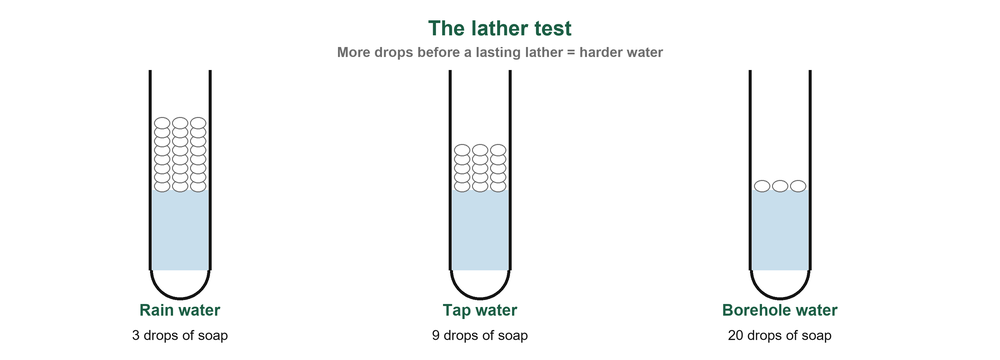
The lather test
- Put 5 cm³ of each water sample in separate test tubes.
- Add soap solution drop by drop, shaking after each drop.
- Stop when a lather lasts about 30 seconds; count the drops.
- The more drops needed, the harder the water.
Temporary and permanent hardness
| Type | Caused by | Removed by boiling? |
|---|---|---|
| Temporary hardness | calcium and magnesium hydrogencarbonates | Yes: the salts form scale ("fur") |
| Permanent hardness | calcium and magnesium sulphates and chlorides | No |
The white scale inside kettles is the solid left behind when temporary hardness is removed by boiling.
Softening hard water
| Method | Removes | Notes |
|---|---|---|
| Boiling | Temporary hardness only | Cheap; leaves scale |
| Adding washing soda | Temporary and permanent hardness | Calcium and magnesium form a solid that settles |
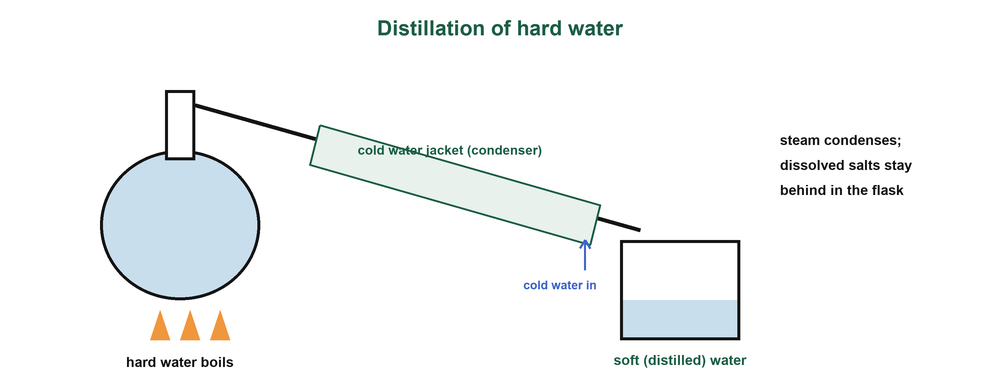
| Distillation | All hardness | Uses much energy; for laboratories, batteries and medicine |
Advantages and disadvantages
Hard water
Advantages
- Contains calcium for strong bones and teeth
- Tastes better than soft water
- Does not dissolve lead from old pipes easily
Disadvantages
- Wastes soap and forms scum
- Forms scale in kettles and pipes, wasting fuel
- Scale can block pipes
Soft water
Advantages
- Lathers easily, saving soap
- No scale in kettles and pipes
- Good for laundry and some industries
Disadvantages
- Tastes flat
- Lacks calcium
- Can dissolve lead from old pipes, which is poisonous
Saving soap with rain water
A family uses 6 bars of soap a month with hard water but 4 with rain water.
Saving: 6 - 4 = 2 bars a month; at KSh 100 a bar that is KSh 200 a month.
In a year: 200 × 12 = KSh 2,400.
Key points to remember
- Pure water is colourless, odourless, tasteless and boils at 100 °C at sea level.
- Hard water contains calcium and magnesium salts and lathers poorly.
- Boiling removes temporary hardness; washing soda and distillation remove both kinds.
- Hard water is good for drinking; soft water is good for washing.
Test yourself: multiple choice
Which water lathers most easily with soap?
Show the answer
B: Rain water is soft.
Hardness of water is caused by dissolved salts of
Show the answer
C: Calcium and magnesium salts cause hardness.
Which method removes both temporary and permanent hardness?
Show the answer
B: Washing soda removes both.
The white scale inside a kettle comes from
Show the answer
A: Boiling removes temporary hardness as scale.
One disadvantage of soft water is that it
Show the answer
D: Soft water dissolves lead more easily.
Practice questions
Describe the lather test for hard water. (4 marks)
Show the answer
Put equal volumes of samples in test tubes; add soap solution drop by drop, shaking; count drops until a lasting lather forms; more drops means harder water.
Distinguish between temporary and permanent hardness. (4 marks)
Show the answer
Temporary hardness is caused by hydrogencarbonates and removed by boiling; permanent hardness is caused by sulphates and chlorides and is not removed by boiling.
Give two advantages and two disadvantages of hard water. (4 marks)
Show the answer
Advantages: calcium for bones; good taste. Disadvantages: wastes soap; forms scale.
Why is distilled water not used for washing clothes on a large scale? (2 marks)
Show the answer
Distillation uses a lot of energy, so it is too expensive.
This is one topic. Get the whole year. The full Grade 9 Integrated Science notes cover every sub-strand of Terms 1, 2 and 3 like this one, with pictures, key points and practice questions with answers, as a printable PDF for KSh 150. Pay with M-Pesa and download at once.
Get the full Grade 9 Integrated Science notes · All Grade 9 Integrated Science resources · Notes for every grade