Grade 9 Mathematics · Strand 2.0 Algebra · Sub-strand 2.2 Equations of a Straight Line
These are free study notes for Grade 9 learners. They follow the official KICD curriculum design for Grade 9 Mathematics (the same topics, in the same order, that your teacher uses) and are taken from our full Grade 9 Mathematics notes. Gradient is the key idea: once you can find it from two points, every other part of this topic follows. Watch the signs when you subtract coordinates.
Roads, ramps, roofs and graphs of cost or savings all involve straight lines. The steepness of a line is its gradient, and its equation lets us find any point on it. In this topic we find gradients, write the equation of a line from two points or from a point and a gradient, use the form y = mx + c, find intercepts and apply straight lines to real life.
Gradient
Gradient
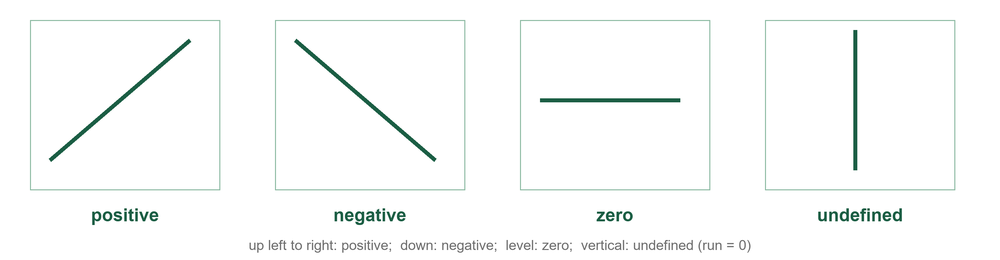
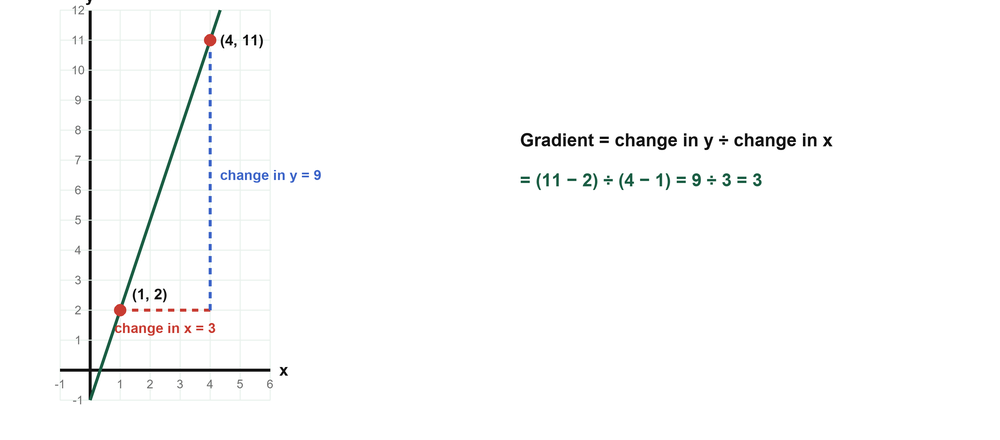
The steepness of a line: gradient = rise ÷ run = change in y ÷ change in x.
| Line | Gradient |
|---|---|
| Goes up from left to right | Positive |
| Goes down from left to right | Negative |
| Horizontal | Zero (the rise is 0) |
| Vertical | Undefined (the run is 0) |
Gradient from two points
Points (1, 2) and (4, 11): change in y = 11 - 2 = 9; change in x = 4 - 1 = 3; gradient = 9 ÷ 3 = 3.
Points (-3, -1) and (1, 7): change in y = 7 - (-1) = 8; change in x = 1 - (-3) = 4; gradient = 8 ÷ 4 = 2.
Always subtract in the same order for y and for x.
The equation of a straight line
Equation from two points
- Find the gradient m from the two points.
- Use one point (x1, y1) in y - y1 = m(x - x1).
- Expand and make y the subject.
- Check with the other point.
Line through (1, 2) and (4, 11)
m = 3. y - 2 = 3(x - 1), so y - 2 = 3x - 3 and y = 3x - 1.
Check (4, 11): 3 × 4 - 1 = 11. Correct.
Line through (2, 3) and (6, 5)
m = (5 - 3) ÷ (6 - 2) = 2 ÷ 4 = 1/2.
y - 3 = 1/2 (x - 2), so y = 1/2 x + 2. Check (6, 5): 3 + 2 = 5.
Line through (3, 5) with gradient 2
y - 5 = 2(x - 3), so y - 5 = 2x - 6 and y = 2x - 1.
Line through (1, 1) parallel to y = 3x + 2
Parallel lines have the same gradient, so m = 3.
y - 1 = 3(x - 1), so y = 3x - 2. (4, 10) is on it because 3 × 4 - 2 = 10.
The form y = mx + c and intercepts
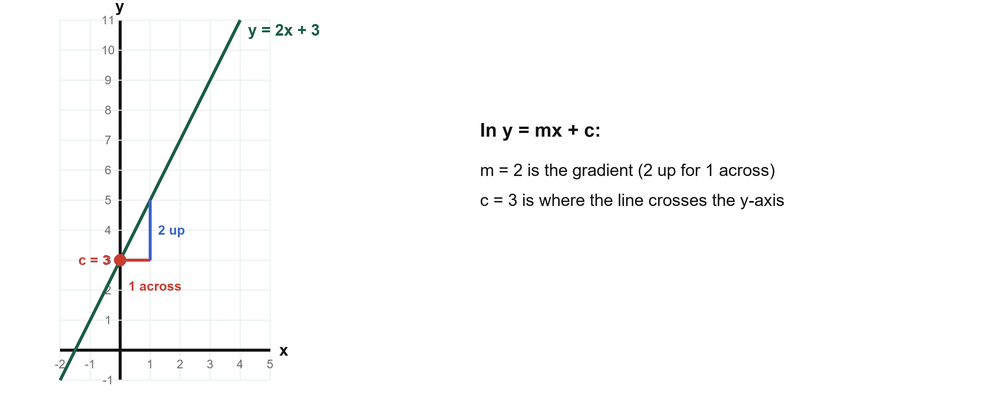
In y = mx + c, m is the gradient and c is the y-intercept (where the line crosses the y-axis).
Rearranging 2y - 4x = 6
Add 4x: 2y = 4x + 6. Divide by 2: y = 2x + 3.
So m = 2 and c = 3.
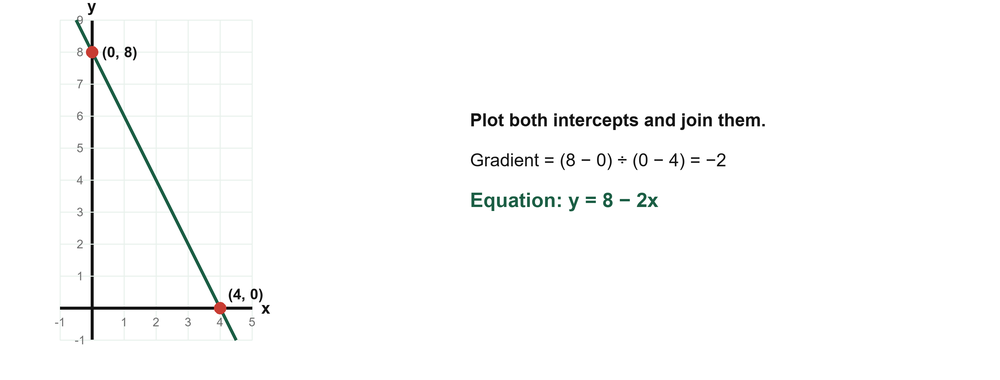
Intercepts of 2x + 3y = 12
y-intercept: put x = 0, 3y = 12, y = 4, so (0, 4).
x-intercept: put y = 0, 2x = 12, x = 6, so (6, 0).
Join (0, 4) and (6, 0) to draw the line.
Straight lines in real life
A taxi fare: C = 50d + 100
Gradient 50: the cost per kilometre. Intercept 100: the fixed charge.
A 6 km trip costs 50 × 6 + 100 = KSh 400.
A fare of KSh 650: 50d + 100 = 650, so 50d = 550 and d = 11 km.
Savings and a draining tank
Juma has KSh 2,000 and saves 250 a week: S = 250w + 2,000. After 8 weeks S = 4,000.
A tank with 1,000 litres loses 40 litres a day: V = 1,000 - 40d. It is empty when 40d = 1,000, after 25 days.
A positive gradient shows growth; a negative gradient shows something being used up.
Key points to remember
- Gradient = change in y ÷ change in x.
- Equation from a point and gradient: y - y1 = m(x - x1).
- In y = mx + c, m is the gradient and c the y-intercept.
- Find intercepts by putting x = 0 (y-intercept) and y = 0 (x-intercept).
- Parallel lines have equal gradients.
Test yourself: multiple choice
What is the gradient of the line through (2, 1) and (5, 13)?
Show the answer
B: (13 - 1) ÷ (5 - 2) = 12 ÷ 3 = 4.
What is the y-intercept of y = -3x + 7?
Show the answer
D: In y = mx + c, c = 7.
Which line is parallel to y = 5x - 2?
Show the answer
A: Parallel lines have the same gradient, 5.
Where does 4x + 2y = 8 cross the x-axis?
Show the answer
C: Put y = 0: 4x = 8, x = 2.
What is the gradient of a horizontal line?
Show the answer
D: The rise is 0, so the gradient is 0.
Practice questions
Find the gradient of the line through (-2, 5) and (4, -7). (2 marks)
Show the answer
(-7 - 5) ÷ (4 - (-2)) = -12 ÷ 6 = -2.
Find the equation of the line through (1, 3) and (3, 7) in the form y = mx + c. (3 marks)
Show the answer
- m = (7 - 3) ÷ (3 - 1) = 2.
- y - 3 = 2(x - 1), so y = 2x + 1.
Find the equation of the line through (-1, 4) with gradient -3. (2 marks)
Show the answer
y - 4 = -3(x + 1), so y = -3x + 1.
Write 3y + 6x = 9 in the form y = mx + c and state the gradient and y-intercept. (3 marks)
Show the answer
3y = -6x + 9, so y = -2x + 3; gradient -2, y-intercept 3.
Find the x- and y-intercepts of 5x - 2y = 10. (2 marks)
Show the answer
x-intercept: 5x = 10, (2, 0). y-intercept: -2y = 10, (0, -5).
A plumber charges a call-out fee and a rate per hour: C = 400h + 600. (a) What do 400 and 600 mean? (b) Find the charge for 3 hours. (c) How many hours give a charge of KSh 2,600? (4 marks)
Show the answer
- (a) 400 is the charge per hour; 600 is the call-out fee.
- (b) 400 × 3 + 600 = KSh 1,800.
- (c) 400h = 2,000, so h = 5 hours.
This is one topic. Get the whole year. The full Grade 9 Mathematics notes cover every sub-strand of Terms 1, 2 and 3 like this one, with pictures, key points and practice questions with answers, as a printable PDF for KSh 150. Pay with M-Pesa and download at once.
Get the full Grade 9 Mathematics notes · All Grade 9 Mathematics resources · Notes for every grade