Grade 9 Mathematics · Strand 5.0 Data Handling and Probability · Sub-strand 5.2 Probability
These are free study notes for Grade 9 learners. They follow the official KICD curriculum design for Grade 9 Mathematics (the same topics, in the same order, that your teacher uses) and are taken from our full Grade 9 Mathematics notes. Two rules carry this topic: add probabilities for "or" (mutually exclusive) and multiply for "and" (independent). Ask which one the question needs before you calculate.
Will it rain tomorrow? What is the chance of winning a raffle? Probability measures how likely an event is, on a scale from 0 (impossible) to 1 (certain). In this topic we carry out experiments, use the probability scale, find probabilities of equally likely outcomes, mutually exclusive events and independent events, and draw tree diagrams. We also see why betting games make players lose money in the long run.
Experiments and the probability scale
Experimental probability
Number of times an event happens ÷ number of trials. 22 heads in 40 tosses gives 22 ÷ 40 = 0.55.
Theoretical probability
For equally likely outcomes: P(event) = favourable outcomes ÷ total outcomes.
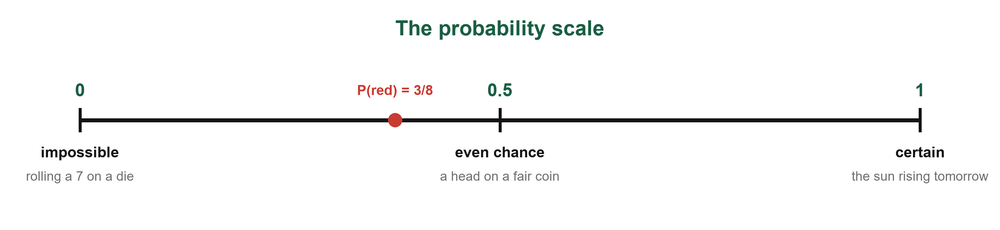
Bottle tops in a bag
A bag holds 3 red and 5 blue tops: P(red) = 3/8.
P(not red) = 1 - 3/8 = 5/8. An event and its opposite add up to 1.
The more trials, the closer the experimental probability usually comes to the theoretical one: a fair coin gets nearer to 0.5 heads as the number of tosses grows.
Mutually exclusive events
Mutually exclusive events
Events that cannot happen at the same time. For them, P(A or B) = P(A) + P(B).
Rolling a die
Rolling a 2 and rolling a 5 are mutually exclusive: P(2 or 5) = 1/6 + 1/6 = 1/3.
Rolling an even number and rolling a 6 are not mutually exclusive, because 6 is both.
Independent events and tree diagrams
Independent events
Events where one does not affect the other. For them, P(A and B) = P(A) × P(B).
A coin and a die
P(head and 6) = 1/2 × 1/6 = 1/12.
Check by listing: H1 ... H6, T1 ... T6 are 12 equally likely outcomes, and only H6 is a head with a 6.
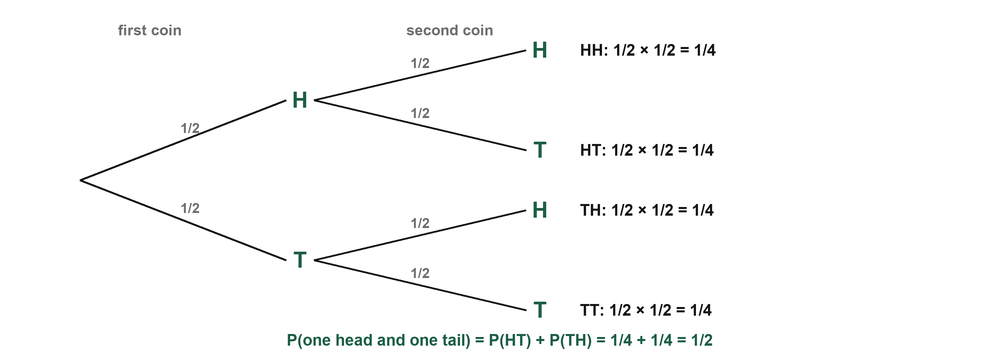
Two coins on a tree diagram
First coin: H or T, each 1/2. Second coin: H or T from each branch, each 1/2.
Multiply along the branches: P(HH) = 1/2 × 1/2 = 1/4.
Add the outcomes wanted: P(one head and one tail) = P(HT) + P(TH) = 1/4 + 1/4 = 1/2.
| Event type | Key word | Rule |
|---|---|---|
| Mutually exclusive | or | Add the probabilities |
| Independent | and | Multiply the probabilities |
Probability in real life and gambling
A dice betting game
You pay KSh 20 to roll a die and win KSh 100 if you roll a 6.
In 60 games you pay 60 × 20 = KSh 1,200 and expect about 1/6 × 60 = 10 wins worth 10 × 100 = KSh 1,000.
On average you lose 1,200 - 1,000 = KSh 200. Betting games are designed so the organiser wins in the long run.
Probability also helps in good ways: weather forecasts, insurance, medical trials and planning for risks such as floods.
Key points to remember
- Probability is between 0 (impossible) and 1 (certain).
- P(event) = favourable outcomes ÷ total outcomes; P(not A) = 1 - P(A).
- Mutually exclusive: P(A or B) = P(A) + P(B).
- Independent: P(A and B) = P(A) × P(B); multiply along tree branches.
- Betting games are designed for players to lose on average.
Test yourself: multiple choice
A box has 4 green and 6 white balls. What is P(green)?
Show the answer
B: 4 ÷ 10 = 2/5.
P(rain) = 0.3. What is P(no rain)?
Show the answer
A: 1 - 0.3 = 0.7.
What is P(head and a 3) when tossing a coin and rolling a die?
Show the answer
D: 1/2 × 1/6 = 1/12.
Which pair of events is mutually exclusive on one roll of a die?
Show the answer
C: 6 is not odd, so both cannot happen together.
A coin is tossed twice. What is P(two tails)?
Show the answer
C: 1/2 × 1/2 = 1/4.
Practice questions
A die is rolled 120 times and shows a 4 on 24 occasions. Find the experimental probability of a 4 and compare it with the theoretical probability. (3 marks)
Show the answer
- Experimental: 24 ÷ 120 = 0.2.
- Theoretical: 1/6 = 0.167, so the experiment gave slightly more 4s than expected.
The letters of the word KENYA are written on cards. A card is picked at random. Find (a) P(E) (b) P(a vowel) (c) P(not K). (3 marks)
Show the answer
(a) 1/5 (b) E and A: 2/5 (c) 4/5.
A die is rolled once. Find P(a 1 or a number greater than 4). (2 marks)
Show the answer
Outcomes 1, 5, 6: 1/6 + 2/6 = 3/6 = 1/2.
Draw a tree diagram for tossing a coin and then rolling a die showing only "6" and "not 6". Find P(tail and not 6). (4 marks)
Show the answer
- Branches: H, T (1/2 each); then 6 (1/6) and not 6 (5/6).
- P(T and not 6) = 1/2 × 5/6 = 5/12.
In a raffle, 500 tickets are sold and there are 5 prizes. Achieng buys 2 tickets. What is the probability that a given ticket of hers wins a prize? (2 marks)
Show the answer
5/500 = 1/100 for each ticket.
This is one topic. Get the whole year. The full Grade 9 Mathematics notes cover every sub-strand of Terms 1, 2 and 3 like this one, with pictures, key points and practice questions with answers, as a printable PDF for KSh 150. Pay with M-Pesa and download at once.
Get the full Grade 9 Mathematics notes · All Grade 9 Mathematics resources · Notes for every grade