
Grade 9 Mathematics · Strand 3.0 Measurements · Sub-strand 3.4 Time, Distance and Speed
These are free study notes for Grade 9 learners, written to the KICD curriculum design and taken from our full Grade 9 Mathematics notes. Most mistakes here are unit mistakes: mixing minutes with hours or km/h with m/s. Each worked example shows the conversion step, so copy that habit.
A matatu driver, an athlete and an airline pilot all work with speed and time. In this topic we find speed in km/h and m/s, average speed, velocity and acceleration, and then use longitudes to work out the local time at places around the world.
Speed and average speed
Speed
Distance travelled per unit time: speed = distance ÷ time. So distance = speed × time and time = distance ÷ speed.
Finding speed
A matatu covers 150 km in 2.5 hours: 150 ÷ 2.5 = 60 km/h.
A runner covers 100 m in 12.5 s: 100 ÷ 12.5 = 8 m/s.
To change km/h to m/s divide by 3.6; to change m/s to km/h multiply by 3.6, because 1 km/h = 1,000 m ÷ 3,600 s.
Converting
72 km/h = 72 ÷ 3.6 = 20 m/s.
15 m/s = 15 × 3.6 = 54 km/h.
Average speed
Total distance ÷ total time (not the average of the speeds).
A journey in two parts
120 km at 60 km/h takes 2 hours; 90 km at 45 km/h takes 2 hours.
Average speed = (120 + 90) ÷ (2 + 2) = 210 ÷ 4 = 52.5 km/h.
Velocity and acceleration
| Quantity | Meaning | Unit |
|---|---|---|
| Distance | How far you travel along the path | m |
| Displacement | Change of position in a stated direction | m with a direction |
| Speed | Distance ÷ time | m/s |
| Velocity | Displacement ÷ time, with a direction | m/s with a direction |
| Acceleration | Change in velocity ÷ time | m/s² |
Walking 400 m east then 300 m west in 300 s
Distance = 700 m; displacement = 100 m east.
Speed = 700 ÷ 300 = 2.33 m/s; velocity = 100 ÷ 300 = 0.33 m/s east.
Acceleration a = (v - u) ÷ t, where u is the starting velocity and v the final velocity. So v = u + a t. A negative acceleration is a deceleration (slowing down).
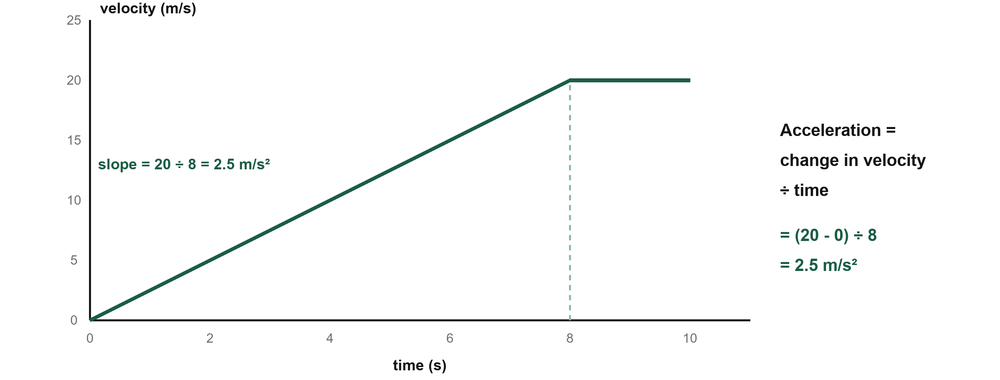
Acceleration
From rest to 20 m/s in 8 s: a = (20 - 0) ÷ 8 = 2.5 m/s².
From 25 m/s to rest in 5 s: a = (0 - 25) ÷ 5 = -5 m/s² (a deceleration).
u = 5 m/s, a = 2 m/s², t = 6 s: v = 5 + 2 × 6 = 17 m/s.
Longitudes and time
Longitude
An imaginary line from the North Pole to the South Pole. The Greenwich meridian (0°) passes through London; places are up to 180° east or west of it.
The Earth turns 360° in 24 hours, which is 15° every hour, or 1° every 4 minutes. The Sun rises in the east, so places to the east of Greenwich are ahead in time and places to the west are behind. Nairobi is at about 37° E.
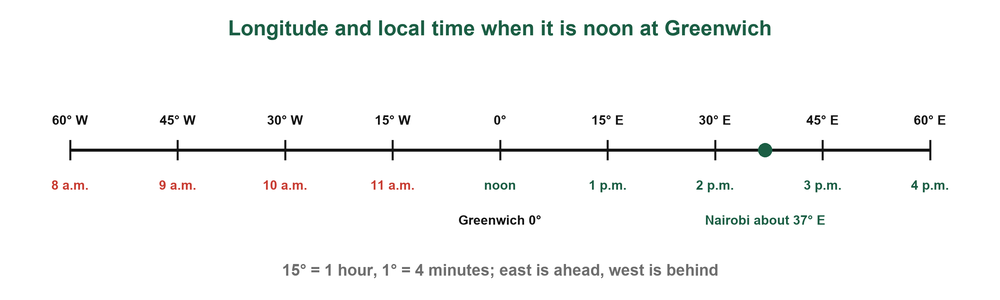
Finding local time when it is 12 noon at Greenwich
A place at 45° E is 45 × 4 = 180 minutes = 3 hours ahead: 3 p.m.
A place at 30° W is 30 × 4 = 120 minutes = 2 hours behind: 10 a.m.
Places at 36° E and 15° W are 36 + 15 = 51° apart: 51 × 4 = 204 minutes = 3 hours 24 minutes.
Same side or opposite sides
If two places are both east (or both west), subtract their longitudes; if one is east and the other west, add them.
Time and distance in real life
A flight to London
A flight leaves Nairobi at 11 p.m. East Africa Time and takes 8.5 hours, landing at 7:30 a.m. East Africa Time.
London is about 3 hours behind in its winter, so it lands at about 4:30 a.m. London time.
Drivers use speed and time to plan journeys and keep to speed limits; pilots, travellers and businesses use time zones to arrange flights and calls.
Key points to remember
- Speed = distance ÷ time; km/h ÷ 3.6 = m/s.
- Average speed = total distance ÷ total time.
- Velocity has a direction; acceleration = (v - u) ÷ t, in m/s².
- 15° of longitude = 1 hour; 1° = 4 minutes; east is ahead, west is behind.
Test yourself: multiple choice
What is 90 km/h in m/s?
Show the answer
A: 90 ÷ 3.6 = 25 m/s.
A cyclist rides 30 km in 1.5 hours and then 10 km in 0.5 hours. What is the average speed?
Show the answer
B: 40 km ÷ 2 hours = 20 km/h.
A car goes from 10 m/s to 30 m/s in 5 s. What is its acceleration?
Show the answer
D: (30 - 10) ÷ 5 = 4 m/s².
How many minutes of time is 1° of longitude?
Show the answer
C: 360° in 24 hours: 1° = 1,440 ÷ 360 = 4 minutes.
It is noon at Greenwich. What time is it at 60° E?
Show the answer
A: 60 × 4 = 240 minutes = 4 hours ahead.
Practice questions
A bus leaves Nairobi at 7:15 a.m. and reaches Nakuru, 160 km away, at 9:15 a.m. Find its average speed in km/h and in m/s. (3 marks)
Show the answer
- 160 ÷ 2 = 80 km/h.
- 80 ÷ 3.6 = 22.2 m/s.
A lorry travels at 50 km/h for 3 hours and then at 80 km/h for 1.5 hours. Find its average speed. (3 marks)
Show the answer
- Distance = 150 + 120 = 270 km; time = 4.5 hours.
- Average speed = 270 ÷ 4.5 = 60 km/h.
A motorbike moving at 12 m/s accelerates at 1.5 m/s² for 8 s. Find its final velocity. (2 marks)
Show the answer
v = 12 + 1.5 × 8 = 24 m/s.
A car moving at 24 m/s stops in 6 s. Find its deceleration. (2 marks)
Show the answer
(0 - 24) ÷ 6 = -4 m/s², a deceleration of 4 m/s².
When it is 10 a.m. in Nairobi (37° E), what is the local time at a place at 23° W? (3 marks)
Show the answer
- Difference = 37 + 23 = 60°, which is 60 × 4 = 240 minutes = 4 hours.
- The place is to the west, so it is behind: 6 a.m.
This is one topic. Get the whole year. The full Grade 9 Mathematics notes cover every sub-strand of Terms 1, 2 and 3 like this one, with pictures, key points and practice questions with answers, as a printable PDF for KSh 150. Pay with M-Pesa and download at once.
Get the full Grade 9 Mathematics notes · All Grade 9 Mathematics resources · Notes for every grade


