
Grade 9 Pre-Technical Studies · Strand 5.0 Entrepreneurship · Sub-strand 5.3 Business Plan
These are free study notes for Grade 9 learners. They follow the official KICD curriculum design for Grade 9 Pre-Technical Studies (the same topics, in the same order, that your teacher uses) and are taken from our full Grade 9 Pre-Technical Studies notes. Try writing a one-page plan for a small business you know, such as a school canteen or a bodaboda, using the components below.
"Failing to plan is planning to fail." Before starting a business, an entrepreneur writes a business plan describing the business, its customers and its money matters. In this topic we explain the importance of a business plan, describe its components, analyse a sample plan and fill in a business plan template.
Meaning and importance
Business plan
A written document describing a business, its goals and how it will achieve them, including money matters.
- Clarifies ideas and goals.
- Shows whether the business can make a profit.
- Guides decisions and helps manage money.
- Helps get loans and investors.
- Helps measure progress.
Components of a business plan
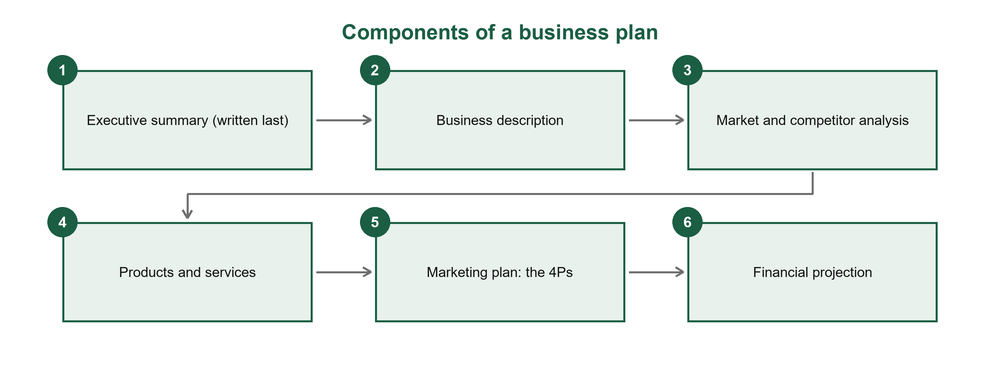
| Component | What it contains |
|---|---|
| Executive summary | A short overview of the whole plan (written last, placed first) |
| Business description | Name, location, owners, type of business, mission and goals |
| Market and competitor analysis | Customers, their number and needs; competitors, their prices, strengths and weaknesses |
| Products and services | What you sell, features, quality and price |
| Marketing plan | The 4Ps: product, price, place, promotion |
| Financial projection | Start-up capital, expected sales, costs and profit |
A financial projection for mandazi
Sales: 30 mandazi a day at KSh 10 = 30 × 10 = KSh 300.
Costs: KSh 180 a day.
Daily profit = 300 - 180 = KSh 120.
Analysing a sample plan
Two youths growing kale and spinach
Summary: kale and spinach on a quarter acre, sold to households and a school.
Market: 50 households and one school; competitor: the open-air market (cheaper but far).
Marketing: delivery to doors and WhatsApp orders.
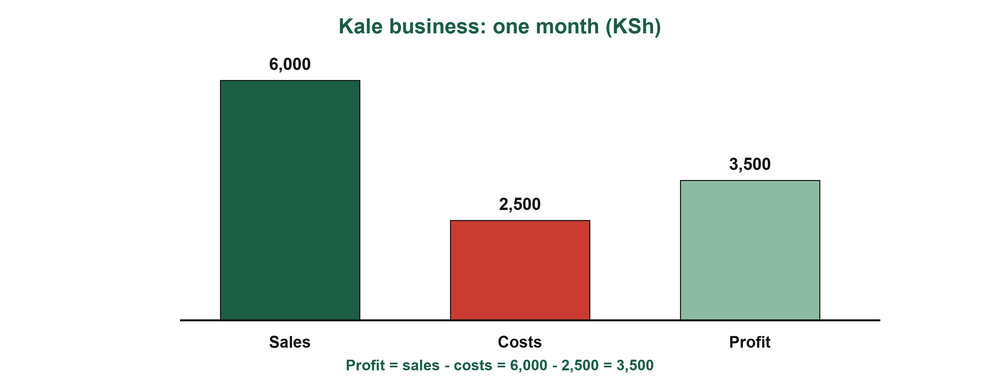
Finance: start-up KSh 8,000; monthly sales KSh 6,000; monthly costs KSh 2,500.
Monthly profit = 6,000 - 2,500 = KSh 3,500.
A gap in the plan
There is no plan for the dry season, when the crops need water. A good plan foresees risks.
Filling in a business plan template
Completing the template
- Describe the business, its mission and goals.
- Analyse customers and competitors.
- Describe products and set prices; plan the 4Ps.
- Work out start-up capital, monthly sales, costs and profit.
- Finally write the executive summary.
Selling shoe racks
Price: KSh 670 per rack; 4 racks a month.
Monthly sales = 4 × 670 = KSh 2,680.
Groups present their plans while the class acts as a panel of lenders asking polite questions. A plan should be reviewed and updated as the business grows.
Key points to remember
- A business plan describes a business, its goals and its money matters.
- It clarifies goals, shows profitability, guides decisions and helps get loans.
- Components: executive summary, business description, market analysis, products, marketing plan, financial projection.
- Profit = sales - costs.
- The executive summary is written last but placed first.
Test yourself: multiple choice
Which part of a business plan is written last but placed first?
Show the answer
D: It summarises everything else.
The 4Ps of marketing are product, price, place and
Show the answer
A: Promotion tells customers about the product.
Sales are KSh 450 and costs KSh 300. The profit is
Show the answer
B: 450 - 300 = 150.
Information about rival businesses belongs in the
Show the answer
C: Competitors are analysed with the market.
Which is a reason for writing a business plan?
Show the answer
B: Lenders want to see a plan.
Practice questions
State four reasons why a business plan is important. (4 marks)
Show the answer
- Clarifies goals
- Shows whether the business can make a profit
- Helps get loans
- Guides decisions and measures progress
List the six components of a business plan. (6 marks)
Show the answer
Executive summary; business description; market and competitor analysis; products and services; marketing plan; financial projection.
A learner sells 40 samosas a day at KSh 15 each. Daily costs are KSh 380. Find the daily sales and profit. (3 marks)
Show the answer
- Sales = 40 × 15 = KSh 600
- Profit = 600 - 380 = KSh 220
The kale business has a start-up capital of KSh 8,000 and a monthly profit of KSh 3,500. After how many whole months will the profits first cover the start-up capital? (3 marks)
Show the answer
- After 2 months: 2 × 3,500 = KSh 7,000 (not yet enough)
- After 3 months: 3 × 3,500 = KSh 10,500, which covers KSh 8,000
- Answer: 3 months
This is one topic. Get the whole year. The full Grade 9 Pre-Technical Studies notes cover every sub-strand of Terms 1, 2 and 3 like this one, with pictures, key points and practice questions with answers, as a printable PDF for KSh 150. Pay with M-Pesa and download at once.
Get the full Grade 9 Pre-Technical Studies notes · All Grade 9 Pre-Technical Studies resources · Notes for every grade