
Grade 9 Social Studies · Strand 5.0 Political Developments and Governance · Sub-strand 5.3 Kenya’s Bill of Rights
These are free study notes for Grade 9 learners, written to the KICD curriculum design and taken from our full Grade 9 Social Studies notes. Article numbers in these notes were checked against the Constitution of Kenya 2010. Learn the main rights with one real-life example each; questions usually describe a situation and ask which right is involved.
Every person in Kenya has rights that the State must respect. These rights are written in the Bill of Rights, Chapter Four of the Constitution. In this topic we explore the Bill of Rights, the rights of special groups, how to apply the Bill of Rights in daily life, and how assertiveness, empathy and solidarity help us stand up for human rights.
The Bill of Rights
Bill of Rights
Chapter Four of the Constitution (Articles 19 to 59), listing the rights and fundamental freedoms of every person in Kenya.
- Rights belong to every person; they are not granted by the State.
- They can be limited only by law, and only where it is reasonable (Article 24).
- Purpose: protect dignity, promote social justice and help every person reach their potential.
Rights and fundamental freedoms
| Article | Right |
|---|---|
| 26 | Right to life |
| 27 | Equality and freedom from discrimination |
| 28 | Human dignity |
| 29 | Freedom and security of the person |
| 31 | Privacy |
| 32 | Freedom of conscience, religion and belief |
| 33 | Freedom of expression |
| 35 | Access to information |
| 36 | Freedom of association |
| 37 | Assembly, demonstration and petition |
| 43 | Economic and social rights: health, housing, food, water, social security, education |
Rights of special groups
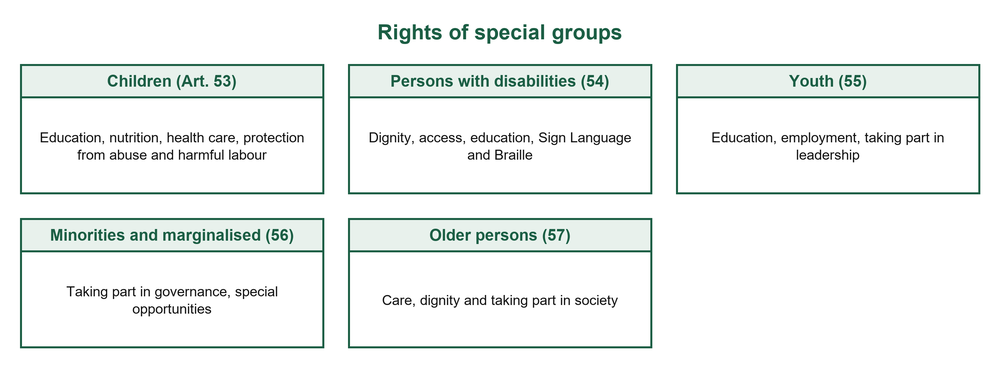
Social justice is fairness in sharing opportunities and resources; inclusivity is making sure no one is left out. Equity sometimes means giving more support to those who need it so they reach the same opportunities. Examples: ramps and accessible toilets, Sign Language interpreters, cash transfers to older persons, scholarships for needy learners and affirmative action for marginalised communities.
Applying the Bill of Rights
| Right | Responsibility that comes with it |
|---|---|
| Freedom of expression | Do not spread hate speech or lies |
| Right to property | Respect other people's property |
| Freedom of religion | Respect other people's beliefs |
| Right to education | Attend school and learn |
Cases to settle fairly
A learner is denied admission for being pregnant: her right to education (Articles 43 and 53) is violated.
A neighbour blocks a public path: others' freedom of movement is affected.
A child is kept home to work: the child's right to education and protection is violated.
Assertiveness, empathy and solidarity
Standing up for a right assertively
- Stay calm.
- Use "I" statements.
- State the right clearly.
- Suggest a fair solution, and seek help from the authorities if needed.
Empathy is understanding how others feel; solidarity is standing with them and acting together. Acts of solidarity include befriending learners with disabilities, visiting older persons, supporting orphans, learning basic Kenyan Sign Language and joining a human rights club.
Key points to remember
- The Bill of Rights is Chapter Four (Articles 19 to 59) of the Constitution.
- Rights belong to every person and can be limited only by reasonable law (Article 24).
- Special groups: children (53), persons with disabilities (54), youth (55), minorities (56), older persons (57).
- Every right comes with a responsibility.
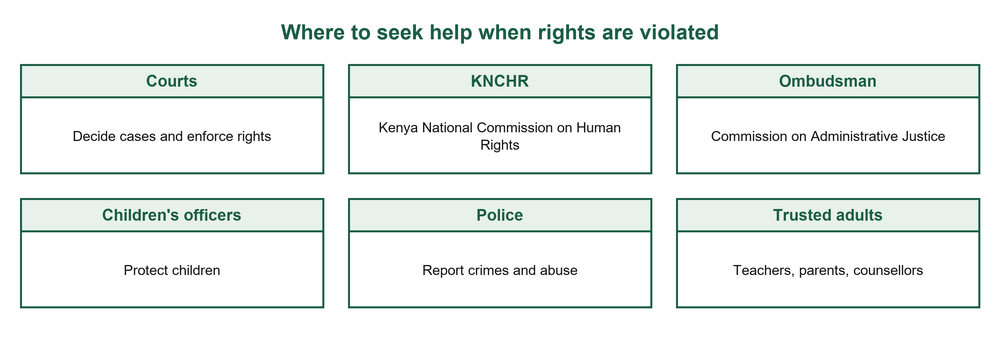
- Assertiveness, empathy and solidarity help protect rights; KNCHR, courts and the Ombudsman give help.
Test yourself: multiple choice
The Bill of Rights is found in which chapter of the Constitution?
Show the answer
B: Chapter Four, Articles 19 to 59.
Article 54 protects the rights of
Show the answer
D: Article 54 covers persons with disabilities.
Which responsibility goes with freedom of expression?
Show the answer
A: Expression must not harm others with hate or lies.
Which body protects human rights in Kenya?
Show the answer
C: The Kenya National Commission on Human Rights.
Standing with others and acting together for their rights is
Show the answer
B: Solidarity means acting together with others.
Practice questions
State four rights found in Kenya's Bill of Rights. (4 marks)
Show the answer
Life; equality; human dignity; privacy; freedom of religion; freedom of expression; access to information; education (any four).
Name the five special groups whose rights are given in Articles 53 to 57. (5 marks)
Show the answer
Children; persons with disabilities; youth; minorities and marginalised groups; older members of society.
Give the responsibility that goes with each right: freedom of expression; right to property. (2 marks)
Show the answer
- Expression: avoid hate speech and lies
- Property: respect other people's property
Describe three ways learners can show solidarity with special groups. (3 marks)
Show the answer
- Include learners with disabilities
- Visit older persons
- Learn basic Kenyan Sign Language (also support orphans, join a rights club)
This is one topic. Get the whole year. The full Grade 9 Social Studies notes cover every sub-strand of Terms 1, 2 and 3 like this one, with pictures, key points and practice questions with answers, as a printable PDF for KSh 150. Pay with M-Pesa and download at once.
Get the full Grade 9 Social Studies notes · All Grade 9 Social Studies resources · Notes for every grade


