Grade 4 CBC Science Study Notes: Living Things
1. Plants
Plants are living things that grow in the soil, water, and on other structures.
Classification of Plants
Classification is the process of sorting or grouping plants according to their shared features.
PLANTS
│
┌────────────────┴────────────────┐
▼ ▼
FLOWERING PLANTS NON-FLOWERING PLANTS
(Maize, Beans, Pawpaw) (Mosses, Ferns, Algae)
- Flowering Plants: Plants that produce flowers.
- Examples: Maize, beans, pawpaw, mango trees, hibiscus.
- Non-Flowering Plants: Plants that do not produce flowers.
- Examples: Mosses, ferns, algae, pine trees.
Safety Precautions When Handling Plants
Some plants have thorns, irritating hairs, or poisonous sap. Learners must observe the following precautions:
- Wear protective gear: Always wear gloves and protective coats/aprons when collecting or examining plant samples.
- Wash hands: Clean hands thoroughly with soap and clean water immediately after handling plants.
- Do not ingest or smell unknown plants: Never eat, taste, or directly smell unfamiliar or poisonous plants.
Importance of Flowering Plants
Flowering plants play a vital role in our daily lives and environment:
- Food: Provide fruits, vegetables, grains, and nuts for human and animal consumption.
- Shelter: Provide timber used to construct houses and furniture.
- Medicine: Produce essential ingredients used in traditional and modern medicines.
- Aesthetics: Enhance environmental beauty through ornamental flowers and landscaping.
2. Fungi
Fungi are unique living organisms. They are neither plants nor animals because they do not make their own food through photosynthesis.
FUNGI
│
┌─────────────────┼─────────────────┐
▼ ▼ ▼
MUSHROOMS YEAST BREAD MOULD
(Edible/Poisonous) (Baking) (Decaying food)
- How Fungi Feed: Fungi grow on dead, decaying matter or damp organic material, absorbing nutrients directly from them.
- Where They Grow: Soil, water, rotting wood, decaying vegetation, and stale food items (e.g., green or black patches of mould on bread).
- Common Examples: Mushrooms, yeast, and bread mould.
Safety Precautions When Handling Fungi
- Wear protective gear: Use gloves and masks to avoid direct contact or breathing in spores.
- Wash hands: Wash hands thoroughly with soap and water after handling any fungal specimen.
- Avoid tasting or smelling wild fungi: Never taste or smell wild mushrooms or moulds; many species are highly toxic.
Importance of Fungi
Fungi provide several economic and environmental benefits:
- Food Source: Edible mushrooms are cultivated and harvested as a nutritious food source and cash crop.
- Baking Industry: Yeast is used as a leavening agent to make bread dough rise.
- Fermentation: Yeast and specific fungi aid in fermenting beverages and traditional milk products.
- Medicine: Used in the production of antibiotics (e.g., penicillin) and other pharmaceutical products.
- Biocontrol: Applied in organic pest management to control harmful insects.
3. Animals: Vertebrates
Animals are divided into two main categories: Vertebrates (animals with a backbone) and Invertebrates (animals without a backbone).
A vertebral column (backbone) extends from the base of the skull, connecting the ribcage, upper limbs, and lower limbs.
VERTEBRATES
│
┌──────────────┬────────┴───────┬──────────────┐
▼ ▼ ▼ ▼ ▼
MAMMALS BIRDS FISH REPTILES AMPHIBIANS
Warm-Blooded vs. Cold-Blooded Animals
Category
Description
Animal Groups
Warm-Blooded
Keep a constant body temperature regardless of external weather.
Mammals, Birds
Cold-Blooded
Body temperature changes according to the surrounding environment.
Fish, Reptiles, Amphibians
The 5 Classes of Vertebrates
1. Mammals
- Body Covering: Hair or fur.
- Temperature: Warm-blooded.
- Breathing: Lungs.
- Reproduction: Give birth to live young (Except egg-laying mammals like the Duck-billed platypus and Spiny anteater).
- Key Feature: Females have mammary glands to produce milk for their young.
- Examples: Human beings, cows, dogs, whales, bats.
2. Birds
- Body Covering: Feathers.
- Temperature: Warm-blooded.
- Breathing: Lungs.
- Reproduction: Lay hard-shelled eggs.
- Key Features: Have wings, beaks, and two legs. Most birds fly, though some (like ostriches) are flightless.
- Examples: Eagles, hens, ostriches, ducks.
3. Fish
- Body Covering: Moist, slippery scales.
- Temperature: Cold-blooded.
- Breathing: Gills (to extract dissolved oxygen from water).
- Reproduction: Lay eggs in water.
- Key Feature: Live entirely in water and move using fins and tails.
- Examples: Tilapia, Nile perch, sharks.
4. Reptiles
- Body Covering: Dry, tough scales.
- Temperature: Cold-blooded.
- Breathing: Lungs.
- Reproduction: Lay soft-shelled, leathery eggs on land.
- Examples: Snakes, lizards, tortoises, crocodiles.
5. Amphibians
- Body Covering: Smooth, moist skin without scales.
- Temperature: Cold-blooded.
- Breathing: Gills when young (tadpoles); lungs and moist skin when adults.
- Reproduction: Lay jelly-like eggs in water.
- Key Feature: Spend part of their lifecycle in water and part on land.
- Examples: Frogs, toads, salamanders.
Grade 4 CBC Science Study Notes: Human Body
1. Sense Organs
Sense organs are special body parts that receive information from our surroundings and send signals to the brain to help us understand the world.
HUMAN SENSE ORGANS
│
┌──────────────┬────────┼──────────────┬──────────────┐
▼ ▼ ▼ ▼ ▼
EYES EARS NOSE TONGUE SKIN
(Sight) (Hearing) (Smell) (Taste) (Touch/Feeling)
The 5 Senses and Their Organs
- Sight: Eyes allow us to see colors, shapes, and movement.
- Hearing: Ears help us hear sounds and music.
- Smell: Nose detects pleasant and bad odors.
- Taste: Tongue helps us taste sweet, salty, sour, and bitter foods.
- Touch / Feeling: Skin allows us to feel heat, cold, pain, pressure, and textures.
Caring for Sense Organs
To keep our sense organs healthy and functional:
- Skin: Bath daily using clean water and soap, then apply oil or lotion to keep it moist.
- Mouth & Tongue: Brush teeth and gently clean the tongue every morning and evening.
- Nose: Wipe and clean the nose using a clean handkerchief.
- Ears: Clean the outer ear gently using a soft cloth or cotton buds (never poke inside the ear canal).
- Safety Rule: Never insert sharp or pointed objects (e.g., pencils, sticks, pins) into the nose or ears.
2. Human Skeleton and Bones
The human skeleton is the internal framework made of bones, cartilage, and connective tissues that supports the entire body.
Main Parts and Functions of the Skeleton
HUMAN SKELETON
│
┌──────────────┬──────┴───────┬──────────────┐
▼ ▼ ▼ ▼
SKULL BACKBONE RIBCAGE LIMB BONES
(Brain protection) (Spine) (Heart/Lungs) (Legs & Arms)
Skeleton Part
Location
Main Function
Skull
Head
Hard bone frame that protects the brain from injury.
Backbone (Spine)
Neck to Pelvis
Made of 33 vertebrae bones. Holds the body upright, allows twisting/bending, and protects the spinal cord.
Rib Cage
Chest Area
Made of 12 pairs of curved rib bones. Protects internal organs like the heart and lungs.
Limb Bones
Arms and Legs
Supports body weight and enables movement (walking, running, writing).
Detailed Structure of Limb Bones
- Upper Limbs (Arms): Contains 30 bones per arm.
- Humerus: The upper arm bone.
- Radius & Ulna: The two paired bones in the forearm.
- Lower Limbs (Legs): Contains 30 bones per leg.
- Femur (Thigh bone): The longest bone in the human body; connects to the hip socket.
- Tibia & Fibula: The two lower leg bones.
- Tarsals, Metatarsals, and Phalanges: Bones forming the ankle, foot, and toes.
3. Muscles
Muscles are bundles of elastic fibrous tissue that contract and relax to produce movement and maintain body posture.
The 3 Types of Muscles
MUSCLE TYPES
│
┌─────────────────────┼─────────────────────┐
▼ ▼ ▼
SKELETON MUSCLES CARDIAC MUSCLES SMOOTH MUSCLES
(Voluntary) (Heart rate) (Involuntary)
- Skeletal Muscles (Voluntary Muscles):
- Connected to bones by tough cords called tendons.
- Controlled consciously by choice (e.g., biceps and triceps when raising your arm).
- Functions: Move the body, keep the body upright, protect internal organs, and control body temperature.
- Cardiac Muscles (Heart Muscle):
- Found exclusively in the heart.
- Contracts automatically and rhythmically without stopping to pump blood through the body.
- Smooth Muscles (Involuntary Muscles):
- Controlled automatically by the body (not under conscious control).
- Found in the walls of internal organs such as the stomach, intestines, urinary bladder, and blood vessels.
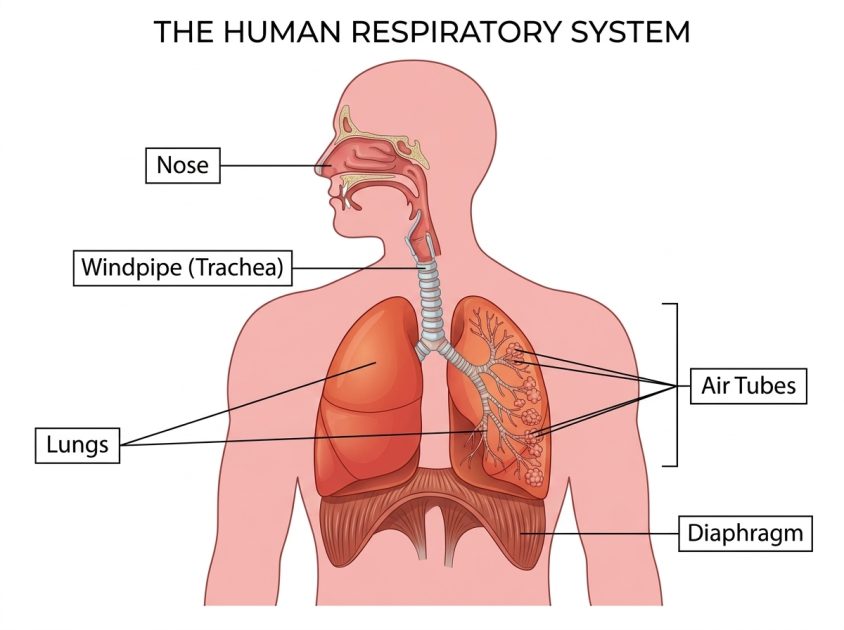
The Human Breathing System
1. What is the Breathing System?
A system is a group of organs that work together to perform a specific function in the body.
Breathing is the process of taking air into the body (inhalation) and releasing air out of the body (exhalation). The human body takes in oxygen (needed for energy) and gets rid of carbon dioxide (waste gas).
2. Parts of the Breathing System and Their Functions
AIR FLOW PATHWAY
│
NOSE (Nostrils) ──► TRACHEA (Windpipe) ──► LUNGS ──► DIAPHRAGM
(Cleans & warms) (C-shaped rings) (Gas exchange) (Controls airflow)
Main Parts and Functions
- Nose (Nostrils):
- Air enters through the nostrils.
- Tiny hairs inside the nose trap dust and dirt particles.
- Mucus (a moist lining) makes the air warm, moist, and clean before it enters the body.
- Trachea (Windpipe):
- A tube that connects the nose to the lungs.
- Supported by C-shaped cartilaginous rings that keep it strong, open, and prevent it from collapsing.
- Contains mucus and tiny hair-like structures (cilia) to filter remaining dirt particles.
- Lungs:
- A pair of spongy, air-filled organs located inside the chest protected by the rib cage.
- Absorb oxygen into the blood and remove carbon dioxide from the body.
- Diaphragm:
- A large dome-shaped muscle located directly below the lungs that separates the chest from the abdomen.
- Breathing In (Inhalation): Moves downward to help pull air into the lungs.
- Breathing Out (Exhalation): Moves upward to help push air out of the lungs.
3. Common Diseases of the Breathing System
Tuberculosis (TB) Affecting Lungs. Source: Rujirat Boonyong / Getty Images
Comparison of Respiratory Diseases
Disease
Cause
Key Symptoms
Prevention Measures
Tuberculosis (TB)
Bacteria
Persistent cough (>3 weeks), coughing up blood, night sweats, weight loss.
BCG vaccination for infants, staying in well-ventilated rooms, covering mouth when coughing.
Pneumonia
Bacteria, Viruses, or Fungi
Chest pain, fever, chills, shaking, severe cough with mucus, shortness of breath.
Pneumococcal vaccination, good hygiene, avoiding smoking exposure.
Common Cold
Virus
Runny/stuffy nose, sneezing, mild sore throat, low fever.
Frequent handwashing with soap, avoiding sharing utensils, covering mouth/nose.
Asthma
Triggers (Pollen, dust, smoke, cold air)
Narrowed airways, whistling/wheezing sound when breathing, shortness of breath.
Identifying and avoiding triggers, using prescribed inhalers/medication.
Coughs
Dust, smoke, infections
Persistent throat clearing, sore throat, hoarse voice.
Avoiding dusty areas, drinking plenty of water, staying away from smoke.
Influenza (Flu)
Virus
High fever, severe body aches, dry cough, fatigue, headache.
Annual flu vaccination, frequent handwashing, staying away from crowded places.
COVID-19
Coronavirus
Fever, dry cough, tiredness, loss of taste or smell, difficulty breathing.
Washing hands for 20 seconds, wearing face masks, maintaining social distance (2 meters).
Summary Checklist for Teachers & Learners
KEY PREVENTIVE HABITS
│
┌─────────────────────────┼─────────────────────────┐
▼ ▼ ▼
HAND HYGIENE RESPIRATORY ETiquette HEALTHY ENVIRONMENT
(Wash with soap 20s) (Sneeze into elbow/tissue) (Dust-free & ventilated)
- Hygiene: Wash hands regularly with soap and running water for at least 20 seconds.
- Cough Etiquette: Cover the mouth and nose using a handkerchief, tissue, or flexed elbow when sneezing or coughing.
- Environment: Maintain well-ventilated, dust-free classrooms and homes.
- Medical Care: Seek medical attention promptly if coughing persists or if breathing difficulties occur.
Grade 4 CBC Health Education Notes: Diseases & Parasites
1. Waterborne Diseases
Waterborne diseases are illnesses caused by microscopic organisms (germs) spread through drinking contaminated water or eating contaminated food.
WATERBORNE DISEASES
│
┌──────────────┬────────┴────────┬──────────────┐
▼ ▼ ▼ ▼
TYPHOID BILHARZIA CHOLERA DYSENTERY
(Bacteria) (Parasitic Worm) (Bacteria) (Bacteria)
Overview of Common Waterborne Diseases
Disease
Primary Cause & Transmission
Key Signs & Symptoms
Specific Prevention & Control
Typhoid
Bacteria spread via contaminated food and water.
• Body weakness & headache
• High fever & vomiting
• Rash on neck & abdomen
• Diarrhoea
• Boil water before drinking.
• Wash fruits and vegetables thoroughly.
• Wash hands with soap before handling food.
• Cover cooked food and spray flies.
Bilharzia (Snail Fever)
Parasitic worms living in fresh water with infected snails; enters through skin.
• Skin rash & itching
• Body weakness & headache
• Fever, vomiting & diarrhoea
• Avoid swimming or walking barefoot in stagnant water.
• Wear rubber boots/gloves in waterlogged areas.
• Drain stagnant water near homes.
Cholera
Bacteria spread through contaminated food and water.
• Severe watery diarrhoea (rice-water stool)
• Frequent vomiting
• Extreme dehydration & weakness
• Boil drinking water.
• Practice strict hand hygiene with soap.
• Properly dispose of human waste in latrines.
• Cover all food to protect from flies.
Dysentery
Bacteria (or amoeba) from contaminated food and water.
• High fever & chills
• Severe stomach cramps
• Bloody/mucus diarrhoea
• Loss of appetite & fatigue
• Boil and filter drinking water.
• Wash hands after using the latrine.
• Cook food well and keep it covered.
• Maintain kitchen surface hygiene.
2. External Body Parasites
External parasites live on the outer surface of the human body (especially the skin and hair) and feed on blood or tissue.
EXTERNAL PARASITES
│
┌─────────────────────┼─────────────────────┐
▼ ▼ ▼
LICE SCABIES JIGGERS
(Insects in hair/clothes) (Microscopic Mites) (Fleas in soil/dust)
Types of External Parasites
1. Lice
- Description: Tiny parasitic insects that live in head hair, body clothing, or bedding. They bite the skin to feed on blood.
- Signs & Symptoms:
- Intense itching of the scalp or body.
- Small red bumps or rash on shoulders, neck, waist, or groin.
- Tiny white eggs (nits) attached to hair shafts.
- Prevention & Management:
- Wash clothes and bedding in hot, soapy water and dry them in direct sun.
- Avoid sharing combs, hairbrushes, hats, or towels.
- Maintain personal hygiene and keep hair clean and combed.
2. Scabies
- Description: A skin condition caused by microscopic mites that burrow into the top layer of skin to lay eggs.
- Signs & Symptoms:
- Severe skin itching that becomes worse at night.
- Small red pimple-like rash, blisters, or crusty sores from scratching.
- Prevention & Management:
- Wash and dry-clean all clothes, towels, and bed linens in hot water.
- Apply anti-parasitic lotion prescribed by a health professional.
- Clean and vacuum rugs or living spaces.
3. Jiggers
- Description: Small parasitic fleas found in dirty, dusty soil or unpaved mud floors. Female jiggers burrow into the skin of feet, toes, or fingers.
- Signs & Symptoms:
- Painful, itchy swelling on the toes, soles of feet, or fingers.
- Formation of sores or ulcers that make walking painful.
- Deformed or falling toenails in severe cases.
- Prevention & Management:
- Always wear shoes or boots when walking outdoors or on dusty ground.
- Smear mud floors with cow dung or cement them to keep dust away.
- Keep animals (like dogs or pigs) out of living areas.
- Treat infected feet using antiseptic wash and medical jelly.
3. Internal Body Parasites
Internal parasites live inside the human body—mainly in the small or large intestines—and steal nutrients from the digested food.
INTERNAL PARASITES
│
┌──────────────┬──────────┴───────────┬──────────────┐
▼ ▼ ▼ ▼
ROUNDWORMS PINWORMS TAPEWORMS HOOKWORMS
(Soil-borne) (Anal itching/eggs) (Raw meat) (Enters bare feet)
Comparison of Internal Parasites
Parasite
How It Enters the Body
Key Symptoms
Prevention & Management
Roundworms
Ingesting soil-contaminated food, unwashed raw vegetables, or dirty water.
• Stomach pain & diarrhoea
• Visible worms in stool
• Poor growth & weight loss in children
• Wash hands with soap after playing in soil.
• Wash raw fruits & vegetables thoroughly.
• Drink boiled/filtered water.
• Take deworming medication.
Pinworms
Swallowing tiny pinworm eggs from dirty hands, fingernails, toys, or bedding.
• Severe anal itching (especially at night)
• Disturbed sleep & irritability
• Loss of appetite & stomach pain
• Keep fingernails short and clean.
• Wash hands after using the toilet.
• Wash bedsheets and underwear daily in hot water.
• Avoid biting nails.
Tapeworms
Eating raw or undercooked meat (beef/pork) containing tapeworm cysts.
• Stomach pain & nausea
• Tapeworm segments seen in stool
• Dizziness & weight loss
• Cook all meat thoroughly (never eat raw meat).
• Inspect meat before cooking.
• Wash hands after handling animals or raw food.
• Deworm domestic pets.
Hookworms
Larvae penetrate bare skin (feet) when walking on soil contaminated with human faeces.
• Red, itchy rash on feet (ground itch)
• Anaemia (pale skin/gums)
• Stunted growth & weakness
• Always wear shoes or gumboots outdoors.
• Always use latrines/toilets for waste disposal.
• Do not use untreated human faeces as fertilizer.
• Wear gloves when gardening.
Key Health Rules for Grade 4 Learners
DAILY PERSONAL HYGIENE RULES
│
┌─────────────────────────┼─────────────────────────┐
▼ ▼ ▼
HANDWASHING FOOTWEAR SAFE FOOD & WATER
(Soap + Clean water) (Wear shoes outdoors) (Boil water & cook meat well)
- Always wash hands with soap and running water: After using the toilet, after playing outdoors, and before handling or eating food.
- Drink safe water: Always boil or filter drinking water to kill germs and parasite eggs.
- Wear shoes: Never walk barefoot on damp soil or dusty grounds to prevent hookworms and jiggers.
- Eat well-cooked food: Ensure meat is fully cooked and fruits/vegetables are washed in clean water.
Environment & Computing
1. Environment: Solid Waste Management
What is Solid Waste?
Solid waste is any discarded or unwanted solid material from homes, schools, offices, markets, hospitals, and factories. It is commonly referred to as trash, garbage, or rubbish.
Solid waste management is the process of collecting, sorting, treating, and disposing of solid waste safely, or turning it into a useful resource.
TYPES OF SOLID WASTE
│
┌─────────────────────┴─────────────────────┐
▼ ▼
DECOMPOSABLE (ORGANIC) WASTE NON-DECOMPOSABLE WASTE
• Rots naturally into soil • Does not rot or break down
• Examples: Food scraps, tomato, fruit • Examples: Plastic bottles, glass,
peels, paper, dead leaves polythene, metal cans
Managing Waste: The 3 Rs
SOLID WASTE MANAGEMENT (THE 3 Rs)
│
┌─────────────────────────┼─────────────────────────┐
▼ ▼ ▼
REUSE RECYCLE REDUCE
(Use items again) (Process into new goods) (Create less waste)
- Reusing: Using an item again for its original purpose or a new purpose instead of throwing it away.
- Examples: Washing glass or plastic bottles to store water or juice, using old tires as flower planters, using old newspapers for wrapping.
- Recycling: Processing waste materials to manufacture brand-new products.
- Examples: Composting organic food waste into rich soil fertilizer, melting old plastics to make new basins, processing waste paper into new tissues or boxes.
- Reducing: Practices that lower the total amount of trash created in the first place.
- Ways to Reduce:
- Use woven baskets or cloth (canvas) shopping bags instead of single-use plastic bags.
- Buy durable, repairable items rather than cheap disposable ones.
- Use washable cloth sponges instead of paper towels.
- Buy food items with less plastic packaging.
Environment Projects
- Project 1: Build a classroom dustbin using locally available materials (e.g., woven reeds, plastic containers, wire mesh).
- Project 2: Construct a toy car using recycled materials (wire, plastic bottle tops, discarded slippers).
2. Computing Devices: Word Processing
A Word Processor is a computer application used to create, edit, format, and print text documents. Examples include Microsoft Word, OpenOffice Writer, and WordPad.
Basic Components of a Word Window
- Title Bar: Displays the document's name at the top.
- Ribbon: Houses menu tabs and commands (e.g., Home, Insert, Page Layout).
- Typing Area: The blank white page where text is entered.
- Insertion Point: The blinking vertical bar (|) showing where text will appear.
- Scroll Bars: Allow vertical and horizontal navigation across the page.
Essential Word Processing Actions
DOCUMENT EDITING FLOW
│
KEY IN TEXT ──► SELECT TEXT ──► FORMAT / EDIT ──► SAVE DOCUMENT
(Keyboard) (Mouse drag) (Font, Size, Align) (File > Save)
1. Selecting Text Shortcuts
- Single Word: Double-click the word.
- Entire Sentence: Hold down Ctrl and click anywhere in the sentence.
- Entire Paragraph: Triple-click inside the paragraph.
- Entire Document: Press Ctrl + A.
2. Formatting Text
- Font Style & Size: Change text appearance or enlargement via the drop-down menus on the Home Tab.
- Bold (B): Makes text thicker (Ctrl + B).
- Italic (I): Slants text to the right (Ctrl + I).
- Underline (U): Places a line underneath text (Ctrl + U).
- Alignment:
- Left Align: Aligns text along the left margin (Default).
- Center: Centers text on the page.
- Right Align: Aligns text along the right margin.
- Justify: Aligns text evenly along both left and right margins.
3. Deleting Text
- Backspace Key: Deletes text to the left of the insertion point.
- Delete Key: Deletes text to the right of the insertion point.
4. Saving vs. Saving As
- Save: Used when saving a document for the first time or updating existing changes.
- Save As: Saves an existing document under a new name or to a different folder location, preserving the original file.
Computer Safety & Etiquette Rules
- Turn on and shut down the computer using the correct step-by-step procedures.
- Keep personal details and passwords private.
- Share computer devices respectfully during class activities.
- Report hardware or software problems to the teacher immediately.
- Log off your profile when leaving the computer station.
3. Coding: Scratch 3.0 Programming
Scratch is a visual programming language where code blocks snap together like jigsaw pieces to control characters, sounds, and animations.
Key Parts of the Scratch Interface
SCRATCH 3.0 INTERFACE
│
┌──────────────┬──────────────┼──────────────┬──────────────┐
▼ ▼ ▼ ▼ ▼
STAGE SPRITE CODE BLOCKS CODING AREA BLOCKS PALETTE
(Presentation (Graphic (Instruction (Where blocks (Categorized
Area) Character) Pieces) Are Dropped) Code Folders)
- Sprite: An animated character or object (the default sprite is Scratchy the Cat).
- Stage: The main area where sprites perform their actions.
- Blocks Palette: The library containing categorized code blocks:
- Motion (Blue): Controls movement and position.
- Looks (Purple): Controls visual appearance and speech bubbles.
- Sound (Magenta): Controls audio clips and volume.
- Events (Yellow): Triggers scripts (e.g., when green flag clicked, when space key pressed).
- Control (Orange): Manages loops and delays (e.g., repeat, wait 1 seconds).
- Coding Area: The workspace where code blocks are dragged, dropped, and snapped together to form scripts.
Step-by-Step Script Construction: Making a Sprite Move & Sound
SIMPLE SCRATCH SCRIPT
│
[ when space key pressed ] ◄── Events Block
│
[ move 10 steps ] ◄── Motion Block
│
[ play sound Dog1 ] ◄── Sound Block
- Select Events from the Blocks Palette. Drag when space key pressed to the Coding Area.
- Select Motion. Drag move 10 steps and snap it directly underneath the Events block.
- Select Sound. Drag play sound Meow until done and snap it under the Motion block.
- Open the Sounds Tab, click Choose a Sound, select Dog1 from the Animal category, and switch the drop-down in the code block to Dog1.
- Press the Spacebar on the keyboard: The sprite moves forward and barks.
Matter, Force & Energy
1. Matter: States & Changes of State
Matter is anything that has mass and occupies space. Everything around us is made of matter.
THREE STATES OF MATTER
│
┌──────────────────────────┼──────────────────────────┐
▼ ▼ ▼
SOLIDS LIQUIDS GASES
(Fixed shape & volume) (Takes container shape) (Fills available space)
• Wood, stone, ice • Water, milk, oil • Air, steam, oxygen
Changes of State Driven by Heating and Cooling
Changes of state occur when matter absorbs heat energy (heating) or loses heat energy (cooling).
CHANGES OF STATE OF MATTER
Sublimation
┌────────────────────────────┐
│ │
▼ │
┌─────────┐ Melting ┌─────────┐
│ SOLID │ ────────────► │ LIQUID │
└─────────┘ ◄──────────── └─────────┘
▲ Freezing │
│ │ Evaporation /
Deposition │ │ Boiling
│ ▼
└──────────────────── ┌─────────┐
│ GAS │
└─────────┘
▲ │
└─────────────┘
Condensation
Process
State Change
Heat Action
Practical Examples
Melting
Solid ──► Liquid
Heating (Absorbs heat)
Ice melting to water; candle wax or cooking fat melting.
Evaporation / Boiling
Liquid ──► Gas
Heating (Absorbs heat)
Water boiling to form steam; wet clothes drying in the sun.
Condensation
Gas ──► Liquid
Cooling (Loses heat)
Water vapour cooling into raindrops; dew forming on leaves.
Freezing
Liquid ──► Solid
Cooling (Loses heat)
Water turning into ice in a freezer; melted fat hardening.
Sublimation
Solid ──► Gas (Directly)
Heating (Absorbs heat)
Mothballs (naphthalene) turning directly into gas/vapour.
Deposition
Gas ──► Solid (Directly)
Cooling (Loses heat)
Mothball vapour cooling down directly into solid crystals.
Applications of Changes of State
- Drying & Food Preservation: Heat causes water evaporation, drying grains, fish, vegetables, and laundry.
- Metal Work: Solid metals are melted into liquids at high temperatures to cast tools and utensils.
- Food Storage: Freezing cools liquids into ice to preserve perishable foods like meat and milk.
2. The Natural Water Cycle
The Water Cycle is the continuous movement of water from the Earth's surface to the atmosphere and back again in a continuous loop.
STAGES OF THE WATER CYCLE
│
STAGE 1: Evaporation & Transpiration (Sun heats water & plants release vapour)
│
▼
STAGE 2: Condensation (Vapour cools high in the sky to form clouds)
│
▼
STAGE 3: Precipitation (Rain, snow, or hail falls from clouds)
│
▼
STAGE 4: Runoff & Infiltration (Water collects in rivers/soil and repeats)
- Stage 1 — Evaporation & Transpiration: The sun heats water bodies (lakes, oceans), turning water into vapour. Green plants also release water vapour through their leaves (transpiration).
- Stage 2 — Condensation: Water vapour rises into the cool upper atmosphere and condenses into small droplets, forming clouds.
- Stage 3 — Precipitation: When cloud droplets grow heavy, they fall to the ground as rain, snow, or hail.
- Stage 4 — Runoff & Infiltration: Rainwater flows over land into rivers and lakes (runoff), while some soaks into the soil (infiltration) to become groundwater. The cycle repeats continuously.
3. Acids and Bases
Substances in our environment are chemically classified as acids, bases, or neutral.
Because we cannot safely taste unknown chemical substances, we use an indicator—such as litmus paper—to identify whether a substance is acidic or basic.
LITMUS PAPER INDICATOR TEST
│
┌────────────────────────────┴────────────────────────────┐
▼ ▼
ACIDIC SUBSTANCES BASIC SUBSTANCES
• Turns Blue Litmus Paper ──► RED • Turns Red Litmus Paper ──► BLUE
• Taste: Sour • Taste: Bitter | Texture: Slippery
Comparison & Common Uses
Property / Category
Acidic Substances
Basic Substances
Litmus Reaction
Turns Blue Litmus paper RED
Turns Red Litmus paper BLUE
Taste & Texture
Sour taste
Bitter taste, slippery or soapy feel
Common Examples
Lemon juice, orange juice, grape juice, sour milk, vinegar, car battery acid.
Wood ash solution, soap, baking soda, antacid tablets, toothpaste.
Practical Uses
• Lemon/vinegar used for food flavouring and salad dressing.
• Acids used in car batteries to generate electricity.
• Baking powder makes dough rise.
• Antacids relieve stomach heartburn.
• Soap and toothpaste clean our bodies and teeth.
4. Force: Gravity
Gravity is the pulling force exerted by the Earth that pulls all unsupported objects downward toward its center.
EFFECTS OF GRAVITY
│
┌──────────────────────────┼──────────────────────────┐
▼ ▼ ▼
FALLING OBJECTS WATER MOVEMENT EARTH ANCHORING
• Ripe fruit falling • Rivers flowing downhill • Keeps humans, animals,
from trees toward lakes and objects firmly on
• Thrown ball coming • Waterfalls cascading the ground (prevents
back down down rocks floating into space)
- Definition: Gravity is an invisible force that pulls objects toward the center of the Earth.
- Key Observations:
- Dropped erasers, pens, or stones fall straight to the floor.
- Leaves and fruits detach from trees and land on the ground.
- Water naturally flows downhill in streams and waterfalls.
5. Sound Energy & Noise Pollution
Sound is a form of energy produced by vibrations (rapid back-and-forth movements of objects).
PRODUCING SOUND ENERGY
│
┌──────────────┬───────────┴───────────┬──────────────┐
▼ ▼ ▼ ▼
CLAPPING HANDS STAMPING FEET WHISTLING / SINGING PLUCKING / BEATING
(Hand impact) (Ground impact) (Air vibration) (Guitar string/drum)
Volume: Loud vs. Soft Sounds
Volume is the degree of loudness or softness of a sound. It depends directly on the amount of vibration energy:
- Loud Sounds (Large Vibrations): Car horns, factory machines, music loudspeakers, stadium crowds, fire alarms.
- Soft Sounds (Small Vibrations): Whispering to a friend, wind rustling leaves, ticking wall clocks.
Sound Pollution
Sound pollution (Noise pollution) refers to unwanted, excessive, or uncomfortably loud sounds that are harmful or disturbing to human ears and health.
- High-Noise Areas: Industrial factories, busy markets, music shops, construction sites, and sports stadia.
- Effects: Hearing damage/loss, headaches, lack of concentration, and sleep disturbance.
- Protection: Wear ear defenders/earplugs in noisy places and keep music volumes at safe levels.
Sound Pollution & Heat Transfer
1. Sound Pollution: Effects & Protection
Sound pollution (Noise pollution) is any excessive, unpleasant, or damaging noise that interferes with daily activities and harms health.
EFFECTS OF SOUND POLLUTION
│
┌──────────────┬────────────┼────────────┬──────────────┐
▼ ▼ ▼ ▼ ▼
HEARING LOSS POOR IRRITABILITY SLEEP COMMUNICATION
(Permanent or ATTENTION & Aggressive DISRUPTION INTERFERENCE
Temporary) (Low focus) Behaviour (Insomnia) (Cannot hear)
Effects on Human Health and Behaviour
Effect
How It Affects Learners & Adults
Loss of Hearing
Continuous exposure to loud noise damages the inner ear structure, leading to partial or complete deafness over time.
Poor Concentration
Constant loud noise distracts the brain, making it difficult to study, read, or perform tasks effectively.
Irritability
Noise causes stress and annoyance, leading to sudden mood changes, frustration, and aggressive behaviour.
Sleep Disturbances
Loud noise disrupts normal sleep patterns, causing fatigue, daytime tiredness, and stress.
Communication Interference
People are forced to shout to be heard, leading to misunderstandings and voice strain.
Protecting Yourself from Loud Sound
PROTECTION FROM NOISE POLLUTION
│
┌───────────────────────┼───────────────────────┐
▼ ▼ ▼
LOWER VOLUME HEARING PROTECTION AVOID NOISY AREAS
(Turn down TVs/radios) (Wear earmuffs/earplugs) (Stay away from machinery)
- Lower device volume: Keep radios, televisions, and personal audio devices at moderate sound levels.
- Wear protective gear: Use earmuffs or earplugs when in high-noise environments (e.g., factories, construction sites).
- Avoid noisy zones: Stay away from loud speakers, industrial machinery, and heavy traffic zones.
- Soundproofing: Build houses using thick walls or sound-absorbing materials to block outside noise.
- Hands-on Project: Construct improvised earmuffs using locally available soft materials (e.g., cloth padding, foam, wire frame).
2. Heat Transfer
Heat is a form of energy that flows from a hotter region to a cooler region. Heat travels through fluids (liquids and gases) mainly by Convection, and through empty space/air by Radiation.
METHODS OF HEAT TRANSFER
│
┌─────────────────────────┴─────────────────────────┐
▼ ▼
CONVECTION RADIATION
(Movement in liquids and gases) (Direct heat rays through air/space)
• Hot fluid rises (less dense) • Sun warming the Earth
• Cold fluid sinks (denser) • Sitting near a campfire
Heat Transfer in Liquids (Convection in Water)
When a liquid is heated from below, the warmer water expands, becomes lighter (less dense), and rises to the top. The cooler, heavier water at the top sinks to the bottom to take its place. This continuous circular movement forms convection currents.
CONVECTION IN LIQUIDS
│
Warm water rises to the top
▲ │
│ ▼
Cold water sinks to the bottom
- Classroom Experiment: Heating water containing sawdust in a clear glass container over a candle flame.
- Observation: The sawdust particles rise up through the center and drop down along the sides, clearly showing the continuous convection currents.
Heat Transfer in Gases (Convection in Air)
Gases heat up and expand just like liquids. Hot air becomes lighter and rises, while cooler, denser air rushes in to replace it, establishing air convection currents.
CONVECTION IN GASES
│
Hot air/smoke rises through Chimney B
▲ │
│ ▼
Cooler air enters through Chimney A
- Classroom Experiment (Two-Chamber Box):
- A cardboard box is divided into Chamber A and Chamber B with chimneys on top.
- A lit candle is placed directly beneath Chimney B.
- A smoldering, smoking paper is held over Chimney A.
- Observation: The cool smoke is drawn down through Chimney A into Chamber A, flows across to Chamber B, gets heated by the candle, and rises out through Chimney B.
Applications of Convection in Daily Life
- Building Ventilation: High vents and windows allow warm air to rise and escape, while fresh, cool air enters through lower windows.
- Land and Sea Breezes: Natural atmospheric circulation created by uneven heating of land and water.
- Boiling Liquids: Boiling water in a sufuria (cooking pot) or kettle.
- Hot Air Balloons: Heating air inside the balloon causes it to rise into the sky.
- Vehicle Engines: Coolant circulating around an engine block to dissipate heat.
3. Heat Transfer by Radiation
Radiation is the transfer of heat energy directly through electromagnetic waves without needing any material or medium to carry it.
RADIATION APPLICATIONS
│
┌─────────────────────────────┼─────────────────────────────┐
▼ ▼ ▼
SOLAR DRYING HEATING & WARMTH GREENHOUSES
(Drying laundry, grains, (Sitting by campfires, (Trapping solar radiation
and fish in sunlight) using electric heaters) for plant growth)
Applications of Radiation in Daily Life
- Sunlight Warmth: Feeling warm when standing outside in direct sunlight.
- Fireplaces & Campfires: Radiating heat laterally to warm people sitting around the fire.
- Drying: Solar heat drying laundry on clotheslines, as well as harvested grains and fish.
- Greenhouses: Trapping radiant solar heat inside plastic or glass structures to promote fast plant growth.
- Solar Heaters: Absorbing radiant energy from the sun to heat domestic water.
- Hands-on Project: Constructing an improvised solar water heater using a black-painted container, clear plastic wrapping, and foil.