Grade 9 Agriculture and Nutrition · Strand 1.0 Conservation of Resources · Sub-strand 1.1 Conserving Animal Feed: Hay
These are free study notes for Grade 9 learners. They follow the official KICD curriculum design for Grade 9 Agriculture and Nutrition (the same topics, in the same order, that your teacher uses) and are taken from our full Grade 9 Agriculture and Nutrition notes. Dry-season feed shortages cost Kenyan dairy farmers milk every year. Hay making is the answer this topic teaches, step by step.
In Kenya the dry season and droughts leave pasture dry and scarce. Animals lose weight, give less milk and may die, and herders travel far, sometimes into conflict over grazing. Conserving forage means keeping surplus feed from the rainy season for the dry season, so animals stay healthy and families keep their income.
Forage and why we conserve it
Forage
Plant material eaten by livestock, such as grasses, legumes and crop residues (maize stover and straw).
Forage conservation
Storing surplus forage from the wet season so it can be fed to animals in the dry season or during drought.
Effects of drought on livestock
- Animals lose weight and body condition.
- Milk yield falls, so families earn less.
- Weak animals fall sick more easily and some die.
- Herders move long distances in search of pasture, which can cause conflict with other communities.
Why conserving forage matters
- Animals survive the dry season and keep producing milk and meat.
- It reduces disaster risk: conserved feed saves animals in a drought.
- It promotes peace, because herders do not compete for scarce pasture.
- It uses crop residues such as maize stover and straw that would otherwise be wasted.
Methods of conserving forage
The KICD design names three main ways of conserving forage: baled hay making, standing forage and stacking.
| Feature | Baled hay | Standing forage | Stacking |
|---|---|---|---|
| What it is | Grass or legumes cut, dried and pressed into bales | Pasture fenced off at the end of the rains and left uncut to be grazed later | Dried forage or crop residues piled in layers on a raised platform and covered |
| Materials | Grass, legumes, straw; baling box and twine | A field of good grass, fencing | Maize stover, straw, dry grass; poles; thatch or polythene |
| Labour | High: cutting, drying, baling | Low: fencing only | Medium: carrying and building |
| Quality of feed | Good if cut at early flowering and dried well | Falls as the grass dries in the field | Fair; depends on the residue used |
| Storage and transport | Easy to store, count and transport | No storage needed; cannot be moved | Stays where it is built |
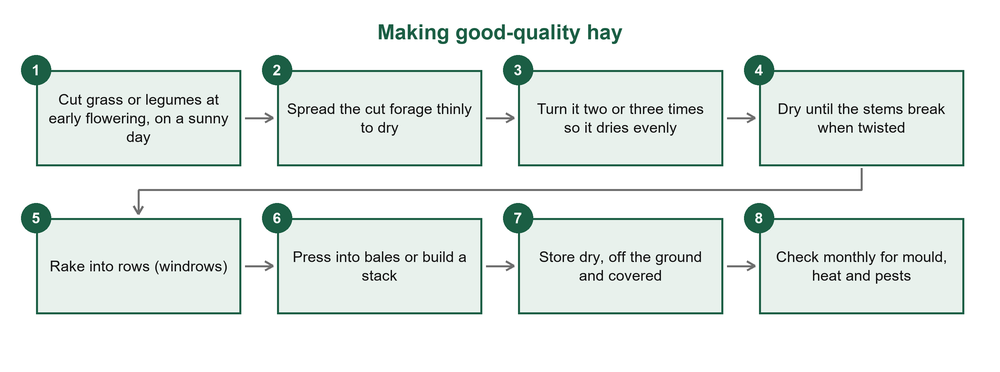
Making good-quality hay
Hay
Grass or legumes cut and dried until the moisture is low enough for safe storage.
Did you know?
Grass cut at early flowering has the most leaves and nutrients. Older grass is stemmy and poor; rain on cut hay washes out nutrients and causes mould.
How to tell that hay is dry enough
- The stems break, rather than bend, when twisted.
- The hay is crisp and greenish, not black or mouldy.
- It smells sweet, not musty.
Box baling
A baling box is a wooden box, open at the top and bottom, with slits for twine. It presses loose hay or crop residues into a firm block that is easy to store and carry.
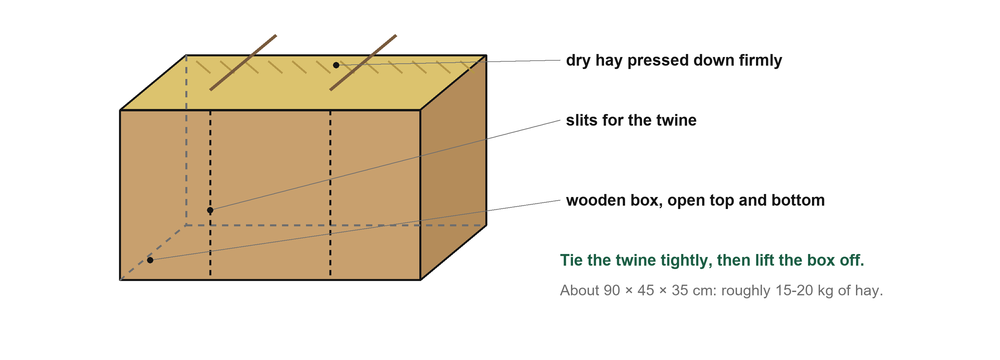
Steps in box baling
- Lay two lengths of twine through the slits along the bottom of the box.
- Fill the box with dry hay, maize stover or straw.
- Press the forage down firmly (step on it), then add more and press again.
- When the box is full and firm, tie the twine tightly over the top.
- Lift the box off the bale.
- Label the bale with the type of forage and the date.
Planning hay for the dry season
A 400 kg dairy cow needs about 10 kg of hay a day.
For 30 days of drought: 10 kg × 30 = 300 kg of hay.
A box bale holds about 15 to 20 kg, so the farmer needs about 15 to 20 bales for that cow.
Stacking and standing forage
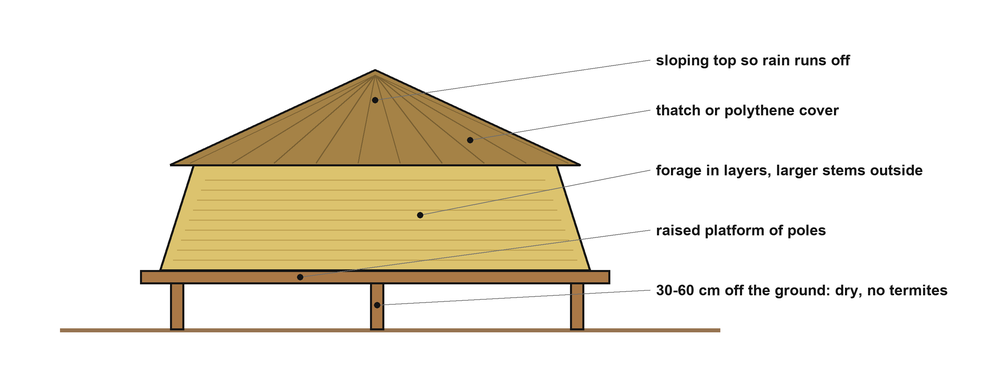
Building a stack
- Build a platform of poles about 30 to 60 cm above the ground.
- Lay the dry forage in layers, with the larger stems on the outside.
- Make the top slope so rain runs off.
- Cover with thatch or polythene.
Standing forage
Advantages
- No cutting, drying or storage costs.
- Little labour: the field only needs fencing.
- Animals feed themselves by grazing.
Disadvantages
- Feed quality falls as the grass dries.
- Risk of fire, and of theft or stray animals.
- The land cannot be used for anything else meanwhile.
Good practice
Graze standing forage section by section so that it lasts through the dry season.
Storing conserved forage and adopting it at home
- Store hay in a dry, airy shed or a covered stack, off the ground and away from fire.
- Check every month: a musty smell or a warm bale means moisture and mould.
- Never feed mouldy hay; it can make animals sick.
How a household can adopt forage conservation
- Keep crop residues (maize stover, bean haulms, straw) after harvest instead of burning them.
- Make box bales by hand; no machine is needed.
- Plant fodder such as Napier grass, Rhodes grass or lucerne.
- Share tools and labour in a farmer group.
Key points to remember
- Forage conservation keeps wet-season feed for the dry season and drought.
- The main methods are baled hay making, standing forage and stacking.
- Cut hay at early flowering, dry it well and store it dry, off the ground and covered.
- A baling box presses forage into firm, easy-to-store bales.
- Conserved forage saves animals, keeps milk and income flowing and reduces conflict over pasture.
Test yourself: multiple choice
Which of these is a crop residue that can be conserved as forage?
Show the answer
B: Maize stover is what is left after the maize is harvested; the others are fodder crops grown on purpose.
At which stage should grass be cut to make good-quality hay?
Show the answer
D: Early flowering gives the most leaves and nutrients.
Why is cut grass turned two or three times while drying?
Show the answer
A: Turning exposes all the grass to sun and air so it dries evenly and does not go mouldy.
A herder fences off good pasture at the end of the rains and keeps animals out until the dry season. This is
Show the answer
C: Standing forage is pasture left uncut to be grazed later.
What should learners do FIRST when making a box bale?
Show the answer
A: The twine must be in place before the box is filled, so the bale can be tied.
Why is a forage stack built on a raised platform?
Show the answer
D: Raising the stack keeps it off damp ground and away from termites.
A stored bale smells musty and feels warm inside. This shows that
Show the answer
B: Heat and a musty smell are signs of moisture and mould.
Practice questions
State three effects of drought on livestock. (3 marks)
Show the answer
- Animals lose weight.
- Milk yield falls.
- Animals fall sick or die.
- Herders move far, causing conflict.
Give two advantages and two disadvantages of standing forage. (4 marks)
Show the answer
- Advantages: no cutting or storage costs; little labour; animals graze it themselves.
- Disadvantages: quality falls as the grass dries; risk of fire or theft; the land is tied up.
Describe the steps of making a box bale. (4 marks)
Show the answer
- Lay twine through the slits.
- Fill with dry forage.
- Press down firmly and add more.
- Tie the twine tightly; lift off the box; label the bale.
A farmer has two 400 kg cows. Each needs about 10 kg of hay a day. How much hay is needed for 45 days? (2 marks)
Show the answer
10 kg × 2 × 45 = 900 kg of hay.
Explain how forage conservation promotes peace in pastoral areas. (2 marks)
Show the answer
Herders have feed at home in the dry season, so they do not move into other communities' grazing land and compete for scarce pasture.
This is one topic. Get the whole year. The full Grade 9 Agriculture and Nutrition notes cover every sub-strand of Terms 1, 2 and 3 like this one, with pictures, key points and practice questions with answers, as a printable PDF for KSh 150. Pay with M-Pesa and download at once.
Get the full Grade 9 Agriculture and Nutrition notes · All Grade 9 Agriculture and Nutrition resources · Notes for every grade