
Grade 9 Agriculture and Nutrition · Strand 4.0 Production Techniques · Sub-strand 4.1 Grafting in Plants
These are free study notes for Grade 9 learners, written to the KICD curriculum design and taken from our full Grade 9 Agriculture and Nutrition notes. Grafting is a practical topic: if your school has a fruit tree nursery, try the steps yourself. Exams often ask you to put the steps in order or name a tool.
The grafted avocado and mango seedlings sold in Kenyan nurseries bear good fruit in two or three years instead of six or more. Grafting joins a shoot from a good tree onto the roots of a strong young plant so that they grow as one. It is also used to repair damaged trees, beautify gardens and make old trees productive again.
Grafting as a method of plant propagation
Plant propagation
Producing new plants, either from seed or from vegetative parts such as cuttings, layers, buds or grafts.
Grafting
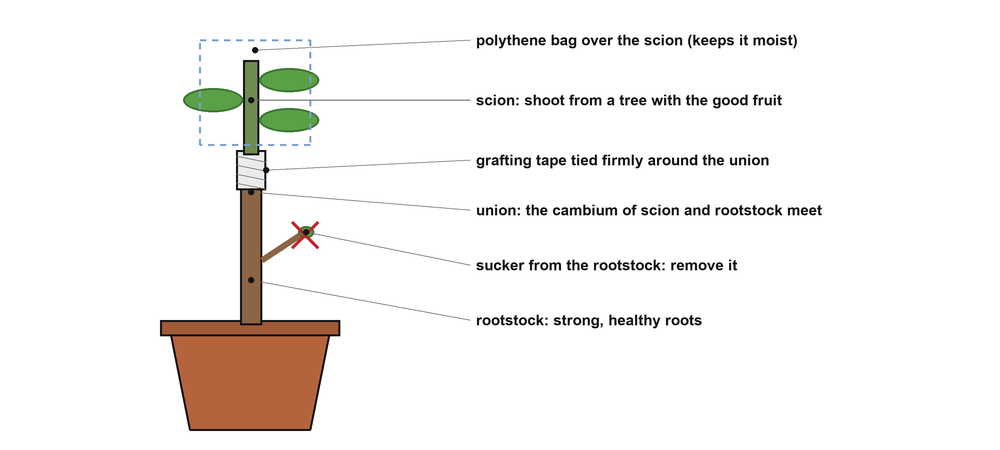
Joining a part of one plant (the scion) onto the rooted part of another (the rootstock) so that they grow together as one plant.
Scion
The shoot taken from a plant with the desired fruit or flowers.
Rootstock
The rooted plant that receives the scion, chosen for strong, healthy, disease-resistant roots.
Union
The place where scion and rootstock join and grow together; their cambium (the growing layer under the bark) must meet.
Compatibility
Scion and rootstock must be the same or closely related plants: avocado on avocado, mango on mango, orange on another citrus such as rough lemon.
Methods of grafting
| Method | How it is done | Used for |
|---|---|---|
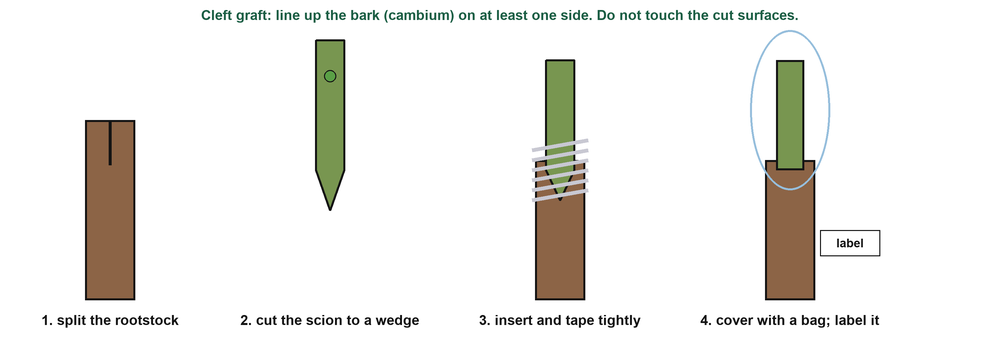
| Cleft (wedge) graft | The rootstock is cut across and split; the scion base is cut into a wedge and pushed into the split | Avocado, mango |
| Whip and tongue graft | Matching slanting cuts with interlocking "tongues" on a scion and rootstock of equal thickness | Young plants of equal thickness |
| Top working | New scions are grafted onto the branches of an old tree | Changing or rejuvenating old trees |
| Bridge graft | Scions are inserted above and below damaged bark to carry sap across the wound | Repairing damaged trees |
Tools for grafting
- Grafting knife: for smooth, clean cuts.
- Secateurs: for cutting the rootstock and scions.
- Grafting tape or polythene strips: for tying the union.
- Polythene bags: keep the scion moist.
- Labels: record the variety and date.
Safety
Grafting is done with a resource person. Cut away from your body and fingers, pass knives handle first and keep blades covered when not in use.
Carrying out a cleft graft
- Water the rootstock a day before. Collect fresh scions in the morning and keep them moist.
- Cut the rootstock across about 20 to 30 cm above the soil.
- Split the rootstock about 3 to 4 cm down the middle.
- Cut the base of the scion into a smooth wedge 3 to 4 cm long.
- Push the scion into the split so the bark (cambium) lines up on at least one side.
- Wrap grafting tape tightly from below the cut upwards.
- Cover the scion with a small polythene bag and label the plant.
Do not touch the cut surfaces
Dirt or germs on the cuts stop the union forming.
Caring for a grafted plant
The curriculum lists these caring practices:
| Practice | Why |
|---|---|
| Watering at the base | Keeps the plant growing while the union forms |
| Protecting the union | Knocks or animals can break the scion off |
| Removing the graft tape after a successful union | Tape left on cuts into the growing stem |
| Removing other buds (suckers) on the rootstock | They take food that the scion needs |
| Signs of success | Signs of failure |
|---|---|
| Scion stays green; buds swell and new leaves grow; a callus forms at the union | Scion turns black or dry; no new growth |
Purposes of grafting
Appraising grafting
Advantages
- Fruits early: 2 to 3 years instead of 5 to 8.
- Keeps the exact variety, e.g. Hass avocado.
- Combines strong roots with good fruit.
- Repairs damaged trees and renews old ones.
Limitations
- Needs skill, a resource person and tools.
- Only compatible plants can be joined.
- Some grafts fail.
- Grafted seedlings cost more.
Key points to remember
- Grafting joins a scion onto a rootstock so that they grow as one plant.
- The cambium of scion and rootstock must meet at the union.
- Methods include cleft, whip and tongue, top working and bridge grafting.
- Aftercare: water, protect the union, remove the tape after union, remove suckers.
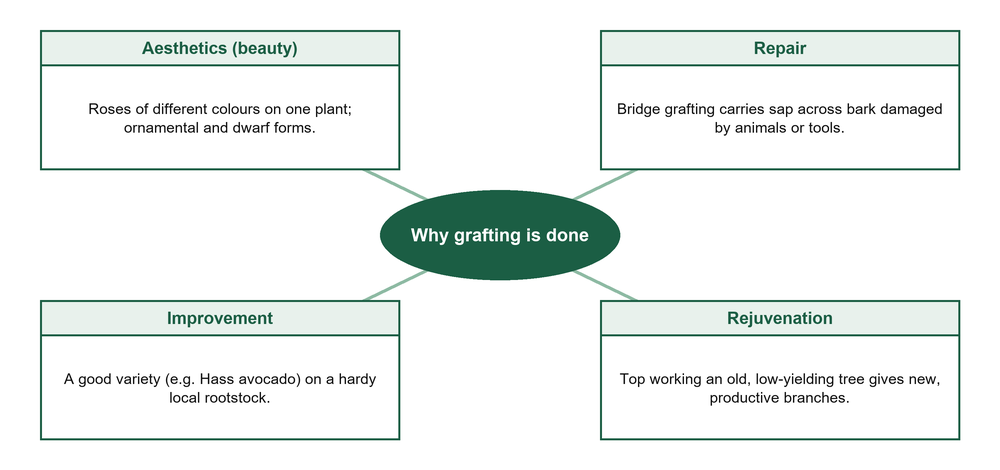
- Grafting is done for aesthetics, repair, improvement and rejuvenation.
Test yourself: multiple choice
In grafting, the shoot taken from a tree with good fruit is the
Show the answer
B: The scion carries the desired variety.
For a graft to succeed, which layers must meet?
Show the answer
C: The cambium is the growing layer that joins scion and rootstock.
Which pair can be grafted together?
Show the answer
A: Only the same or closely related plants are compatible.
Shoots growing from the rootstock below the union should be
Show the answer
D: Suckers take food that the scion needs.
Grafting new scions onto an old, low-yielding tree to renew it is done for
Show the answer
C: Rejuvenation makes an old tree productive again.
Which is a sign that a graft has FAILED?
Show the answer
B: A dead scion dries and turns black.
Bridge grafting is done to
Show the answer
A: Scions bridge the wound and carry sap across it.
Practice questions
Define the terms scion, rootstock and union. (3 marks)
Show the answer
- Scion: the shoot from the plant with the desired fruit or flowers.
- Rootstock: the rooted plant that receives the scion.
- Union: where the scion and rootstock join and grow together.
Describe how a cleft graft is carried out. (5 marks)
Show the answer
- Cut the rootstock across and split it 3 to 4 cm.
- Cut the scion base into a wedge.
- Insert so the cambium lines up on at least one side.
- Tie tightly with grafting tape.
- Cover with a polythene bag and label.
State four practices for caring for a grafted plant. (4 marks)
Show the answer
- Watering.
- Protecting the union.
- Removing the graft tape after a successful union.
- Removing other buds (suckers) on the rootstock.
Name the four purposes of grafting and give an example of one. (5 marks)
Show the answer
- Aesthetics, repair, improvement and rejuvenation.
- Example: improvement, e.g. Hass avocado grafted onto a hardy local rootstock.
This is one topic. Get the whole year. The full Grade 9 Agriculture and Nutrition notes cover every sub-strand of Terms 1, 2 and 3 like this one, with pictures, key points and practice questions with answers, as a printable PDF for KSh 150. Pay with M-Pesa and download at once.
Get the full Grade 9 Agriculture and Nutrition notes · All Grade 9 Agriculture and Nutrition resources · Notes for every grade


